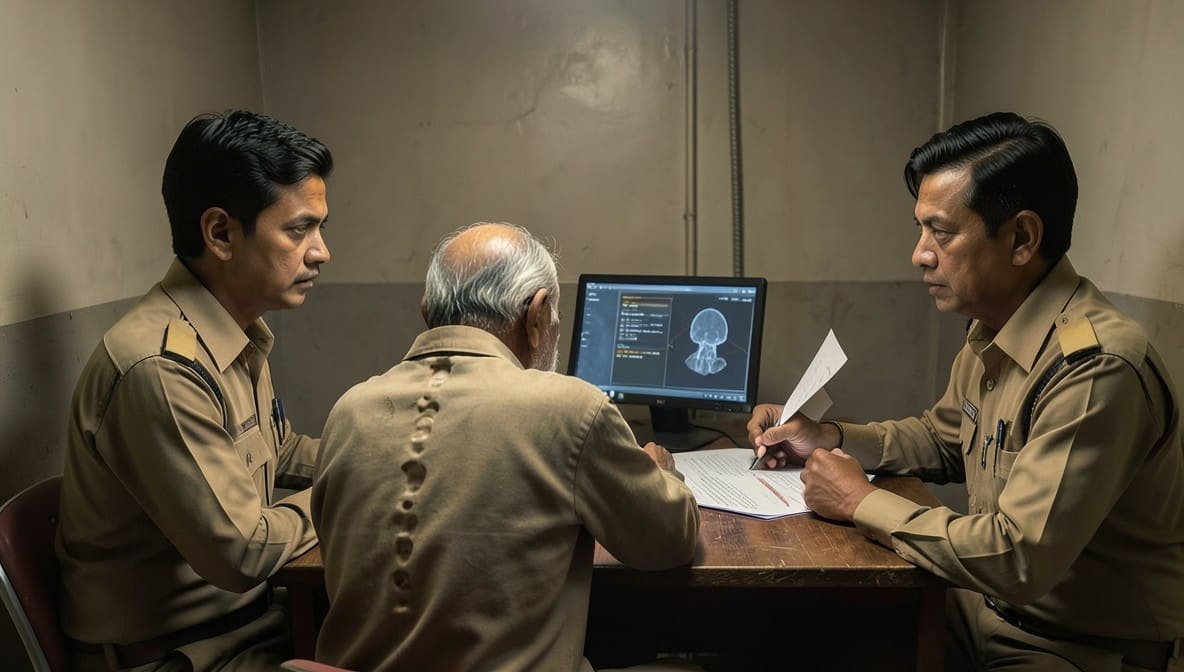
The Andhra Pradesh High Court has delivered a nuanced judgment balancing the investigative powers of the police with the constitutional rights of an accused police officer. In a case involving allegations of custodial death and evidence tampering, the Court modified stringent conditions imposed by a lower court on police custody, permitting scene reconstruction while mandating videographic documentation and accused safety measures.
Background & Facts
The Dispute
The case revolves around Crime No. 107 of 2026 registered at Krishna Lanka Police Station, Vijayawada, under Sections 127(4), 127(6), and 103(1) of the Bharatiya Nagarik Suraksha Sanhita (BNSS) and Section 238 of the Bharatiya Nyaya Sanhita (BNS). The complainant, Suda Suresh Veera Venkata Nagu Raju, a former Inspector of Police, is accused of illegally detaining and allegedly killing Gade Sai Krishna, against whom non-bailable warrants were pending. Despite being apprehended on 06.05.2026, Sai Krishna was not produced before the jurisdictional magistrate, and his whereabouts or corpse remain unknown.
Key Facts
- 06.05.2026: Gade Sai Krishna apprehended at Markapur and handed over to Krishna Lanka Police Station.
- 01.05.2026 to 01.06.2026: CCTV footage of Krishna Lanka Police Station goes missing for this crucial period.
- 06.05.2026 onwards: Sai Krishna’s whereabouts unknown; allegations of custodial death emerge.
- WP No. 15132 of 2026: Division Bench of the High Court directs production of Sai Krishna, but compliance fails.
- Special Investigation Team (SIT): Formed by the State to investigate the alleged custodial killing and evidence tampering.
Procedural History
- CrI.M.P.No.1400 of 2026: Filed by the prosecution before the II Additional Judicial Magistrate of First Class, Vijayawada, seeking police custody of the respondent-accused.
- 02.07.2026: Magistrate allows police custody but imposes stringent conditions, including:
- 28.1: Accused entitled to nominate two advocates, with one present during interrogation.
- 28.4: Entire interrogation to be conducted under CCTV coverage.
- 28.5: Continuous audio-visual recording of interrogation.
- 28.10: Presence of one advocate permitted during interrogation.
- 28.13: CCTV footage to be preserved intact.
- 28.14: SIT and jail authorities jointly responsible for accused’s safety.
- 28.15: Police custody not to extend beyond 10.07.2026.
- 03.07.2026 onwards: SIT unable to proceed with police custody due to conditions.
- Criminal Petition No. 5443 of 2026: Filed by the State under Section 528 of BNSS to modify the Magistrate’s conditions.
Relief Sought
The State sought modification of the Magistrate’s conditions to:
- Allow custodial interrogation at Vijayawada for scene reconstruction and evidence recovery.
- Remove restrictions confining interrogation to Central Prison, Rajamahendravaram.
- Ensure effective investigation without compromising accused safety.
The Legal Issue
The central question was whether the conditions imposed by the Magistrate under Section 187 of BNSS unduly restricted the investigative powers of the police, particularly in a case involving allegations of custodial death and evidence tampering by a police officer.
Arguments Presented
For the Petitioner/State
- Statutory Scheme: Conditions imposed by the Magistrate contravene Sections 23 and 180 of BNSS, which empower the police to conduct investigations, including scene reconstruction and evidence recovery.
- Investigative Hurdles: Confining interrogation to Central Prison, Rajamahendravaram, impedes the investigation, as the crime scene is at Krishna Lanka Police Station, Vijayawada.
- Heinous Crime: The accused, a police officer, allegedly tampered with CCTV footage and screened evidence, necessitating his presence at Vijayawada for effective investigation.
- Precedents Cited:
- State of Bihar and Another v. PP Sarma IAS and Another (1991 Supp 1 SCC 222): Judicial intervention should not impede investigation.
- P. Chidambaram v. Directorate of Enforcement (2019 9 SCC 24): Statutory powers of investigation must not be curtailed.
- Central Bureau of Investigation v. Vikas Mishra @ Vikash Mishra (2023 6 SCC 49): Doctrine of confirmation of subsequent events is integral to investigation.
For the Respondent/Accused
- Framing Allegation: The SIT seeks police custody solely to frame the respondent, without supportive evidence.
- Life Threat: The respondent apprehends life-threatening risks during custodial interrogation.
- Custodial Violence: Reliance on Nandini Satpathy v. P.L. Dani and Another (1978 2 SCC 424) and D.K. Basu v. State of West Bengal (1997 1 SCC 416), which condemn custodial violence and emphasize accused rights.
- Infrastructure: Central Prison, Rajamahendravaram, is equipped with modern facilities, and interrogation there does not prejudice the investigation.
The Court's Analysis
The Court undertook a detailed examination of the statutory framework and constitutional mandates governing police custody and accused rights.
Statutory Provisions
- Section 23 of Bharatiya Sakshya Adhiniyam (BSA): Confessions to police officers are inadmissible unless made in the immediate presence of a magistrate. However, information leading to discovery of facts may be proved.
- Section 38 of BNSS: Accused entitled to meet an advocate during interrogation, though not throughout.
- Section 180 of BNSS: Police empowered to examine witnesses and record statements during investigation.
The Court emphasized the threefold test under Section 23 of BSA (analogous to Section 27 of the Indian Evidence Act), as discussed in Raja Khan v. State of Chattisgarh (2025 3 SCC 314):
- Information must lead to discovery of a fact.
- Only the portion of information distinctly connected to the discovery is admissible.
- Discovery must relate to the commission of the offence.
Judicial Precedents
The Court relied on P. Chidambaram, State of Bihar, and Central Bureau of Investigation v. Vikas Mishra to underscore that judicial intervention should not impede statutory investigative powers unless exceptional circumstances exist. The doctrine of confirmation of subsequent events was held integral to unfolding the truth.
Balancing Competing Interests
The Court acknowledged the self-contradictory stand of the respondent:
- The respondent alleged tampering with CCTV footage to cover his actions but sought to rely on the same mechanism (CCTV recording) during interrogation.
- The Court noted that while the respondent’s apprehensions could not be dismissed outright, they must be balanced against the statutory powers of investigation and the constitutional mandate to unravel the truth.
Constitutional Safeguards
The Court reiterated the constitutional safeguards against custodial violence, as enunciated in D.K. Basu and Nandini Satpathy, while emphasizing that investigative powers must not be unduly curtailed. The Court acted as a guardian of both accused rights and investigative integrity, striking a balance between the two.
"The statutory power and functions of the Judicial intervention should not impede the investigation being conducted by the Investigation Agency, unless there are exceptional circumstances."
The Verdict
The Court allowed the Criminal Petition in part, modifying the Magistrate’s order dated 02.07.2026 as follows:
- Police custody period: Commences on 09.07.2026 and ends on 16.07.2026.
- Scene reconstruction: The SIT is permitted to take the accused to the scene of offence at Krishna Lanka Police Station, Vijayawada, for recovery of material evidence and reconstruction of the offence.
- Videographic documentation:
- Every movement of the accused from Central Prison, Rajamahendravaram, to Vijayawada and back must be videographed.
- The Investigation Officer must submit the original videographic recordings to the jurisdictional magistrate at Vijayawada by 17.07.2026.
- The Jail Superintendent must submit the original CCTV footage of the prison during the custody period to the magistrate by 17.07.2026.
- Accused safety: The Investigation Officer and SIT members are directed to ensure the life, limb, and personal dignity of the accused, in line with constitutional safeguards.
- Other conditions: All other conditions imposed by the Magistrate remain unchanged.
- Impartial investigation: The SIT is directed to conduct an impartial and scientific investigation to uphold the integrity of "Satyameva Jayate".
The Court clarified that its observations were solely for disposing of the petition and should not influence the investigation.
What This Means For Similar Cases
Investigative Powers Must Not Be Unduly Restricted
- Courts must balance investigative powers with accused rights, ensuring that statutory mandates under BNSS and BSA are not unduly curtailed.
- Scene reconstruction and evidence recovery are critical investigative tools, particularly in cases involving custodial deaths or evidence tampering.
- Judicial intervention should not create insurmountable hurdles for the prosecution, unless exceptional circumstances exist.
Transparency and Accountability in Police Custody
- Videographic documentation of custodial interrogation and accused movements is non-negotiable, ensuring transparency and accountability.
- CCTV footage preservation is mandatory, particularly in cases involving allegations of evidence tampering or custodial violence.
- Advocate presence during interrogation, while ensuring accused rights, must not obstruct the investigation.
Constitutional Safeguards Remain Paramount
- Custodial violence remains a grave concern, and courts must ensure accused safety during interrogation.
- Police officers accused of crimes must not be allowed to manipulate procedural safeguards to evade investigation.
- Investigative agencies must conduct impartial and scientific investigations, upholding the rule of law and constitutional values.