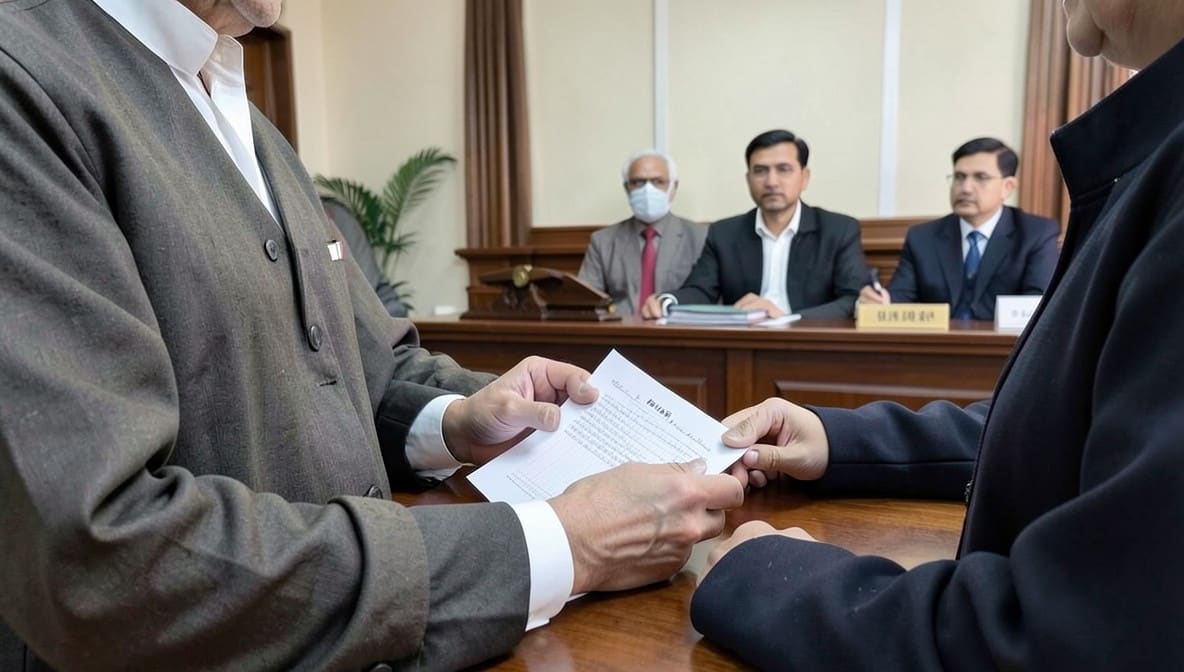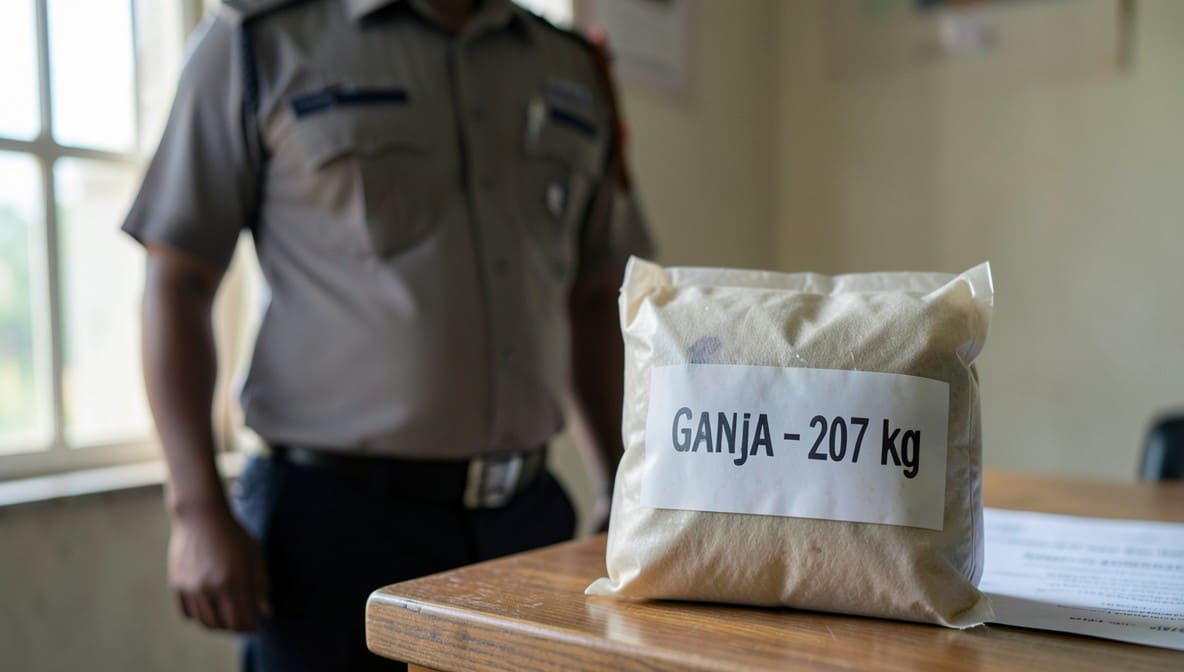
The Gauhati High Court has established a critical precedent that procedural violations in arrest render statutory bail restrictions under the NDPS Act inapplicable, reinforcing that personal liberty cannot be curtailed without strict adherence to statutory safeguards.
Background & Facts
The Dispute
The accused applicant, Sebul Hussein Laskar, was arrested in connection with a narcotics case involving the recovery of approximately 18.915 kg of Yaba tablets - classified as a commercial quantity under the NDPS Act. The contraband was recovered from a truck driven by a co-accused and from the residence of another individual, not from the accused applicant’s person or vehicle. The prosecution’s case hinges on a confessional statement recorded under Section 180 of the BNSS, which the defense contends is inadmissible under Section 23 of the BNS, 2023.
Procedural History
- 09.06.2025: Accused arrested during checkpoint operation near Sonabarighat Bypass
- 10.06.2025: Produced before Special Judge, NDPS Court, Cachar; placed in judicial custody
- 28.08.2025: Charge sheet filed under Section 193 of BNSS
- 30.08.2025: Special Judge denied bail, mechanically invoking Section 37 of NDPS Act
- 21.02.2026: Bail application heard before Gauhati High Court
Relief Sought
The petitioner seeks regular bail on grounds of illegal arrest, absence of recovery from his person, inadmissibility of confession, prolonged custody without trial progress, and violation of mandatory arrest procedures under BNSS.
The Legal Issue
The central question was whether Section 37 of the NDPS Act applies to deny bail when the arrest itself violates mandatory procedural requirements under Section 36 of the BNSS, 2023, thereby rendering the arrest illegal.
Arguments Presented
For the Petitioner
The petitioner’s counsel argued that the arrest was illegal due to non-compliance with Section 36 of the BNSS, which requires an Arrest Memo to be attested by a family member or respectable local witness and counter-signed by the accused. No such attestation was present, and no notice under Section 48 of the BNSS was properly documented. The counsel relied on Article 21 and 22 of the Constitution to assert that illegal arrest nullifies the state’s ability to invoke stringent bail conditions. They distinguished Hero Sarkar v. Union of India on grounds that it did not address complete procedural collapse.
For the Respondent
The Additional Public Prosecutor contended that Section 37 of the NDPS Act applies irrespective of procedural lapses because the quantity of contraband recovered was commercial. Citing Hero Sarkar v. Union of India, the State argued that minor deviations in arrest procedure cannot override the statutory bar on bail for serious drug offenses. The State maintained that the accused’s presence at the scene and involvement in the conspiracy were sufficient to trigger Section 37.
The Court's Analysis
The Court conducted a rigorous analysis of Section 36 and Section 62 of the BNSS, 2023, emphasizing that these provisions are not directory but mandatory. It held that Section 62 explicitly states that no arrest shall be made except in accordance with the BNSS or other applicable law. The absence of any witness attestation on the Arrest Memo, coupled with the failure to serve notice under Section 48, rendered the arrest procedurally void.
"Non-compliance of such provisions will be in violation of the mandatory provisions which will in turn make such arrest illegal. Once an arrest becomes illegal, the arrested person shall have an unfettered right to be set at liberty i.e. to be released on bail."
The Court rejected the State’s reliance on Hero Sarkar, distinguishing it on the basis that the Calcutta High Court’s decision did not involve a total failure to comply with the foundational arrest procedure. It affirmed that Section 37 of the NDPS Act operates only when the arrest is lawful. An illegal arrest strikes at the root of the prosecution’s authority to detain, and thus, the bail restrictions under Section 37 cannot be invoked.
The Court further underscored that personal liberty under Article 21 is not contingent on the gravity of the offense but on adherence to lawful procedure. The failure to record witness signatures or serve notice was not a technicality but a constitutional breach.
The Verdict
The petitioner won. The Court held that an arrest violating Section 36 of the BNSS, 2023 is illegal and nullifies the applicability of Section 37 of the NDPS Act. The accused was granted bail on furnishing a bond of ₹1,00,000 with two sureties, subject to standard conditions.
What This Means For Similar Cases
Arrest Must Comply with BNSS Section 36
- Practitioners must now challenge bail denials under NDPS Act where Arrest Memo lacks witness attestation or counter-signature
- Failure to comply with Section 36 renders arrest illegal, irrespective of contraband quantity
- Courts must examine arrest compliance before applying Section 37 restrictions
Procedural Violations Trump Substantive Gravity
- The mere fact of commercial quantity does not override procedural illegality
- Bail applications must be framed to highlight specific breaches of BNSS Sections 36 and 48
- Courts cannot mechanically apply Section 37 without first validating the legality of arrest
Notice Under Section 48 Must Be Documented
- The absence of any named recipient in Section 48 notice constitutes a procedural defect
- Defense must demand production of service proof; failure to provide it supports bail plea
- Courts may infer violation of Article 22(1) if family is not informed of arrest