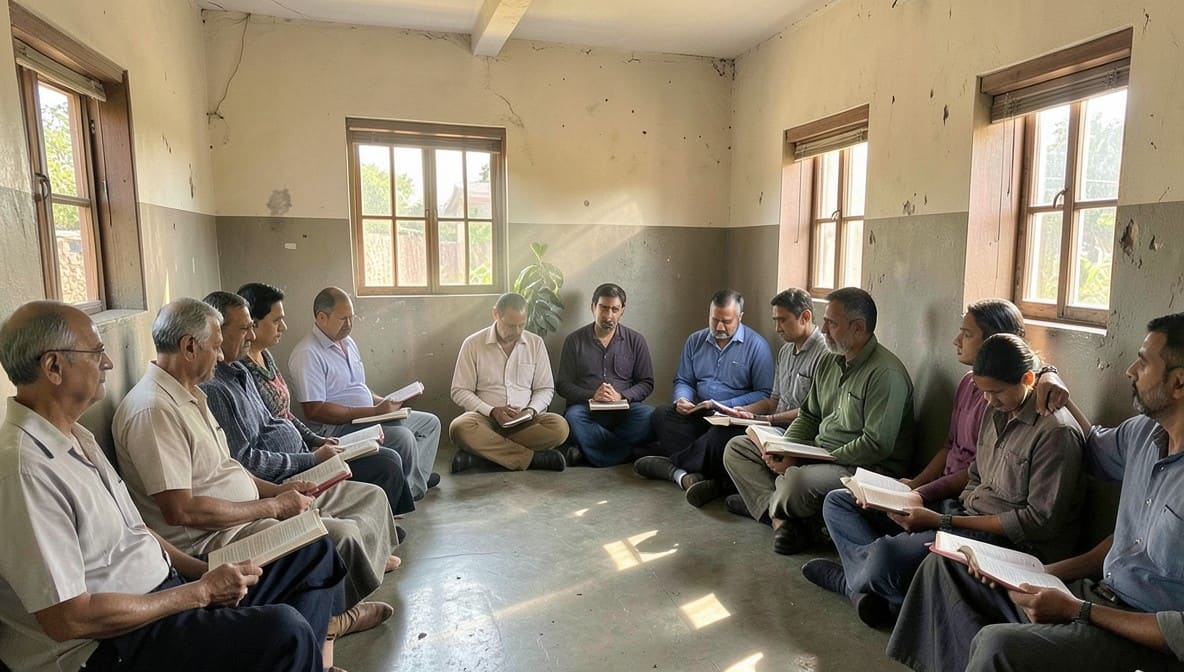
The Allahabad High Court has reaffirmed that the state cannot interfere with religious worship or rituals in the absence of credible evidence linking them to a threat to public order. This judgment reinforces the constitutional guarantee of religious freedom under Articles 25 to 28, setting a clear boundary on executive overreach in matters of faith.
Background & Facts
The Dispute
The petitioners, five individuals representing Christian religious trusts and societies in Azamgarh district, Uttar Pradesh, filed this writ petition seeking protection from state interference in their weekly religious prayers and ritual ceremonies. The petitioners allege that local authorities, including the District Magistrate and Superintendent of Police, have been obstructing their religious assemblies on Saturdays and Sundays, despite the absence of any lawful justification.
Key Facts
- Petitioner No.1 is President of Masihi Prathna Bhawan Seva Sansthan, located at Purana Pul, Civil Lines, Azamgarh
- Petitioner No.2 is President of New Hope Raising Church Trust, situated at Village Dharampur Asalpur, Post Daulatabad, Tehsil Sadar, Azamgarh
- Petitioner No.3 is Chairman of Jivan Jyoti Charitable Trust, located at Village Renva @ Bhangwa, Post Chanu Bairidh Ghambhipur, Azamgarh
- All three entities are registered public trusts operating under their respective bye-laws for charitable, welfare, and religious purposes
- The petitioners claim their religious gatherings are peaceful, lawful, and conducted in accordance with their faith
- They allege repeated interference by state authorities, including denial of permission, intimidation of attendees, and disruption of services
- Representations were made to the District Magistrate and Superintendent of Police, but no substantive response or action was taken
- No FIR, complaint, or documented evidence of unlawful activity (e.g., forced conversion, breach of peace) was produced by the state
Procedural History
- 08.12.2023: Division Bench of this Court delivered a reasoned order in Writ-C No.37103 of 2023, addressing identical facts and legal issues
- 17.06.2026: Present writ petition (Writ-C No.23982 of 2026) filed by petitioners seeking similar relief
- No interim orders or stays were granted prior to this judgment
- No lower court proceedings occurred prior to this writ petition
Relief Sought
The petitioners sought:
- A writ of mandamus directing the respondents not to interfere in religious prayers and rituals conducted by the petitioners’ societies
- Any other suitable writ, order, or direction the Court may deem fit
The Legal Issue
The central question was whether the state can restrict religious worship and ritual ceremonies conducted by recognized religious trusts in the absence of any concrete evidence linking such activities to a threat to public order, and whether such restrictions violate Articles 25, 26, 27, and 28 of the Constitution of India.
Arguments Presented
For the Petitioner
Learned counsel for the petitioners relied on the precedent set by the Division Bench in Writ-C No.37103 of 2023, arguing that:
- Religious worship, including weekly prayers and rituals, is a core exercise of freedom of conscience under Article 25
- The right to manage religious affairs under Article 26 includes the right to conduct gatherings without state interference
- Article 27 prohibits compelling payment of taxes for promotion of any religion, and state obstruction amounts to indirect coercion
- Article 28 protects religious instruction in educational institutions, and by extension, the right to assemble for worship
- The state’s alleged interference is based on unsubstantiated suspicions of conversion, not on any lawful ground
- No evidence was produced to show that the gatherings disturbed public order, peace, or morality
For the Respondent
The learned Standing Counsel for the State did not dispute the petitioners’ submissions or offer any counter-arguments. No affidavit, evidence, or legal justification was filed to support the alleged interference. The state did not contest the applicability of the earlier judgment.
The Court's Analysis
The Court examined the precedent established in Writ-C No.37103 of 2023, which had already held that:
"Holding of religious prayer is not violative of any law that has been shown to us. Under the Constitution every citizen has a right to practice and perform his faith and religious congregation that is, of course, subject to public order."
The Court noted that the state’s purported justification - allegations of conversion - was neither substantiated nor presented as part of the record. Mere "serious inputs" without corroboration, documentation, or investigation do not constitute a lawful basis for restricting fundamental rights.
The Court emphasized that public order is the only permissible ground for restricting religious practice under Article 25(1), and such restriction must be narrowly tailored, proportionate, and based on objective evidence. Speculation, hearsay, or administrative convenience cannot override constitutional guarantees.
The Court further observed that the petitioners’ societies are registered public trusts engaged in lawful activities, and their religious gatherings are not inherently disruptive. The absence of any complaint from neighbors, police reports, or court orders indicated no actual threat.
The Court declined to entertain fresh arguments or require additional representations, noting that the earlier judgment had already laid down the legal standard and that the state had not challenged it.
The Verdict
The writ petition is disposed of in terms of the order dated 08.12.2023 in Writ-C No.37103 of 2023. The respondents are directed not to interfere in the religious prayers and ritual ceremonies conducted by the petitioners’ societies. The petitioners are entitled to conduct their worship without hindrance, subject only to the general law of public order. No further directions are issued as the earlier order remains binding.
What This Means For Similar Cases
Religious Worship Cannot Be Suspended on Suspicion
- Practitioners must argue that any restriction on religious gatherings must be supported by documented evidence of a direct and imminent threat to public order
- Mere allegations of conversion, without FIRs, witness statements, or investigation reports, are legally insufficient
- Administrative orders based on "inputs" or anonymous complaints violate the principle of natural justice and constitutional rights
State Must Prove Threat, Not Petitioners Prove Innocence
- The burden lies on the state to demonstrate how a religious activity endangers public order
- Courts will not accept vague or unsubstantiated claims as grounds for restricting Articles 25-28
- Any interference must be the least restrictive means possible, and only after due process
Precedent as Binding Authority in Identical Matters
- When a Division Bench has ruled on identical facts and legal issues, subsequent petitions raising the same claims may be disposed of summarily by reference to the earlier order
- This prevents multiplicity of litigation and reinforces consistency in constitutional interpretation
- Practitioners should cite Writ-C No.37103 of 2023 as binding precedent in all similar cases in the Allahabad High Court jurisdiction