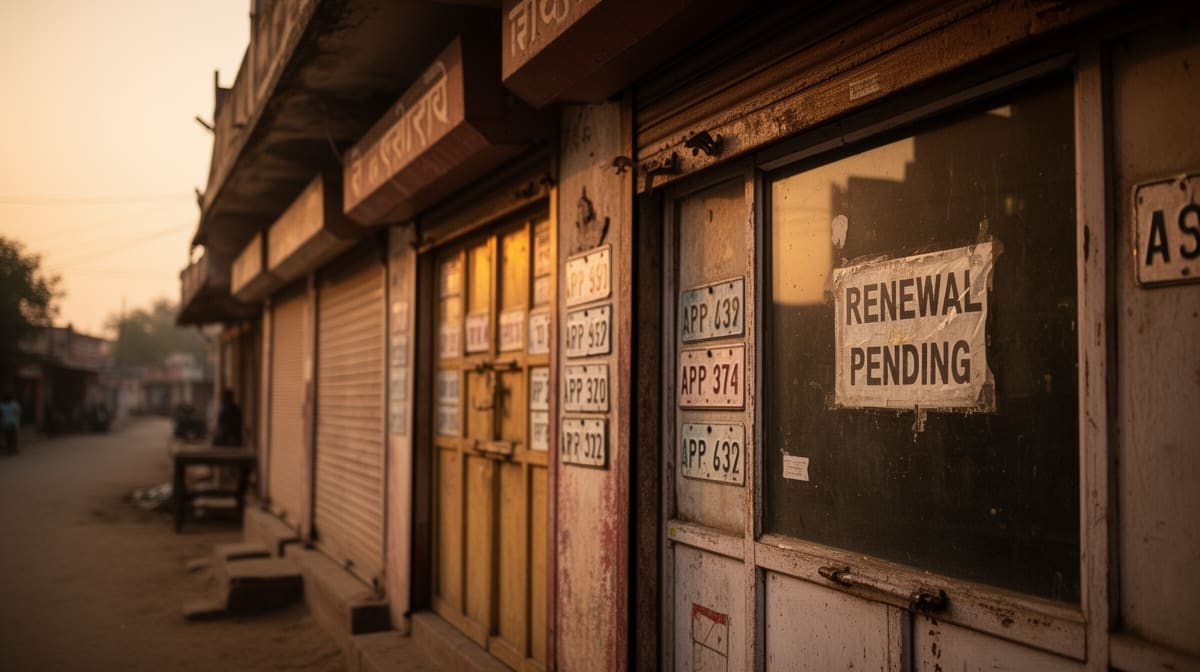
The Rajasthan High Court has affirmed that the State may condition the renewal of liquor licenses on collective participation thresholds within district-wide clusters, rejecting arguments that such mechanisms violate constitutional guarantees of equality. The judgment underscores that while no fundamental right exists to trade in intoxicants, executive policy must still satisfy the minimal threshold of non-arbitrariness under Article 14.
Background & Facts
The Dispute
The dispute arises from the Rajasthan Excise & Temperance Policy, 2025-2029, which introduced a new framework for the renewal and settlement of retail liquor shops. Under this policy, existing licensees were granted renewal rights subject to two key conditions: (1) at least 70% of eligible licensees in a district must apply for renewal, and (2) all shops within a designated cluster must apply for renewal. A cluster is defined as a group of one to five contiguous shops. If these conditions are not met, the entire cluster is put to e-auction.
Procedural History
- January 2025: The State notified the Excise & Temperance Policy, 2025-2029, replacing the prior licensing regime.
- February 2025: District Excise Officers issued notices canceling renewal applications of petitioners whose clusters failed to meet the 70% renewal threshold or had unrenewed shops.
- March 2025: Multiple licensees filed writ petitions before the Rajasthan High Court challenging Clauses 2.2.6, 2.2.7, and 2.2.8 of the policy.
- January - February 2026: Arguments were heard across multiple dates before a Division Bench.
- March 6, 2026: Judgment delivered dismissing all petitions.
The Parties' Positions
- Petitioners: Existing liquor licensees whose renewal applications were canceled due to insufficient cluster or district-wide participation. They argued the policy was arbitrary, discriminatory, and violated Article 14 by making individual rights contingent on third-party conduct.
- Respondents: State of Rajasthan and Excise Department, defending the policy as a rational, uniform mechanism to prevent revenue leakage, ensure even distribution of outlets, and avoid unregulated liquor trade.
Relief Sought
The petitioners sought: (a) declaration that Clauses 2.2.6, 2.2.7, and 2.2.8 are unconstitutional; (b) quashing of cancellation notices; and (c) direction to renew their licenses.
The Legal Issue
The central question was whether Article 14 of the Constitution prohibits the State from making the renewal of an individual liquor license contingent upon the renewal participation of other licensees within a cluster or district, and whether such a condition constitutes manifest arbitrariness.
Arguments Presented
For the Petitioner
Petitioners contended that the impugned clauses violate Article 14 by creating an irrational classification among similarly situated licensees. They argued that a compliant licensee, who fulfills all eligibility criteria and pays the required fees, should not be penalized due to the inaction of others. Reliance was placed on Secretary to Government, Tamil Nadu v. K. Vinayagamurthy and Khoday Distilleries Ltd. v. State of Karnataka to assert that even in a regulated privilege, State action must be non-arbitrary. They further contended that the 70% threshold lacked empirical basis and that cluster formation was opaque, leading to discriminatory outcomes across districts.
For the Respondent
The State argued that liquor trade is a privilege, not a right, and that the policy was designed to ensure administrative efficiency and revenue stability. It emphasized that the 70% threshold and cluster mechanism apply uniformly across the State and were adopted after deliberation. The State cited Khoday Distilleries to affirm its exclusive regulatory power under Entry 8 of List II. It also contended that petitioners had voluntarily accepted the policy terms by submitting renewal applications, thereby estopping them from challenging the conditions. The State further denied allegations of non-transparency, asserting that cluster lists were communicated and limited bidding opportunities were provided.
The Court's Analysis
The Court began by affirming that the State holds exclusive authority over liquor trade under Entry 8 of List II and that no fundamental right to trade in intoxicants exists under Article 19(1)(g). Citing Khoday Distilleries Ltd. v. State of Karnataka, the Court reiterated that the State may impose conditions on renewal, including collective mechanisms, to prevent revenue leakage and ensure orderly distribution.
"The State can further place restrictions and limitations on such trade or business which may be in nature different from those on trade or business in articles res commercium."
The Court held that while Article 14 prohibits arbitrariness, it does not require the State to guarantee individual renewal rights irrespective of policy design. The 70% threshold was found to be a rational policy tool to ensure substantial participation and prevent fragmented settlement. The Court noted that the policy applied uniformly across all districts and that no evidence was presented to show discriminatory application.
Regarding cluster formation, the Court observed that grouping contiguous shops is an administrative function within the Excise Commissioner’s domain. The absence of publicly disclosed criteria for contiguity did not, in itself, render the policy arbitrary, particularly since the mechanism was applied consistently and provided opportunities for limited bidding before auction.
The Court rejected the argument that the policy amounted to economic coercion, noting that renewal remains voluntary and that licensees were not compelled to acquire additional shops - only given an opportunity to do so before auction. The Court emphasized that judicial review does not permit substitution of policy wisdom, and the State’s interest in preventing unregulated liquor trade justified the mechanism.
Finally, the Court held that petitioners, having submitted applications with full knowledge of the conditions, could not later challenge them merely because the outcome was unfavorable. The doctrine of approbation and reprobation applied.
The Verdict
The petitioners lost. The Rajasthan High Court held that Clauses 2.2.6, 2.2.7, and 2.2.8 of the Excise & Temperance Policy, 2025-2029 are constitutionally valid and do not violate Article 14. The Court dismissed all writ petitions, upholding the State’s authority to condition renewal on collective participation thresholds and cluster-based settlement.
What This Means For Similar Cases
Renewal Is Conditional, Not Absolute
- Practitioners must advise clients that renewal of liquor licenses is subject to policy conditions, even if the licensee is fully compliant.
- Legal challenges must focus on proving manifest arbitrariness or discriminatory application - not mere dissatisfaction with policy terms.
- The burden shifts to petitioners to demonstrate that the policy lacks rational nexus or is applied unevenly.
Cluster Mechanisms Are Legally Sustainable
- States may group licensed outlets into clusters to ensure uniform coverage and prevent revenue loss from unoccupied outlets.
- The absence of detailed public criteria for cluster formation does not invalidate the policy if applied uniformly.
- Licensees should be advised to monitor cluster composition early in the renewal cycle and act promptly if their cluster is at risk.
Judicial Restraint in Policy Matters
- Courts will not interfere with fiscal or administrative policy choices unless they are patently irrational or discriminatory.
- Arguments based on economic inefficiency or revenue loss are not grounds for judicial intervention.
- Participation in a policy process with full knowledge precludes subsequent challenges under the doctrine of estoppel.