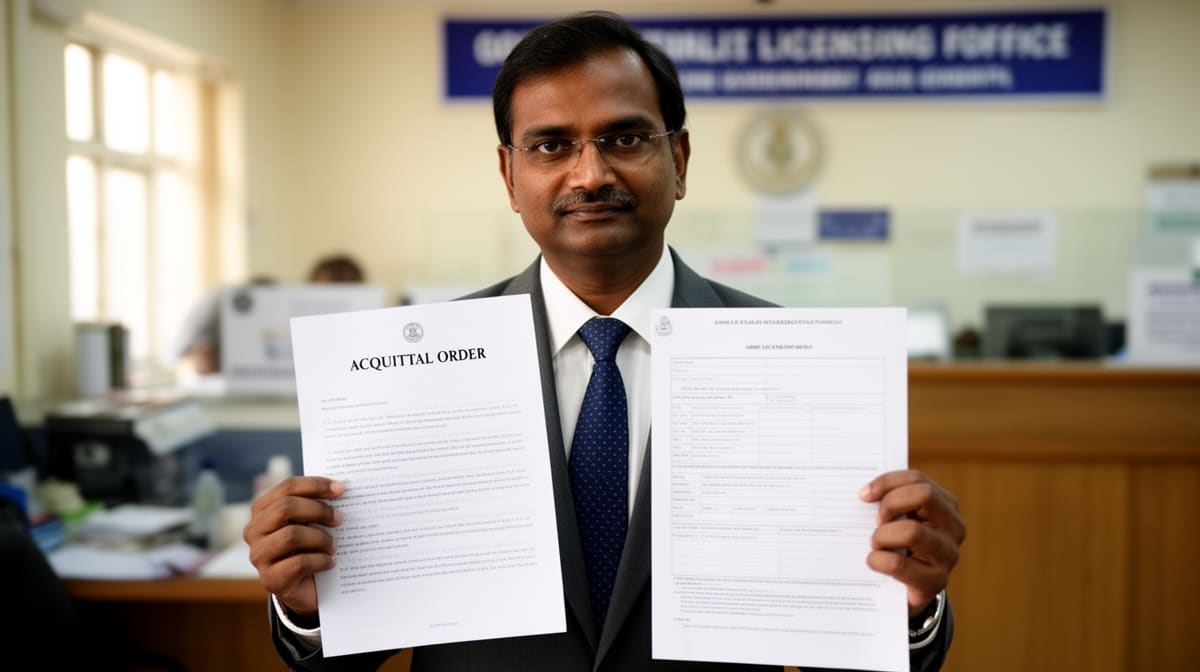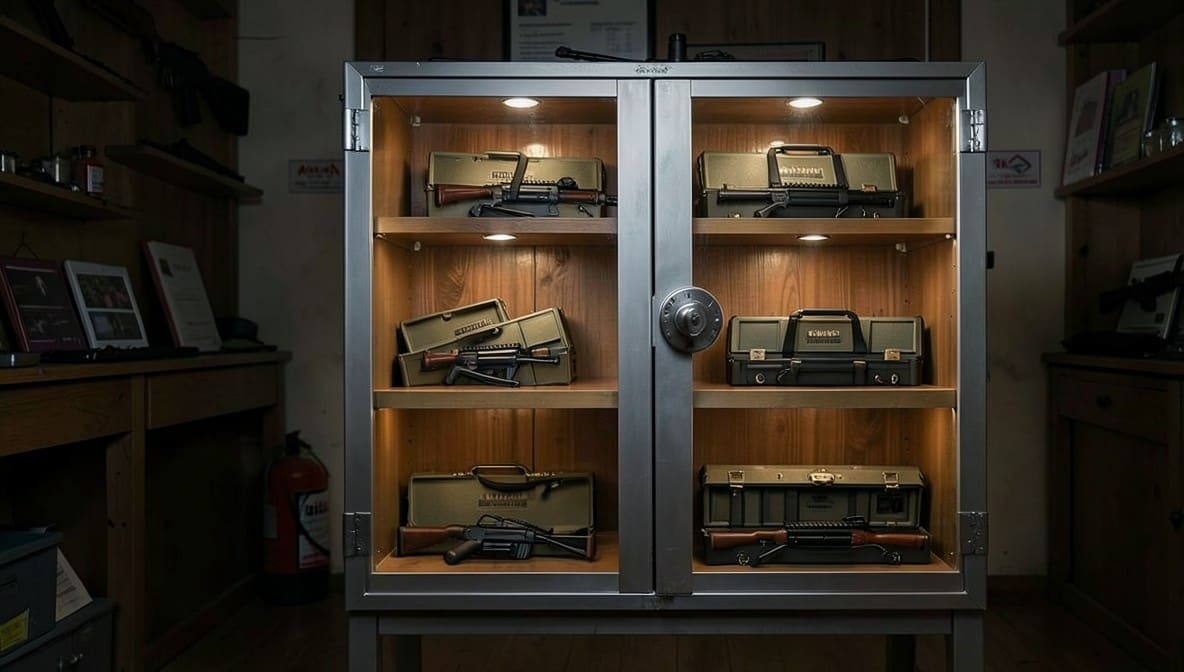
The Madhya Pradesh High Court has clarified that administrative authorities cannot impose non-statutory conditions for renewal of arms dealer licenses, reinforcing the principle that licensing decisions must be grounded exclusively in statutory provisions. This judgment provides critical guidance to licensed dealers and licensing bodies on the limits of regulatory discretion under the Arms Act and Rules.
Background & Facts
The Dispute
The petitioner, M/s Girvar Mohan Anand Arms and Ammunition Dealer, operates as a licensed dealer in firearms and ammunition under Form VIII and Form IX of the Arms Rules, 2016. The petitioner’s license, originally granted on 14.02.2020, was renewed periodically and was valid until 31.12.2024. The petitioner applied for renewal on 24.09.2024, paying the prescribed fee of Rs. 10,000 via challan. The application was forwarded to the State Government for final decision after receiving favorable reports from the Superintendent of Police, Gwalior, and the Sub-Divisional Magistrate, both of which confirmed no adverse criminal antecedents or violations.
Key Facts
- The petitioner’s license is issued under Form VIII and Form IX of the Arms Rules, 2016
- The license permits purchase, sale, and safe custody of arms and ammunition
- No express condition in the license mandates installation of fire extinguishers or deployment of security guards
- Clause 15 of the license refers only to Rule 10 of the Arms Rules, 2016
- The inspection report cited in the rejection order noted absence of a security guard and fire extinguisher
- No evidence of illegal sales, diversion of stock, record violations, or public safety threats was recorded
- The petitioner had no prior disciplinary history or license violations
Procedural History
- 14.02.2020: Initial grant of Arms Dealer License in Form VIII and Form IX
- 01.01.2020 to 31.12.2024: Validity period of last renewal
- 24.09.2024: Petitioner filed renewal application with fee of Rs. 10,000
- October - December 2024: Reports obtained from Superintendent of Police and Sub-Divisional Magistrate; both found no adverse material
- January - June 2025: State Government delayed decision despite completion of formalities
- 25.02.2025: Petitioner filed Writ Petition No. 7324/2025 seeking direction to decide renewal
- 04.03.2025: High Court directed respondents to decide application within one week of certified copy receipt
- 07.04.2025: Respondents failed to comply
- 17.04.2025: Contempt Petition No. 1787/2025 filed for non-compliance
- 27.06.2025: Impugned order issued rejecting renewal on grounds of absence of security guard and fire extinguisher
- 28.06.2025: Petitioner became aware of rejection order
- 04.05.2025: Present writ petition filed under Article 226
Relief Sought
The petitioner sought quashing of the impugned order dated 27.06.2025 and a direction to renew the arms dealer license forthwith, asserting that the rejection was arbitrary, non-speaking, and contrary to statutory provisions.
The Legal Issue
The central question was whether the rejection of renewal of an Arms Dealer License issued under Form VIII and Form IX can be based on the absence of a security guard and fire extinguisher, when such requirements are not mandated under Rule 10 of the Arms Rules, 2016 or the express conditions of the license.
Arguments Presented
For the Petitioner
Learned counsel argued that Rule 10 of the Arms Rules, 2016, which prescribes safety training and storage obligations, applies only to licensing forms including Form VIII and Form IX, but does not mandate physical infrastructure such as security guards or fire extinguishers. The rule requires safety training and written undertakings regarding secure storage, not structural modifications. Clause 15 of the license merely references Rule 10 and does not impose additional conditions. The inspection report’s findings were vague, unsubstantiated, and unrelated to any statutory violation. The rejection was therefore arbitrary, non-reasoned, and violative of Article 14 of the Constitution.
For the Respondent
The State contended that the impugned order was lawful and based on the inspection report highlighting serious safety deficiencies. It argued that the absence of basic safety measures like a security guard and fire extinguisher posed a risk to public safety, and that the authority had a duty to ensure compliance with safety norms even if not explicitly stated in the rules. The State relied on its general power to safeguard public order under the Arms Act.
The Court's Analysis
The Court undertook a detailed textual analysis of Rule 10 of the Arms Rules, 2016, which governs safe storage and handling for licensees under Form VIII and Form IX. The rule mandates completion of a safety training course, submission of written undertakings regarding secure storage in a safe or steel almirah, and periodic inspections by the licensing authority. Crucially, the rule does not prescribe the installation of fire extinguishers or deployment of security personnel.
"Rule 10... does not extend to licences issued under Form VIII and Form IX in the sense of mandating physical infrastructure such as fire extinguishers or security guards."
The Court emphasized that the license conditions, including Clause 15, explicitly refer only to Rule 10 and contain no additional stipulations. The impugned order relied entirely on an inspection report that recorded no violation of actual statutory or contractual obligations - no illegal sales, no record discrepancies, no thefts, and no evidence of public endangerment. The Court held that administrative discretion cannot be exercised to impose conditions not found in the statute or the license itself.
The Court further noted that the State’s delay in deciding the renewal application - spanning over six months despite court directions - constituted procedural arbitrariness. The rejection order, issued only during contempt proceedings, lacked transparency and was not preceded by any show-cause notice or opportunity to rectify alleged deficiencies.
The Court reaffirmed the principle that administrative decisions affecting livelihood must be reasoned, based on relevant considerations, and free from extraneous factors. The reliance on non-statutory safety norms rendered the order illegal, arbitrary, and liable to be set aside.
The Verdict
The writ petition was allowed. The impugned order dated 27.06.2025 rejecting the renewal of the petitioner’s arms dealer license was quashed. The respondents were directed to renew the petitioner’s license forthwith, provided no other legal impediment exists. No costs were awarded.
What This Means For Similar Cases
Statutory Conditions Are Exhaustive
- Practitioners must challenge license rejections based on non-statutory conditions, especially where rules explicitly enumerate obligations
- Licensing authorities cannot introduce new safety requirements by administrative fiat
- Any condition imposed must be traceable to the statute or the license’s express terms
Inspection Reports Must Be Specific and Substantive
- Vague observations like "absence of security guard" without evidence of risk or violation are insufficient grounds for denial
- Inspection reports must link findings to specific statutory breaches
- Authorities must record concrete violations, not general safety concerns
Delay in Decision-Making Constitutes Arbitrariness
- Administrative inaction followed by sudden rejection, especially after court directions, violates principles of natural justice
- Petitioners may invoke contempt proceedings to compel timely decisions
- Delayed decisions tainted by non-reasoned orders are vulnerable to quashing