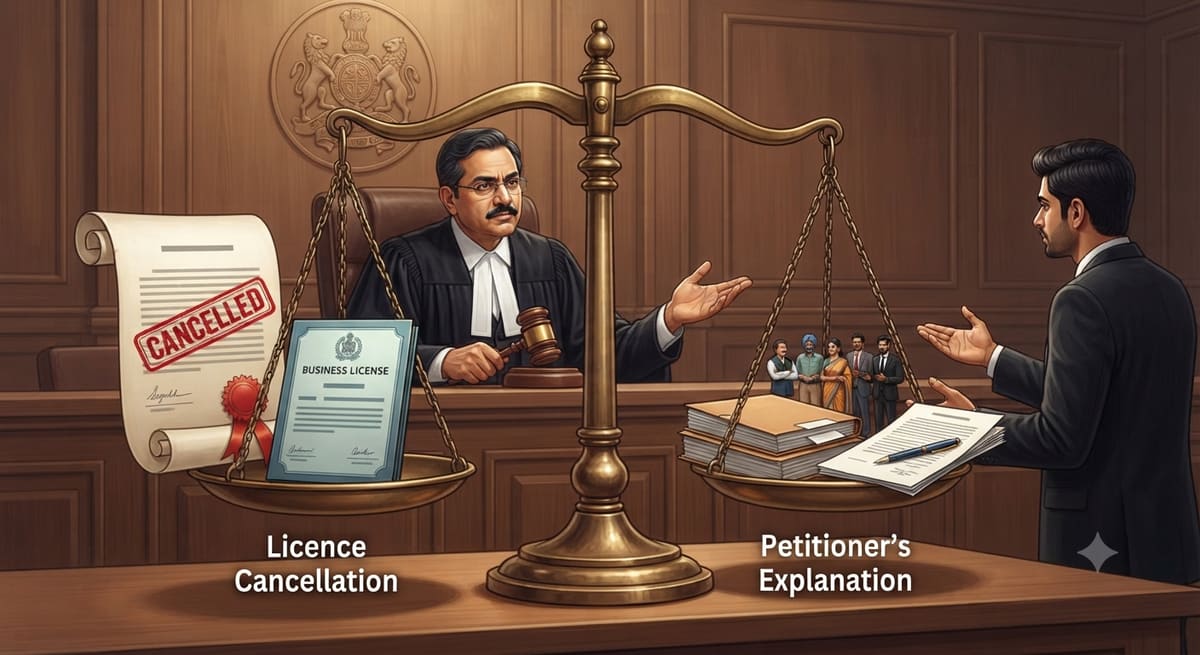
The Calcutta High Court has invalidated a 45-year age cap for applicants seeking Fair Price Shop dealership licenses, holding that such a restriction is arbitrary, discriminatory, and violative of fundamental rights under Articles 14, 19(1)(g), and 21 of the Constitution. The judgment reasserts that executive policy cannot impose personal eligibility criteria without rational justification, especially when it excludes capable individuals from lawful economic participation.
Background & Facts
The Dispute
The three writ petitions challenge Clause 9(ii) of the Vacancy Notification dated 17.12.2024 and Clause 11(v) of the West Bengal Targeted Public Distribution System (Maintenance & Control) Order, 2024, which impose an upper age limit of 45 years for applicants seeking appointment as Fair Price Shop (FPS) Dealers. The petitioners, all above 45 years of age, were otherwise fully eligible - possessing suitable shop-cum-godown facilities, adequate bank balances, and residential proximity to the advertised locations - but were barred from applying solely on account of age.
Key Facts
- The Vacancy Notification dated 17.12.2024, issued by the Sub-Divisional Controller (F&S), Gangarampur, District Dakshin Dinajpur, advertised vacancies for FPS Dealerships in Ward Nos. 0005, 0013, and 0016.
- Clause 11(v) of the Control Order, 2024, introduced for the first time an age restriction of 45 years for new applicants, a provision absent in prior Control Orders of 2003 and 2013.
- The petitioners disclosed compliance with all other eligibility criteria, including proof of bank balance, shop ownership, and residential address.
- The notification required upload of proof of date of birth via the official portal, indicating that age was a verifiable, not discretionary, criterion.
- The State permitted individuals above 75 - 80 years to continue operating FPS businesses if they inherited them through compassionate appointment, with no upper age limit for continuation.
- Compassionate appointments under Chapter VI, Clause 39(3) of the Control Order, 2024, allow widows or dependents aged 87 - 88 years to assume dealership, even if they operate beyond 100 years.
- The Central TPDS Control Order, 2015, and the National Food Security Act, 2013, contain no age restrictions for FPS dealership entry.
- The State has not produced any empirical data, study, or administrative rationale to justify why individuals aged 46 - 60 are less capable of managing FPS operations.
Procedural History
- 17.12.2024: Vacancy Notification issued by Sub-Divisional Controller (F&S), Gangarampur, under the West Bengal Targeted Public Distribution System (Maintenance & Control) Order, 2024.
- Late December 2024 - January 2025: Petitioners attempted to apply but were rejected on grounds of exceeding age limit.
- 07.04.2025: Coordinate Bench of the Calcutta High Court passed an interim order directing the State to proceed with the selection process but restrain issuance of licenses pending final decision.
- 2025: State filed M.A.T. No. 745 of 2025 before the Division Bench challenging the interim order.
- 23.03.2026: Final arguments concluded before the Division Bench.
- 10.04.2026: Judgment delivered by Justice Smita Das De.
The Parties' Positions
Petitioners:
- Argued that the age limit is arbitrary, discriminatory, and violates Articles 14, 19(1)(g), and 21.
- Highlighted the absence of age cap in prior Control Orders and in the Central TPDS Order, 2015.
- Pointed out the contradiction between barring entry at 45+ while permitting continuation beyond 80 via compassionate appointment.
- Relied on Indian Council of Legal Aid and Advice v. Bar Council of India (1995) 1 SCC 732 to demonstrate that age-based exclusion without rational nexus violates Article 14.
- Contended that digital literacy, cited by the State as justification, is a skill, not an age-dependent trait.
Respondent State:
- Defended the age limit as a policy decision within executive discretion under Article 19(6).
- Argued that the State has the right to prescribe eligibility criteria for granting a privilege, not a fundamental right.
- Relied on judgments like Hirandra Kumar v. Allahabad HC (2020) 17 SCC 401 and Directorate of Film Festivals v. Gaurav Ashwin Jain (2007) 4 SCC 737 to assert non-interference in policy.
- Claimed that FPS dealership is a state-granted privilege, not a right, and that age limit ensures long-term service by younger dealers.
- Asserted that petitioners lacked locus standi as they were ineligible and filed after the application deadline.
Relief Sought
The petitioners sought:
- Declaration that Clause 11(v) of the Control Order, 2024, and Clause 9(ii) of the Vacancy Notification dated 17.12.2024, are ultra vires Articles 14, 19(1)(g), and 21.
- Quashing of the age restriction.
- Direction to the State to permit them to participate in the selection process without age-based disqualification.
The Legal Issue
Whether the imposition of a 45-year upper age limit for applicants seeking Fair Price Shop dealership, without any rational nexus to operational efficiency or public interest, violates the fundamental rights to equality under Article 14, freedom to practice any profession under Article 19(1)(g), and right to livelihood under Article 21 of the Constitution.
Arguments Presented
For the Petitioner
The petitioners contended that the age restriction is manifestly arbitrary under Shayara Bano v. Union of India (2017) 9 SCC 1, as it lacks any empirical or administrative justification. They emphasized that the State permits individuals above 80 years to operate FPS businesses through compassionate appointments, thereby undermining the claimed rationale of ensuring long-term service. The petitioners relied on Indian Council of Legal Aid and Advice to show that age-based exclusion without correlation to performance is discriminatory. They argued that digital literacy, cited by the State as a reason for preferring younger applicants, is a skill that can be certified independently of age. The restriction, they submitted, creates two classes of citizens - those under 45 and those above - with no intelligible differentia justifying unequal treatment. The absence of such a cap in the Essential Commodities Act, 1955, or the Central TPDS Order, 2015, further demonstrated the State’s overreach.
For the Respondent
The State contended that the fixation of age limits falls within its policy domain under Article 19(6) and is not subject to judicial review unless manifestly arbitrary or unconstitutional. It relied on Hirandra Kumar and Government of Andhra Pradesh v. N. Subbarayudu (2008) 14 SCC 702 to assert that cut-off dates and age limits are administrative tools to ensure efficiency and continuity. The State argued that FPS dealership is a privilege, not a right, and that the government is not obligated to grant it to every eligible applicant. It further claimed that petitioners lacked locus standi as they did not apply before the deadline and were ineligible by virtue of age. The State also distinguished compassionate appointments as a separate class of beneficiaries, not comparable to general applicants.
The Court's Analysis
The Court undertook a rigorous analysis of the age restriction under the twin doctrines of reasonable classification and manifest arbitrariness. It first examined whether the classification based on age satisfied the Anwar Ali Sarkar test: intelligible differentia and rational nexus. While age is an intelligible differentia, the Court found no rational nexus between the age cap of 45 and the objective of efficient ration distribution.
"The State has failed to furnish any data, study, or administrative record to show that a person aged 46 to 60 is less capable of operating a Fair Price Shop than a person aged 44. The fact that individuals above 80 are permitted to continue operations through compassionate appointment fatally undermines the claim of physical fitness or technological adaptability as justification."
The Court rejected the State’s reliance on Hirandra Kumar and Directorate of Film Festivals, noting that those cases involved cut-offs for recruitment or selection where the state had a legitimate interest in youth and longevity of service. Here, the State permitted continuation beyond 80, rendering the entry restriction illogical. The Court emphasized that digital literacy, cited as a rationale, is a skill, not an age-dependent biological trait, and could be verified through certification - making the age bar an irrational proxy.
The Court invoked Shayara Bano to hold that the provision was manifestly arbitrary: "A law is manifestly arbitrary if it is capricious, irrational, or without adequate determining principle." The absence of any guiding principle, coupled with the contradiction between entry and continuation rules, rendered the restriction unconstitutional.
The Court further held that the restriction violated Article 19(1)(g), as the right to carry on any profession includes the right to compete for state-conferred opportunities. The State’s argument that FPS dealership is a privilege did not absolve it from constitutional obligations under Article 14. Citing Ramana Dayaram Shetty, the Court reiterated that when the State acts in a public capacity, its actions must be non-arbitrary and non-discriminatory.
The Court also found the restriction violative of Article 21, as the right to livelihood encompasses the right to access lawful economic opportunities. Debarment from a legitimate business opportunity solely on age, without justification, directly impacts the petitioner’s means of subsistence.
The Verdict
The petitioners succeeded. The Calcutta High Court struck down Clause 11(v) of the West Bengal Targeted Public Distribution System (Maintenance & Control) Order, 2024, and quashed Clause 9(ii) of the Vacancy Notification dated 17.12.2024. The State is directed to permit the petitioners and all other eligible applicants above the age of 45 to participate in the selection process for Fair Price Shop Dealerships without any age-based disqualification. No order as to costs.
What This Means For Similar Cases
Age-Based Restrictions Must Be Justified by Empirical Data
- Practitioners must now demand empirical evidence for any age cap in public appointments or licenses - mere administrative convenience is insufficient.
- Where a policy permits continuation beyond the entry age limit (e.g., compassionate appointments), the entry restriction becomes inherently discriminatory and unsustainable.
- Courts will not accept vague assertions of "policy discretion" when the restriction creates a clear contradiction in state practice.
Digital Literacy Cannot Be Assumed Based on Age
- Any requirement for technological proficiency must be verified through objective criteria (e.g., certification, training) rather than age-based exclusion.
- This precedent applies to other digital public services - e.g., e-governance portals, online licensing, or digital payment systems - where age is used as a proxy for competence.
Locus Standi Extends to Challenging Eligibility Criteria
- A person denied participation due to an unconstitutional eligibility condition has locus standi even if they did not submit an application before the deadline.
- The challenge is to the rule itself, not the selection outcome, making it a public law issue amenable to writ jurisdiction.
Policy Must Align with Parent Legislation
- Subordinate legislation cannot impose personal qualifications not contemplated in the parent statute (here, the Essential Commodities Act, 1955).
- Any new eligibility criterion must be traceable to the enabling law; otherwise, it is ultra vires.