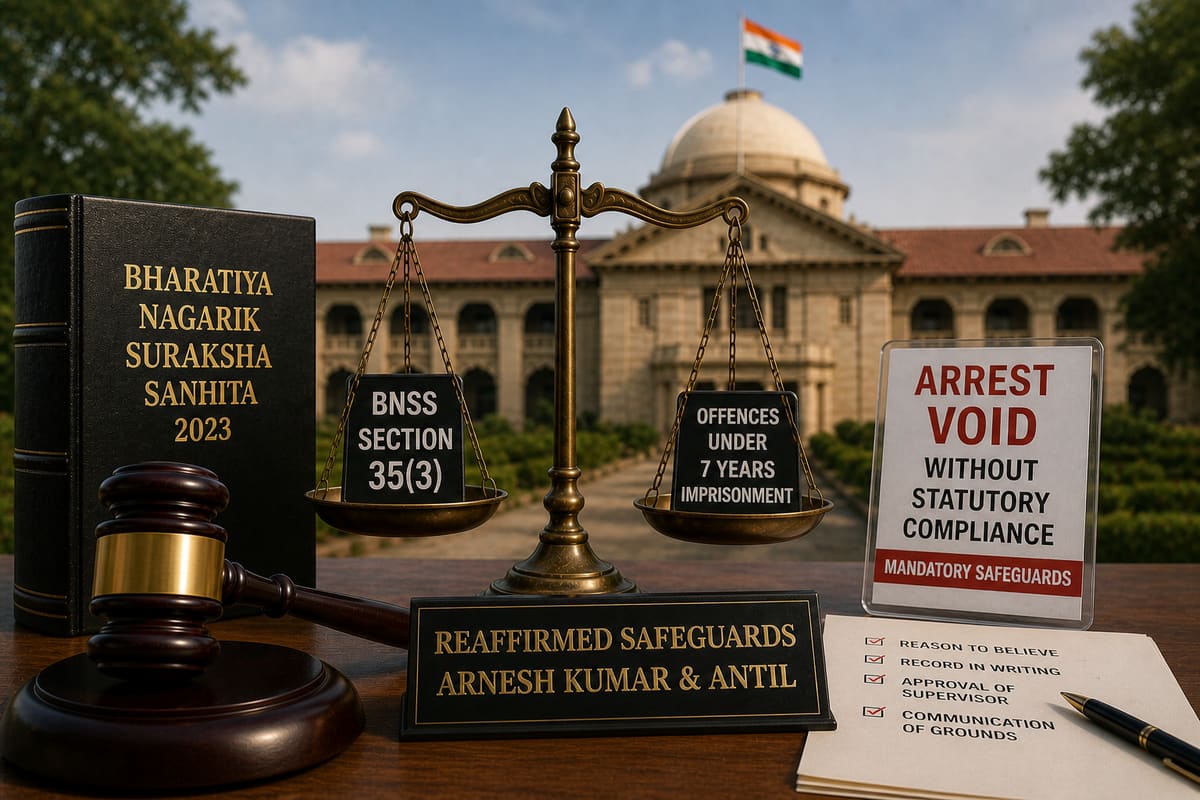
The Allahabad High Court has dismissed an anticipatory bail application under Section 35(3) BNSS, holding that the applicant failed to establish a prima facie case for arrest where the alleged offences are punishable with imprisonment for less than seven years. The Court directed the investigating agency to strictly adhere to the Supreme Court's guidelines in Arnesh Kumar v. State of Bihar and Mohd. Asfak Alam v. State of Jharkhand during investigation, while disposing of the application without granting anticipatory bail.
Background & Facts
The Genesis
The applicant, Amit Chhaunkar, filed an anticipatory bail application under Section 482 BNSS (Cr.P.C. 438 equivalent) seeking protection from arrest in Case Crime No. 0029 of 2025, registered at P.S. Cyber Crime, Mathura District under the following provisions:
Section 318(4) BNSS (kidnapping or abducting in order to subject person to grievous hurt, slavery, etc.)
Section 3(5) BNSS (kidnapping or abducting with intent to wrongfully confine)
Section 66D of the Information Technology Act (cheating by personation by using computer resource)
The applicant apprehended arrest based on the allegations in the FIR, which were registered on an unspecified date in 2025.
Key Facts
The FIR alleges that the applicant committed offences under Sections 318(4), 3(5) BNSS and Section 66D IT Act in relation to a cyber fraud incident.
The maximum punishment for the offences under Sections 318(4) and 3(5) BNSS is less than seven years' imprisonment.
Section 66D IT Act prescribes punishment up to three years' imprisonment.
The applicant filed the anticipatory bail application on an unspecified date in 2026, prior to any arrest.
Procedural History
2025: FIR registered at P.S. Cyber Crime, Mathura District (Case Crime No. 0029 of 2025).
2026: Anticipatory bail application filed before the Allahabad High Court (BNSS No. 5934 of 2026).
16.07.2026: Application heard and disposed of by the High Court.
The Parties' Positions
The applicant sought anticipatory bail, citing apprehension of arrest in the FIR. The State opposed the application, arguing that the offences alleged do not entail punishment exceeding seven years, and that the applicant's apprehension of arrest was not substantiated.
Relief Sought
The applicant prayed for:
Enforcement of anticipatory bail under Section 482 BNSS.
Protection from arrest in Case Crime No. 0029 of 2025.
The Legal Issue
The central question was whether an anticipatory bail application under Section 482 BNSS is maintainable where the alleged offences are punishable with imprisonment for less than seven years, and the applicant fails to demonstrate a prima facie case for arrest.
Arguments Presented
For the Applicant
The Learned counsel for the applicant did not address the objection raised by the State regarding the maximum punishment prescribed for the offences. The applicant relied on the general principle of anticipatory bail but did not provide specific grounds to justify the need for protection from arrest.
For the Respondent
The Learned A.G.A. for the State raised a preliminary objection, contending that:
The offences alleged against the applicant do not entail punishment exceeding seven years upon conviction.
Section 35(3) BNSS provides adequate safeguards against arbitrary arrest for offences punishable with less than seven years.
The Supreme Court's judgments in Arnesh Kumar v. State of Bihar and Mohd. Asfak Alam v. State of Jharkhand protect the applicant from arrest in such cases.
The applicant failed to establish a prima facie case for anticipatory bail.
The Court's Analysis
The Court examined the statutory framework under BNSS and the principles laid down by the Supreme Court in Arnesh Kumar and Mohd. Asfak Alam. It noted that Section 35(3) BNSS empowers the investigating officer to release an accused on bail for offences punishable with less than seven years, subject to conditions. The Court observed:
"The Learned A.G.A. has raised an objection regarding the maintainability of the instant application by submitting that the applicant does not apprehend his arrest as the offences that have been alleged against the applicant do not entail in the event of a conviction, a punishment of more than seven years."
The Court held that the applicant failed to rebut the State's contention or demonstrate exceptional circumstances warranting anticipatory bail. It relied on the Supreme Court's caution against routine grant of anticipatory bail in cases involving offences punishable with less than seven years, emphasizing that such offences do not ordinarily warrant custodial interrogation.
The Court further directed the investigating officer to strictly comply with the guidelines laid down in Arnesh Kumar and Mohd. Asfak Alam during the investigation, ensuring that the applicant is not subjected to unnecessary harassment or arrest without due cause.
The Verdict
The Allahabad High Court disposed of the anticipatory bail application without granting relief. The Court directed the investigating officer to strictly adhere to the Supreme Court's guidelines in Arnesh Kumar and Mohd. Asfak Alam while conducting the investigation in Case Crime No. 0029 of 2025. No anticipatory bail was granted to the applicant.
What This Means For Similar Cases
Anticipatory Bail Is Not Automatic
Practitioners must note that anticipatory bail is not a matter of right, especially where the offences alleged are punishable with less than seven years' imprisonment. The Court reiterated that:
Section 35(3) BNSS provides sufficient safeguards against arbitrary arrest.
The Supreme Court's judgments in Arnesh Kumar and Mohd. Asfak Alam restrict the grant of anticipatory bail to exceptional circumstances.
Applicants must demonstrate a strong prima facie case or exceptional circumstances to justify anticipatory bail in such cases.
Compliance with Arnesh Kumar Principles Is Mandatory
Investigating agencies must strictly follow the guidelines laid down in Arnesh Kumar and Mohd. Asfak Alam to avoid arbitrary arrests.
Courts will not entertain anticipatory bail applications where the offences alleged do not warrant custodial interrogation.
The Burden of Proof Lies on the Applicant
The applicant bears the burden of establishing a prima facie case for anticipatory bail.
Mere apprehension of arrest is insufficient; the applicant must demonstrate exceptional circumstances or a strong case on merits.