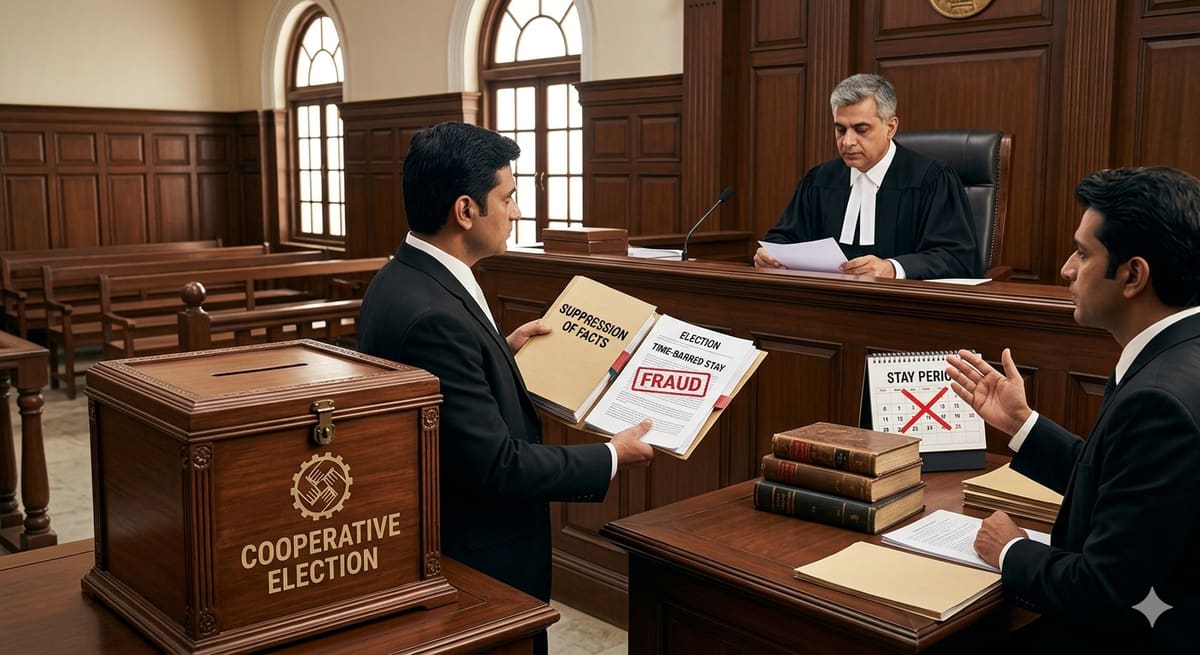
The Gauhati High Court has reaffirmed that the annulment of a cooperative society’s election cannot rest on technical or unquantified irregularities. In a significant ruling, the Court emphasized that statutory violations must demonstrably affect the outcome to justify overturning a democratically concluded process. This judgment reinforces the principle that administrative power must be exercised with proportionality and reasoned analysis, particularly when it disrupts collective self-governance.
Background & Facts
The Dispute
The dispute arose from the election of the Board of Directors of the Meherpur-Krishnapur Co-operative Society Ltd. held on 18.03.2023. The election was uncontested, with 14 valid nominations for 15 posts, resulting in all candidates being declared elected without polling. The Registrar of Co-operative Societies, Assam, later annulled the election on grounds that the attendance sheet contained duplicate signatures and signatures of deceased members.
Procedural History
- December 2022: The Zonal Joint Registrar appointed a One-man Committee to conduct the election after the previous Board failed to hold elections as required under Section 41(4) of the Assam Co-operative Societies Act, 2007.
- January 2023: A voter list was published after inviting corrections for deceased members and legal heirs; notices were published in two local newspapers.
- March 2023: The AGM was held with quorum achieved; 14 candidates were elected uncontested.
- April 2023: The Registrar first annulled the election citing natural justice violations; this order was set aside by the High Court on writ petition.
- September 2023: The Registrar issued a second order annulling the election, citing duplicate signatures and deceased voters on the attendance sheet.
- August 2024: The learned Single Judge set aside the Registrar’s order, holding the anomalies were not material.
- February 2026: The present intra-Court appeal was heard and dismissed.
Relief Sought
The petitioner sought to uphold the election results and prevent annulment of the uncontested election. The respondents sought to sustain the Registrar’s order on grounds of statutory non-compliance.
The Legal Issue
The central question was whether Section 29(1) of the Assam Co-operative Societies Act, 2007, mandates automatic annulment of an election upon any irregularity in the attendance sheet or voter list, or whether the Registrar must demonstrate that such irregularities materially affected the legitimacy of the proceedings.
Arguments Presented
For the Appellant
The appellant contended that the presence of deceased members and duplicate signatures on the attendance sheet rendered the General Assembly invalid under Section 29(1), which requires the assembly to consist only of eligible voters. Reliance was placed on Zora Singh v. J.M. Tendon to argue that any breach of statutory eligibility nullifies the entire proceeding. It was further argued that the Registrar’s quasi-judicial authority permits annulment where statutory norms are violated, regardless of material impact.
For the Respondent
The respondents argued that the Registrar’s order lacked quantification, reasoning, and evidence of material impact. They cited Section 26(3) and Rule 27 of the 2019 Rules, which provide specific statutory remedies for voter list disputes and election challenges, respectively. The failure to invoke these remedies within prescribed timelines rendered the challenge time-barred and procedurally defective. They also invoked the doctrine of approbation and reprobation, noting the appellant’s silence during the process and subsequent challenge only after an unfavorable outcome.
The Court's Analysis
The Court undertook a rigorous examination of the statutory framework under the Assam Co-operative Societies Act, 2007, and the 2019 Election Rules. It held that while Section 29(1) is mandatory, it does not prescribe automatic nullity for every procedural deviation. The Court distinguished between mandatory compliance and automatic invalidity, emphasizing that statutory mandates must be interpreted in light of their purpose and consequences.
"A statutory mandate may be mandatorily in obligation, yet the consequence of breach may depend upon the nature, extent, and impact of deviation."
The Court found the Registrar’s order fatally deficient for failing to quantify the number of irregularities, determine whether they affected quorum, or assess whether the outcome was altered. The absence of any analysis on materiality rendered the order arbitrary and constitutionally unsustainable.
The Court also rejected the reliance on Zora Singh, noting that the precedent applies only when the ground for annulment is independently sustainable - which it was not here. The Registrar’s failure to engage with the statutory remedies under Section 26(3) and Rule 27 was critical. The appellant’s delay and resort to an executive forum lacking adjudicatory power further undermined the legitimacy of the challenge.
The Court underscored that cooperative societies embody democratic self-governance. Annulment of an election is a drastic step requiring proportionality. The Registrar’s supervisory role is to correct illegality, not to supplant collective will. The order was found to be unsupported by objective data and devoid of reasoned analysis, violating the constitutional requirement of reasoned decision-making as affirmed in S.N. Mukherjee v. Union of India.
The Verdict
The petitioner won. The Court held that annulment of a cooperative election requires demonstrable material impact, not mere technical irregularities. The Registrar’s order was set aside for lack of reasoned analysis and failure to apply statutory remedies. The uncontested election was upheld.
What This Means For Similar Cases
Annulment Cannot Be Based on Technical Irregularities
- Practitioners must now challenge election irregularities through statutory remedies under Section 26(3) and Rule 27, not via administrative appeals.
- Any attempt to annul an election based on unquantified attendance sheet anomalies will fail unless material impact is proven.
- Courts will not validate annulments where the Registrar fails to record how irregularities affected quorum, composition, or outcome.
Statutory Remedies Are Exhaustive and Time-Bound
- Failure to file a challenge within 10 days of voter list publication (Section 26(3)) or within 3 days of election results (Rule 27) bars subsequent challenges.
- Administrative complaints to the Co-operation Department are not substitutes for statutory adjudication.
- Delayed challenges, especially after an unfavorable outcome, attract the doctrine of approbation and reprobation.
Proportionality Is a Constitutional Imperative
- Supervisory authorities must ensure their actions are proportionate to the mischief.
- Annulment is a last resort; lesser remedies like correction of voter lists or re-election of specific members must be considered first.
- The autonomy of cooperative institutions is protected unless there is clear, material illegality.