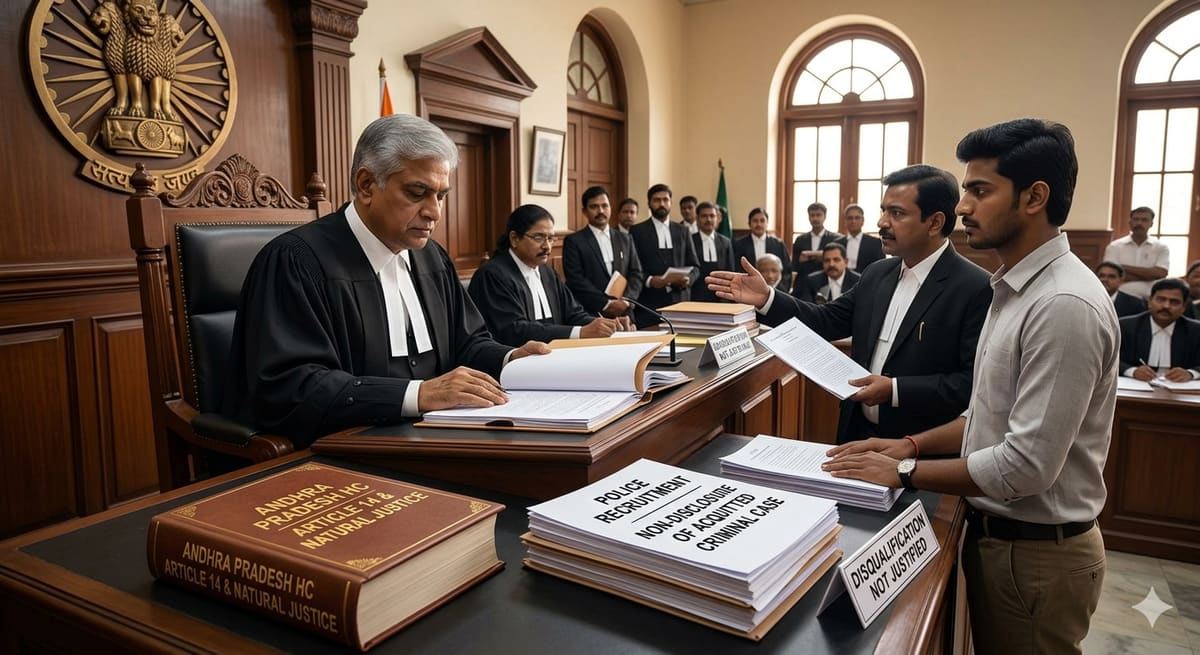
The Madras High Court Madurai Bench clarified that an acquittal resulting from a complete lack of evidence qualifies as an 'honourable acquittal' under G.O. Ms. No.1410 of 2008, thereby removing the statutory disqualification for recruitment into the disciplined forces. The Court upheld the single judge’s order quashing the rejection of R Dinesh’s candidature for Jail Warden and affirmed his right to appointment within twelve weeks, emphasizing that benefit-of-doubt acquittals without evidentiary foundation must be treated as honourable.
Background & Facts
The Dispute
The dispute arose from the rejection of R Dinesh’s application for the post of Jail Warden by the Director General of Police and other appellants, who relied on G.O. Ms. No.1410 of 2008 to treat his earlier acquittal in Crime No.129 of 2017 as involvement in a criminal case, thereby disqualifying him from constabulary service.
Key Facts
- R Dinesh applied for Jail Warden on 01.08.2022 and disclosed in his application the criminal case Crime No.129 of 2017 registered against him for alleged offences under Sections 147, 148, 188, 204(b), 332 IPC read with Sections 3 and 4 of the Tamil Nadu Property (Prevention of Damage and Loss) Act, 1992.
- The criminal case was registered in 2017 (Crime No.129 of 2017).
- The Sessions Court acquitted R Dinesh and all other accused on 19.04.2022 after full trial, finding no evidence to connect them to the offences.
- The acquittal was based solely on lack of evidence; there was no evidence connecting R Dinesh to the alleged offences.
- G.O. Ms. No.1410, Home (Pri-II) Department, dated 17.10.2008, provides that a person acquitted or discharged on benefit of doubt shall be treated as involved in a criminal case, except in case of honourable acquittal.
- G.O. Ms. No.99, Home (Courts-IV) Department, dated 20.02.2021, directed withdrawal of 308 cases registered during the 2017 Jallikattu protest, including cases similar to Crime No.129 of 2017.
- The learned Single Judge passed the impugned order on 18.03.2024 in W.P.(MD) No.399 of 2024, quashing the rejection and directing the appellants to appoint R Dinesh as Jail Warden within twelve weeks from receipt of the order.
- The present Writ Appeal (W.A.(MD) No.488 of 2025) was filed by the appellants challenging that order.
Procedural History
- 17.11.2017: Crime No.129 of 2017 registered against R Dinesh and others for alleged offences during Jallikattu agitation.
- 19.04.2022: Sessions Court acquitted R Dinesh and all other accused after full trial, finding no evidence to connect them to the offences.
- 01.08.2022: R Dinesh submitted his application for Jail Warden, disclosing the criminal case.
- 18.03.2024: Learned Single Judge passed order quashing the rejection and directing appointment within twelve weeks.
- 07.09.2026: Judgment reserved.
- 25.09.2026: Judgment delivered.
Relief Sought
The appellants sought to set aside the Single Judge’s order dated 18.03.2024, to uphold the rejection of R Dinesh’s candidature, and to deny him appointment as Jail Warden. The respondent (R Dinesh) sought to uphold the Single Judge’s order, to secure his appointment within twelve weeks, and to have no costs awarded.
The Legal Issue
The central question was whether an acquittal resulting from a complete lack of evidence, i.e., a benefit-of-doubt acquittal without any evidentiary foundation, falls within the exception of 'honourable acquittal' contained in G.O. Ms. No.1410 of 2008, thereby entitling the acquitted person to be treated as 'not involved in a criminal case' for the purpose of recruitment into the disciplined forces.
Arguments Presented
For the Appellants
The appellants, represented by Special Government Pleader Mr.M.Kannan, argued that G.O. Ms. No.1410 treats any person acquitted or discharged on benefit of doubt as involved in a criminal case, unless the acquittal is honourable. They contended that the concept of honourable acquittal is narrow and requires a positive finding of innocence, not merely lack of evidence. They emphasized the need to maintain discipline and dignity in the police force, asserting that appointing a person with any criminal antecedent, even if acquitted, would be detrimental to service integrity. They relied on the language of the order and the policy underlying the Government Directive to submit that the Single Judge erred in extending the honourable acquittal exception to a case where the acquittal was based solely on doubt.
For the Respondent
Respondent’s counsel Mr.K.Muthu Ganesa Pandian submitted that the acquittal in Crime No.129 of 2017 was a honourable acquittal because the prosecution failed to adduce any evidence connecting him to the alleged offences, and the Sessions Court acquitted all accused after full consideration of the prosecution case. He argued that the Supreme Court in Commissioner of Police vs Mehar Singh (2013) 7 SCC 685, following Inspector General of Police vs S. Samuthiram (2013) 1 SCC 598, defined honourable acquittal as an acquittal after full consideration where the prosecution miserably fails to prove the charges. He further pointed out that G.O. Ms. No.99 of 2021 had withdrawn 308 similar cases, indicating a policy shift that such cases lack evidentiary basis. He maintained that the Single Judge correctly applied the exception and that the appellants’ appeal lacked merit.
The Court's Analysis
The Court began by noting that G.O. Ms. No.1410 of 2008 disqualifies a person who has been involved in any criminal case, with Explanation (1) treating a person acquitted or discharged on benefit of doubt as involved, while Explanation (2) provides the sole exception for honourable acquittal. The Court observed that the expression 'honourable acquittal' is not defined in the Penal Code or the Criminal Procedure Code but is a judicial coinage. It then turned to the Supreme Court’s pronouncement in Commissioner of Police vs Mehar Singh, (2013) 7 SCC 685, which cited Inspector General of Police vs S. Samuthiram, (2013) 1 SCC 598, and held:
'25. The expression “honourable acquittal” was considered by this Court in S. Samuthiram. … … This Court observed that the expressions “honourable acquittal”, “acquitted of blame” and “fully exonerated” are unknown to the Criminal Procedure Code or the Penal Code. They are coined by judicial pronouncements. It is difficult to define what is meant by the expression “honourably acquitted”. This Court expressed that when the accused is acquitted after full consideration of the prosecution case and the prosecution miserably fails to prove the charges levelled against the accused, it can possibly be said that the accused was honourably acquitted.'
The Court emphasized that the key ingredient is a acquittal after full consideration of the prosecution evidence, not a acquittal based on procedural technicality, compromise, or witness hostility. Applying this test to the present case, the Court recorded that the Sessions Court examined 24 prosecution witnesses, none of whom identified the writ petitioner or any other accused, and that the acquittal was recorded after full trial on the merits. The Court found that the prosecution had miserably failed to prove the charges, there being literally no evidence to connect the writ petitioner to the alleged offences. Consequently, the acquittal satisfied the Supreme Court’s description of honourable acquittal.
The Court further noted that G.O. Ms. No.99 of 2021, which withdrew 308 cases registered during the 2017 Jallikattu protest, reinforced the view that such cases lacked evidentiary foundation and were registered merely to control law and order. This administrative action aligned with the judicial understanding of honourable acquittal. The Court concluded that, as the writ petitioner’s acquittal qualified as honourable acquittal under the aforementioned Government Order, he fell within the exception and must be treated as 'a person not involved in a criminal case' for recruitment purposes. Accordingly, the Single Judge’s order quashing the rejection and directing appointment within twelve weeks was correct, and there was no warrant to interfere with the same.
The Court also observed that imposing a blanket disqualification on benefit-of-doubt acquittals would undermine the presumption of innocence and could deter qualified candidates from seeking employment in the disciplined forces, contrary to the objective of maintaining a competent and dignified service.
The Verdict
The Court dismissed the Writ Appeal as devoid of merits and upheld the order of the learned Single Judge dated 18.03.2024. It affirmed that R Dinesh shall be appointed as Jail Warden within twelve weeks from the date of receipt of that order, and held that no costs would be awarded. The judgment thus grants the respondent the relief of appointment and confirms the statutory exception for honourable acquittal under G.O. Ms. No.1410 of 2008.
What This Means For Similar Cases
Honourable Acquittal Requires Evidentiary Vacuum
- An acquittal must follow a full trial where the prosecution fails to adduce any credible evidence linking the accused to the offence.
- Mere benefit-of-doubt arising from witness hostility or procedural lapses does not qualify.
Administrative Policies Align with Judicial Doctrine
- Government orders withdrawing cases registered during mass protests signal recognition of lack of evidentiary basis.
- Such executive actions reinforce the application of the honourable acquittal exception in service jurisprudence.
Procedural Safeguards for Candidates
- Candidates must disclose prior criminal proceedings in their applications.
- Authorities must assess whether the acquittal is honourable before applying the disqualification clause of G.O. Ms. No.1410.
- Appointment orders should specify a clear compliance timeline, as the Court did here with twelve weeks.