The Punjab and Haryana High Court has reinforced the constitutional imperative of free and fair local elections by mandating concrete safeguards - including videography, a court observer, and relocation of polling to a neutral venue - to prevent coercion and ensure electoral integrity. This order, while grounded in a procedural agreement, establishes a precedent for transparent panchayat-level democratic processes.
Background & Facts
The Dispute
The petitioners, residents and electors of Panchayat Samiti Majri in SAS Nagar, Mohali, sought judicial intervention to ensure that the upcoming elections for the posts of Chairman and Vice-Chairman were conducted in a free, fair, democratic, and transparent manner. They expressed concerns over potential voter intimidation, lack of neutrality in the polling venue, and absence of independent oversight.
Key Facts
- The elections for Chairman and Vice-Chairman of Panchayat Samiti, Majri were pending and had not been scheduled.
- A similar writ petition, CWP No.7832 of 2026 (Taranjit Singh and others v. State of Punjab and others), had been decided on 13.03.2026, addressing identical concerns for Panchayat Samiti Dera Baba Nanak, District Gurdaspur.
- In Taranjit Singh’s case, the Court had directed:
- Videography of the entire voting process at the petitioner’s cost
- Conduct of elections via secret ballot papers
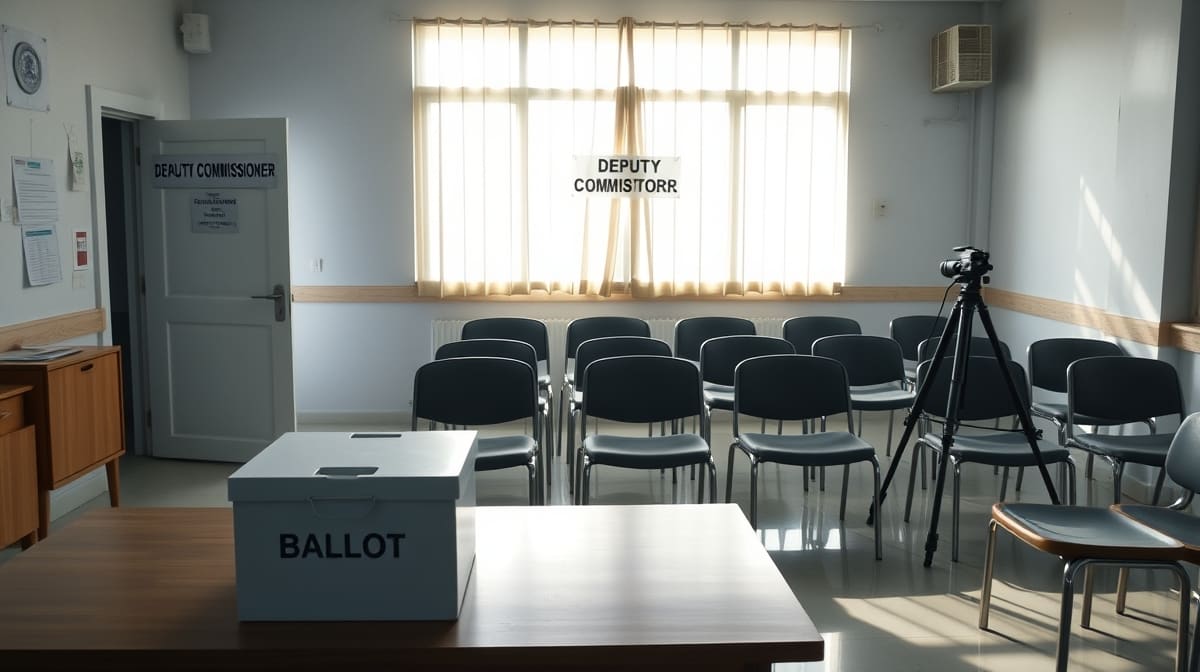
- Relocation of polling from SDM’s office to the Deputy Commissioner’s office
- Permission for voters in police or judicial custody to cast votes under supervision
- Prohibition against restricting any voter’s right to participate
- The petitioners in the present case sought application of the same safeguards to Panchayat Samiti Majri.
- The petitioners further requested the Court to fix a specific date for the elections, which had not been determined.
Procedural History
- 13.03.2026: Judgment delivered in Taranjit Singh v. State of Punjab (CWP No.7832/2026), establishing the procedural framework for fair panchayat elections.
- 30.03.2026: Present petition (CWP No.9581/2026) filed seeking identical reliefs for Panchayat Samiti Majri.
- 30.03.2026: Hearing conducted before a Division Bench of Justices Harsimran Singh Sethi and Deepak Manchanda.
- 30.03.2026: State accepted the applicability of the Taranjit Singh order and agreed to comply with all directions.
- 30.03.2026: Petitioner requested fixation of election date and appointment of a court observer.
- 30.03.2026: Court fixed the election date as 04.04.2026 at 10:00 a.m.
- 30.03.2026: Advocate Aayush Gupta (Enrolment No. PH/5420/2020) appointed as Court Observer.
The Parties' Positions
For the Petitioner
- Sought replication of the Taranjit Singh order to ensure parity and prevent arbitrariness.
- Requested fixation of election date to prevent indefinite delay.
- Proposed appointment of an independent Court Observer to monitor proceedings and submit a report.
- Offered to bear all costs associated with videography and observer remuneration.
For the Respondent-State
- Accepted the applicability of the Taranjit Singh order without objection.
- Agreed to fix the election date as directed.
- Agreed to appoint a Court Observer and provide security.
- Affirmed that no illegality had occurred but welcomed the order to preempt any future allegations.
Relief Sought
The petitioners sought:
- Application of the Taranjit Singh order to the elections of Panchayat Samiti Majri
- Fixation of a specific date for the elections
- Appointment of an independent Court Observer
- Videography of the election process at the petitioner’s cost
- Security for the Court Observer
- Conduct of elections at the Deputy Commissioner’s office, SAS Nagar, Mohali
- Allowing voters in custody to cast ballots
- Restriction of entry to only eligible voters and necessary officials
The Legal Issue
The central question was whether the High Court can, in the absence of proven illegality, issue proactive directions to ensure free, fair, and transparent panchayat elections under Article 226 of the Constitution, particularly when similar safeguards have been previously established in a parallel case.
Arguments Presented
For the Petitioner
The petitioner relied on the precedent set in Taranjit Singh v. State of Punjab to argue that the principles of transparency, voter autonomy, and institutional neutrality are not discretionary but essential to the democratic character of panchayat elections under the Punjab Panchayati Raj Act, 1994. The petitioner emphasized that the right to vote is a constitutional right and must be protected from subtle coercion, especially in rural settings where influence peddling is common. The request for a Court Observer was grounded in the need for independent verification and accountability.
For the Respondent-State
The State did not contest the petitioner’s request. It accepted that while no illegality had been established, the issuance of clear, binding directions would preempt future litigation and uphold public confidence in the electoral process. The State’s cooperation reflected a pragmatic recognition that procedural fairness is as vital as legal compliance in maintaining democratic legitimacy.
The Court's Analysis
The Court observed that the present petition was not filed on the basis of any proven violation but as a preventive measure to ensure that the electoral process for Panchayat Samiti Majri met the highest standards of transparency. The Court noted that the State had fully cooperated and accepted the applicability of the Taranjit Singh order, thereby eliminating any adversarial tension.
"This order is being passed not because any illegality has been done by the State. Rather, the present order is being passed so that no allegation qua the conduct of election process is raised, and free and fair election is conducted."
The Court emphasized that the constitutional mandate under Article 243G and the principles of participatory democracy require more than mere compliance with statutory formalities. The presence of a neutral venue, independent observation, and public documentation through videography serve as institutional safeguards against latent coercion and procedural arbitrariness.
The Court further held that the appointment of a Court Observer, even at the petitioner’s expense, was a reasonable and proportionate measure to enhance public trust. The Court noted that the observer’s role was not to interfere but to observe and report, thereby acting as a neutral witness to the integrity of the process.
The direction to conduct the election at the Deputy Commissioner’s office, rather than the SDM’s office, was justified as a precautionary measure to avoid any perception of administrative bias. The Court also affirmed that voters in custody must not be disenfranchised, reinforcing the principle that the right to vote is inviolable, even for those under state detention.
The Court’s reasoning was not based on punitive intent but on the affirmative duty of the State to create conditions conducive to genuine electoral participation.
The Verdict
The petition was disposed of with the following directions:
- The elections for Chairman and Vice-Chairman of Panchayat Samiti, Majri shall be held on 04.04.2026 at 10:00 a.m. at the Office of the Deputy Commissioner, SAS Nagar, Mohali.
- The entire voting process shall be videographed at the cost of the petitioner.
- Advocate Aayush Gupta (Enrolment No. PH/5420/2020) is appointed as Court Observer and shall be paid a remuneration of Rs. 50,000 by the petitioner in advance.
- The State shall provide full security to the Court Observer.
- Only eligible voters as per the Punjab Panchayati Raj Act, 1994, and necessary officials shall be permitted at the venue.
- Voters in police or judicial custody shall be allowed to cast their votes under supervision and returned to custody immediately after.
- The Deputy Commissioner shall ensure all eligible voters are notified of the date, time, and venue.
- The Court Observer shall submit a report to the Court after the election.
- All pending applications are disposed of.
What This Means For Similar Cases
Proactive Judicial Intervention Is Permissible for Electoral Integrity
- Practitioners may now file writ petitions under Article 226 even in the absence of proven illegality, if there is a credible apprehension of unfairness in panchayat elections.
- Courts may issue preventive directions to institutionalize transparency, especially where similar safeguards have been previously ordered.
- The burden of proving fairness now shifts to the State to demonstrate that no procedural safeguards are needed.
Court Observers Are Legally Recognized Tools for Accountability
- Appointment of Court Observers, even at private cost, is now a validated mechanism for ensuring electoral credibility.
- The State must provide security to such observers as part of its duty to protect democratic processes.
- Observers’ reports may be admissible in future litigation challenging election outcomes.
Neutral Venue and Videography Are Now De Facto Standards
- Elections for panchayat heads must be held at the Deputy Commissioner’s office, not at lower administrative offices like SDM’s, to avoid perceptions of bias.
- Videography is no longer optional - it is a mandatory component of fair elections when requested, even if borne by petitioners.
- Any future challenge to panchayat election results may be defeated if these safeguards were not implemented.