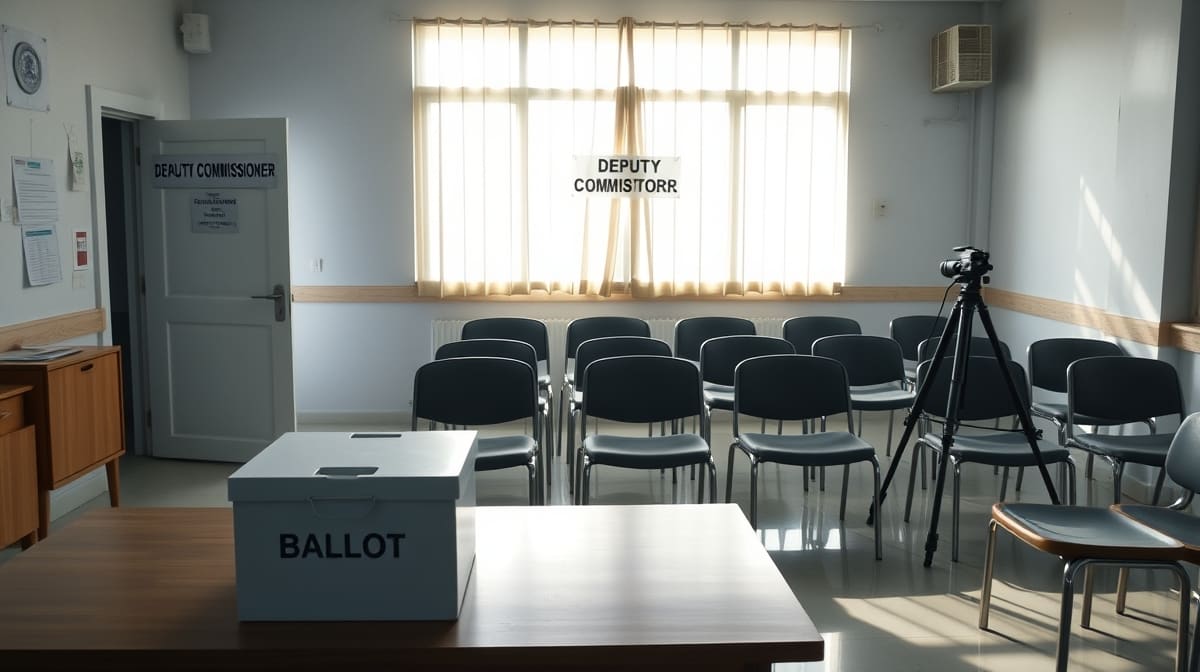
The Punjab and Haryana High Court has reinforced the constitutional imperative of free and fair local elections by mandating concrete safeguards against electoral malpractice. In a decisive order, the Court directed that the upcoming election for Chairman and Vice Chairman of Panchayat Samiti, Fattu Dhinga, be conducted under strict oversight, including videography, appointment of an independent court observer, and relocation to a neutral administrative venue.
Background & Facts
The Dispute
The petitioners, residents and voters of Panchayat Samiti, Fattu Dhinga, Tehsil Sultanpur Lodhi, District Kapurthala, filed a writ petition seeking judicial intervention to ensure that the election for Chairman and Vice Chairman, originally scheduled for 01.04.2026, was conducted in a free, fair, democratic, and transparent manner. They alleged that the electoral process was being undermined by intimidation, lack of transparency, and potential manipulation by local authorities.
Key Facts
- The election was initially scheduled for 01.04.2026 but was postponed by the State to 04.04.2026.
- The petitioners drew parallels to Taranjit Singh v. State of Punjab (CWP No.7832-2026), decided on 13.03.2026, where similar safeguards were ordered for elections in Dera Baba Nanak, District Gurdaspur.
- The petitioners expressed apprehension that polling agents and police were visiting voters’ homes to exert undue influence.
- The venue for voting was originally proposed to be the office of the Sub-Divisional Magistrate (SDM), which the petitioners contended was not a neutral administrative location.
- No formal complaint of rigging had been filed, but the petitioners sought preventive judicial oversight to avoid any perception of bias.
Procedural History
- 01.04.2026: Writ Petition (CWP No.9901-2026) filed before the High Court of Punjab and Haryana, Chandigarh.
- 01.04.2026: Hearing conducted before Justices Harsimran Singh Sethi and Deepak Manchanda.
- 01.04.2026: State counsel confirmed that the election had been postponed to 04.04.2026 and agreed to implement the directions from Taranjit Singh’s case.
- 01.04.2026: Parties reached an agreement on the terms of electoral conduct.
- 01.04.2026: Court disposed of the petition based on the agreed terms.
Relief Sought
The petitioners sought:
- Mandatory videography of the entire voting process.
- Conduct of elections at the office of the Deputy Commissioner, Kapurthala, as a neutral venue.
- Appointment of an independent Court Observer to monitor proceedings.
- Security for voters and observers.
- Permission for voters in police or judicial custody to cast ballots.
- Restriction of entry to the polling venue to only eligible voters and authorized officers.
The Parties' Positions
Petitioners: Argued that without judicial intervention, the election risked being compromised by intimidation and lack of transparency. They relied on the precedent set in Taranjit Singh’s case to argue that preventive measures, not reactive ones, were necessary to uphold democratic integrity.
Respondent-State: Accepted the petitioners’ concerns and agreed to implement all safeguards ordered in Taranjit Singh’s case. The State confirmed that the election would be held on 04.04.2026 at the Deputy Commissioner’s office, with videography, and that voters in custody would be permitted to vote.
The Legal Issue
The central question was whether the High Court has the authority to impose procedural safeguards - such as videography, appointment of a Court Observer, and relocation of polling to a neutral venue - to ensure free and fair elections to Panchayat bodies in the absence of proven malpractice, but in the face of credible apprehensions.
Arguments Presented
For the Petitioner
The petitioners relied on the precedent in Taranjit Singh v. State of Punjab to argue that the Court’s power under Article 226 of the Constitution extends to issuing preventive directions to protect the democratic process. They emphasized that the right to free and fair elections is a facet of Article 19(1)(a) and Article 21, and that public confidence in local governance requires visible transparency. They further contended that videography at the petitioner’s cost was a reasonable burden to ensure accountability.
For the Respondent
The State accepted the petitioners’ concerns and agreed to adopt all measures ordered in Taranjit Singh’s case. The Additional Advocate General affirmed that the State had no objection to videography, use of the Deputy Commissioner’s office as the venue, and the appointment of a Court Observer. The State emphasized its commitment to upholding electoral integrity and welcomed judicial oversight to preempt allegations of bias.
The Court's Analysis
The Court observed that while no concrete evidence of electoral fraud had been established, the mere apprehension of manipulation undermines the legitimacy of democratic institutions. The Court held that in matters of local self-governance, the perception of fairness is as critical as actual fairness.
"This order is being passed not because any illegality has been done by the State, rather, the present order is being passed so that no allegation qua the conduct of election process is raised, and free and fair election is conducted."
The Court affirmed the applicability of its earlier order in Taranjit Singh’s case, noting that the principles laid down therein - videography, neutral venue, inclusion of voters in custody, and restriction of unauthorized entry - were universally applicable to Panchayat elections under the Punjab Panchayati Raj Act, 1994. The Court further held that the appointment of an independent Court Observer, even at the petitioners’ expense, was a proportionate measure to enhance public trust.
The Court also clarified that the right to vote extends to those in custody, and that jail and police authorities are bound by the order to facilitate voting without delay or obstruction. The Court emphasized that the Deputy Commissioner’s office, as a higher administrative authority, provided greater neutrality than the SDM’s office.
The Verdict
The petition succeeded. The Court directed that the election for Chairman and Vice Chairman of Panchayat Samiti, Fattu Dhinga, scheduled for 04.04.2026, shall be:
- Videographed at the cost of the petitioners.
- Conducted in the Office of the Deputy Commissioner, Kapurthala.
- Monitored by Court Observer Ms. Shruti, Advocate, who shall be paid Rs.50,000 by the petitioners in advance.
- Secured by the State for the Court Observer and voters.
- Open to voters in police or judicial custody, who shall be brought to the venue, allowed to vote, and returned to custody immediately after.
- Restricted to only eligible voters and authorized officers; no loitering permitted.
The Court Observer shall submit a report to the Court after the election. All pending applications were disposed of.
What This Means For Similar Cases
Judicial Oversight Is Prophylactic, Not Reactive
- Practitioners may now seek preventive directions under Article 226 even in the absence of proven malpractice, if credible apprehensions of electoral bias exist.
- Courts may impose transparency measures - such as videography and neutral venues - as standard safeguards in sensitive local elections.
Court Observers Are Legally Recognized Electoral Monitors
- Appointment of independent Court Observers, even at private cost, is now a judicially sanctioned mechanism to ensure electoral integrity.
- The State is obligated to provide security to such observers, and their reports carry judicial weight.
Voters in Custody Have Absolute Right to Vote
- The judgment establishes that no person eligible to vote under the Panchayati Raj Act can be denied the right to vote merely because they are in custody.
- Jail and police authorities must comply with court orders facilitating voting, and failure to do so may attract contempt proceedings.
Venue Neutrality Is Non-Negotiable
- Polling at SDM offices is now effectively disfavored; Deputy Commissioner’s offices are the preferred neutral venues.
- Any deviation from a neutral venue must be justified with compelling reasons, or risk judicial intervention.
Cost-Sharing for Transparency Is Permissible
- The Court has validated that petitioners may bear the cost of videography and observer remuneration as a reasonable condition for ensuring transparency.
- This sets a precedent for future litigants to fund oversight mechanisms where public funds are unavailable or delayed.