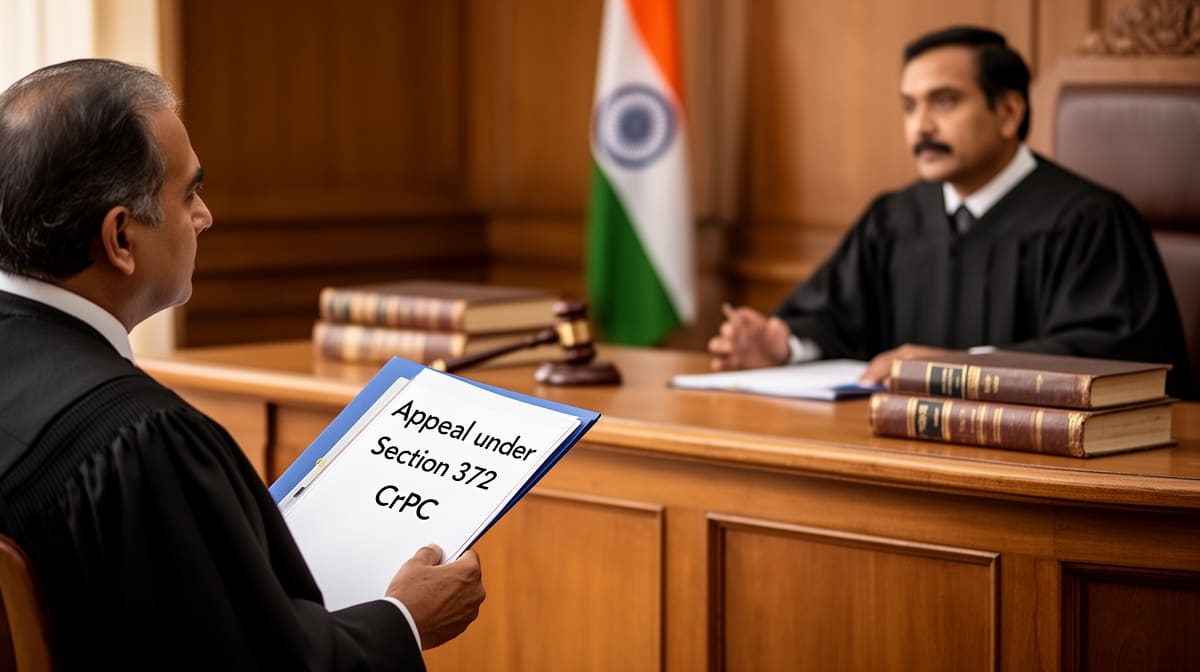
The Punjab and Haryana High Court has clarified that a victim of a crime possesses an independent, statutory right to appeal an order of acquittal under the proviso to Section 372 of the Code of Criminal Procedure, without being constrained by the restrictive conditions of Section 378(4). This ruling reinforces the Supreme Court’s recent exposition in M/s Celestium Financial v. A. Gnanasekaran and affirms the legislative intent to empower victims as autonomous participants in criminal justice.
Background & Facts
The Dispute
The appellant, Suraj Behl, sought to challenge an order of acquittal passed by the Judicial Magistrate First Class, Karnal, in a criminal complaint. The complaint was originally filed by the appellant, who also alleged himself to be the victim of the alleged offence. However, instead of invoking the proviso to Section 372 CrPC, he filed an appeal under Section 378(4), which requires prior special leave from the High Court.
Procedural History
- The trial court acquitted the accused on 06.09.2024.
- The appellant filed an appeal before the High Court under Section 378(4) CrPC, accompanied by an application for special leave.
- The High Court, upon review, found that the appellant was both complainant and victim, and thus entitled to a direct right of appeal.
- No advocate appeared for the appellant, but the Court took judicial notice of the statutory rights available.
Relief Sought
The appellant sought setting aside of the acquittal order and conviction of the respondents. However, the High Court did not adjudicate the merits, instead redirecting the matter to the appropriate forum under the correct legal provision.
The Legal Issue
The central question was whether a person who is both a complainant and a victim must seek special leave under Section 378(4) CrPC to appeal an acquittal, or whether they may directly invoke the proviso to Section 372 CrPC as a matter of right.
Arguments Presented
For the Appellant
Though no advocate appeared, the appellant’s filing implicitly relied on the procedural route under Section 378(4), suggesting a misunderstanding of the victim’s statutory rights. The Court inferred that the appellant, as victim, was entitled to the broader remedy under Section 372, and thus the application was misfiled.
For the Respondent
No appearance was made by the respondents, and no counter-arguments were presented before the Court.
The Court's Analysis
The Court relied extensively on the Supreme Court’s judgment in M/s Celestium Financial v. A. Gnanasekaran, which meticulously dissected the interplay between Sections 372 and 378 CrPC. The Court emphasized that the proviso to Section 372 CrPC, inserted in 2009, was designed to grant victims an independent, non-derivative right to appeal, irrespective of their role as complainant.
"Thus, if a victim who is a complainant, proceeds under Section 378, the necessity of seeking special leave to appeal would arise but if a victim whether he is a complainant or not, files an appeal in terms of proviso to Section 372, then the mandate of seeking special leave to appeal would not arise."
The Court held that Section 378(4) imposes procedural hurdles only on non-victim complainants. When the complainant is also the victim, the remedy under Section 372 is not merely alternative - it is the primary and preferred route. The Court further noted that the legislative intent behind the 2009 amendment was to correct historical imbalances that sidelined victims in criminal proceedings.
The Court declined to examine the merits of the acquittal, observing that doing so would prejudice the Sessions Court’s independent adjudication. Instead, it directed the matter to be reclassified and re-adjudicated under the correct statutory framework.
The Verdict
The appellant prevailed on the procedural point. The High Court held that a victim may appeal an acquittal directly under the proviso to Section 372 CrPC without seeking special leave under Section 378(4). The appeal was remitted to the Sessions Judge for disposal as a victim’s appeal under Section 372 CrPC or Section 413 BNSS, 2023.
What This Means For Similar Cases
Victim’s Appeal Is a Right, Not a Privilege
- Practitioners must now advise victims to file appeals under Section 372 CrPC as a matter of right, not under Section 378(4)
- Applications under Section 378(4) filed by victims should be withdrawn or converted to Section 372 appeals
- Courts must reject Section 378(4) applications from victims as procedurally defective
Procedural Misfiling Does Not Bar Substantive Relief
- Even if a victim mistakenly files under Section 378(4), courts must treat it as a Section 372 appeal
- The High Court’s remittal direction establishes that procedural errors by victims are curable without prejudice
- This prevents technical dismissal of appeals by victims on technical grounds
Section 372 Supersedes Section 378 for Victims
- The proviso to Section 372 operates independently of Section 378
- A victim need not prove ‘sufficient grounds’ or obtain leave - only that they suffered loss or injury from the alleged offence
- This applies even if the victim is not the original complainant, as long as they are legally recognized as such under the definition in Celestium Financial