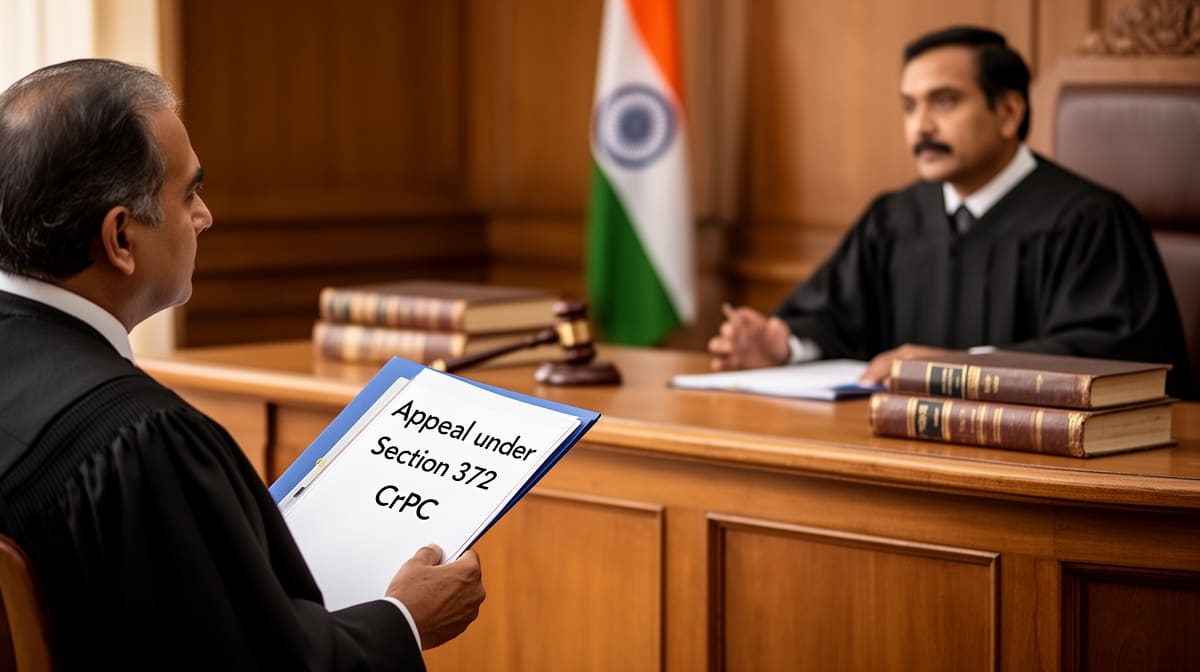
The Madhya Pradesh High Court has reaffirmed the statutory right of victims to prefer appeals against acquittal orders under Section 372 of the Code of Criminal Procedure, directing lower courts to reconsider such appeals in light of the Supreme Court’s recent clarification in M/s Celestium Financial v. A. Gnanasekaran. This order resolves a procedural impasse and reinforces the legislative intent behind the 2009 amendment to CrPC.
Background & Facts
The Dispute
The petitioner, Sunil Brothers through its proprietor Smt. Manju, is the victim in Criminal Case No. 1799/13, which concluded with an acquittal order by the learned Trial Court on 29.12.2021. Dissatisfied with the acquittal, the petitioner filed a criminal appeal before the Lower Appellate Court (Sessions Court, Ratlam) under Section 372 of the CrPC on 15.01.2022.
Key Facts
- The original criminal case (No. 1799/13) arose from allegations of criminal breach of trust and cheating under Sections 406 and 420 IPC
- The Trial Court acquitted the accused on 29.12.2021, citing insufficient evidence
- The petitioner filed the appeal under Section 372 CrPC on 15.01.2022
- The Lower Appellate Court dismissed the appeal on 27.07.2024, holding that Section 372 CrPC was not applicable due to a prior order by this Court dated 13.07.2022
- The 13.07.2022 order by the High Court had relied on Mallikarjun Kodagali v. State of Karnataka (2018 SCC Online SC 1941), which had interpreted Section 372 narrowly
Procedural History
- 29.12.2021: Acquittal order passed by Trial Court in Criminal Case No. 1799/13
- 15.01.2022: Petitioner filed Criminal Appeal No. 62/2024 under Section 372 CrPC
- 13.07.2022: High Court passed order in MCRC No. 32421/2022, relying on Mallikarjun Kodagali to restrict Section 372 appeals
- 27.07.2024: Lower Appellate Court dismissed the appeal, citing the 13.07.2022 High Court order and Mallikarjun Kodagali
- 15.04.2024: Petitioner filed the present Misc. Criminal Case No. 49332/2024 before the High Court
- 13.05.2026: Judgment delivered by the High Court
Relief Sought
The petitioner sought setting aside of the Lower Appellate Court’s order dated 27.07.2024 and direction to the Sessions Court to hear and decide Criminal Appeal No. 62/2024 on merits under Section 372 CrPC.
The Legal Issue
The central question was whether the Lower Appellate Court was justified in dismissing a victim’s appeal under Section 372 of the CrPC based on an earlier High Court order that relied on Mallikarjun Kodagali, when the Supreme Court in M/s Celestium Financial v. A. Gnanasekaran (08.04.2025) had clarified the scope and applicability of Section 372 CrPC.
Arguments Presented
For the Petitioner
The petitioner’s counsel argued that the Lower Appellate Court erred in relying on Mallikarjun Kodagali, which was superseded by the Supreme Court’s judgment in M/s Celestium Financial v. A. Gnanasekaran. The judgment in Celestium Financial explicitly held that Section 372 CrPC confers an independent statutory right on victims to appeal against acquittals, irrespective of whether the prosecution had appealed. The petitioner emphasized that the appellate court’s refusal to entertain the appeal violated the legislative intent behind the 2009 amendment to CrPC.
For the Respondent
The respondent did not appear or file any written submissions. The Court noted the absence of any counter-argument from the accused or the State.
The Court's Analysis
The Court examined the evolution of judicial interpretation of Section 372 CrPC. It noted that while Mallikarjun Kodagali had imposed restrictive conditions on victim appeals, the Supreme Court in M/s Celestium Financial v. A. Gnanasekaran had unequivocally overruled such restrictive interpretations. The Apex Court held:
"Section 372 CrPC is a substantive right conferred upon the victim to prefer an appeal against an order of acquittal. It is not contingent upon the prosecution’s decision to appeal, nor can it be curtailed by procedural technicalities or prior judicial orders based on outdated interpretations."
The Court observed that the Lower Appellate Court’s reasoning in paragraphs 16 to 21 of its order was based on an obsolete legal framework. The reliance on the 13.07.2022 High Court order, which itself was grounded in Mallikarjun Kodagali, was legally unsustainable in light of the binding precedent established by the Supreme Court on 08.04.2025.
The Court emphasized that the doctrine of stare decisis requires lower courts to follow the latest authoritative pronouncement by the Supreme Court. The failure of the Sessions Court to apply the Celestium Financial judgment constituted a clear error of law.
The Verdict
The petition succeeded. The High Court set aside the order dated 27.07.2024 passed by the Lower Appellate Court in Criminal Appeal No. 62/2024. The Court directed the Sessions Court, Ratlam, to restore the appeal and decide it expeditiously in accordance with law, including any applications filed therewith, applying the principles laid down in M/s Celestium Financial v. A. Gnanasekaran. The appeal must be heard and decided within 12 weeks from the date of this order.
What This Means For Similar Cases
Victim Appeals Are Not Discretionary
- Practitioners must now treat Section 372 CrPC appeals as a statutory right, not a privilege subject to judicial discretion
- Lower courts cannot dismiss such appeals on grounds of delay, lack of prosecution appeal, or prior restrictive orders
- Any order rejecting a Section 372 appeal post-April 2025 must be challenged immediately on grounds of non-application of Celestium Financial
Precedent Supersedes Local Practice
- High Court orders predating Celestium Financial that restrict Section 372 appeals are no longer binding
- Advocates must cite M/s Celestium Financial v. A. Gnanasekaran as controlling authority in all victim appeal matters
- Courts must conduct a fresh review of all pending Section 372 appeals dismissed between 2018 and 2025
Procedural Compliance Is Mandatory
- The appellate court must provide a full hearing to both parties
- The judgment must record reasons for acceptance or rejection of the appeal on merits
- Failure to do so renders the order liable to be set aside under Article 227 of the Constitution