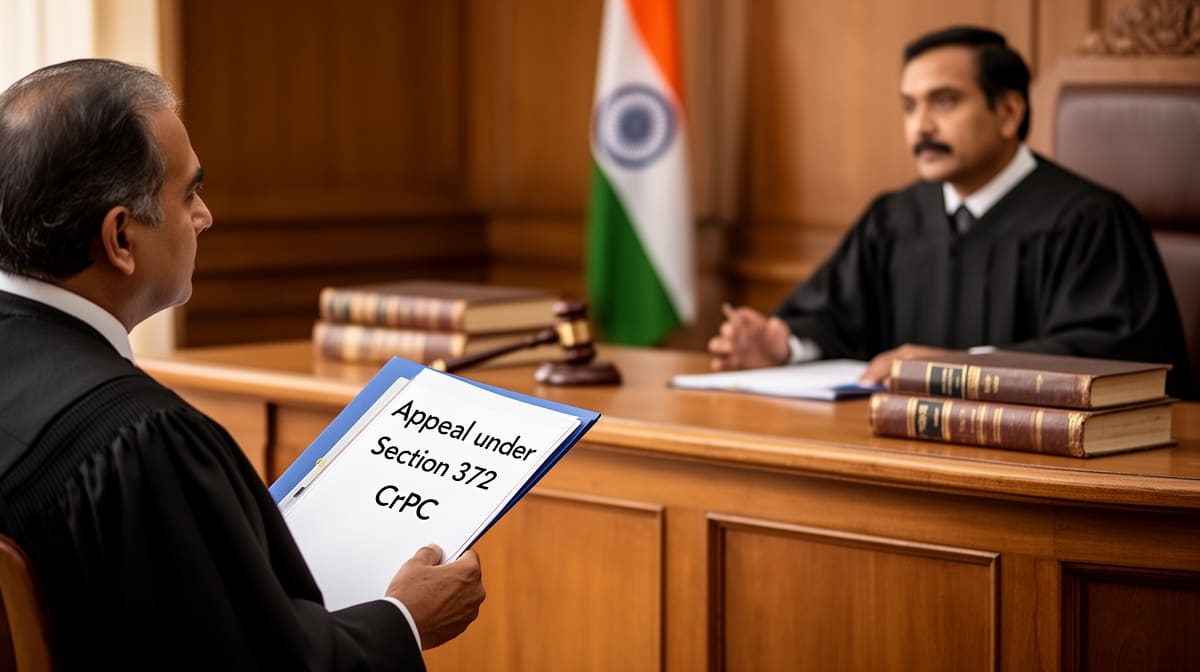
The Punjab High Court has affirmed that a victim of a criminal offence possesses an unconditional statutory right to file an appeal against an order of acquittal directly before the Court of Sessions under Section 372 of the Code of Criminal Procedure, 1973, without requiring prior special leave from the High Court. This landmark clarification resolves long-standing procedural uncertainty and aligns victim rights with constitutional principles of access to justice.
Background & Facts
The Dispute
The present matter arose from a criminal case filed under Sections 323, 452, 148, 149, 506, and 120B of the Indian Penal Code (IPC), wherein the respondents were acquitted by the trial court. The appellant, who was the complainant and victim in the case, sought to challenge the acquittal. Initially, the appellant filed an application before the Punjab and Haryana High Court seeking special leave to appeal under Section 378(4) of the CrPC, which historically governed appeals by victims in private complaint cases.
Key Facts
- The original criminal complaint was filed under Sections 323, 452, 148, 149, 506, and 120B IPC
- The trial court acquitted all respondents on 28.11.2018
- The appellant filed an application before the High Court on 28.11.2018 seeking leave to appeal under Section 378(4) CrPC
- The High Court, by its order dated 28.11.2018, treated the application as a revision petition and assigned it as CRA-AS-166-2018
- The appellant relied on the Supreme Court’s judgment in M/s. Celestium Financial v. A. Gnanasekaran (2025(3) RCR (Criminal) 208) to argue that Section 372 CrPC now provides an independent right of appeal
Procedural History
- Date of offence: Not specified in judgment
- Date of trial court acquittal: Prior to 28.11.2018
- 28.11.2018: High Court treated application as revision petition and assigned case number CRA-AS-166-2018
- 10.04.2026: Hearing before Punjab and Haryana High Court on the maintainability of the appeal
- 10.04.2026: Judgment delivered by Justice Sukhvinder Kaur
The Parties' Positions
For the Appellant
The appellant, acting as the victim-complainant, contended that the judgment in M/s. Celestium Financial v. A. Gnanasekaran had fundamentally altered the legal landscape by recognizing an absolute right of appeal under Section 372 CrPC. He argued that the prior requirement of seeking special leave under Section 378(4) was no longer applicable, and that his application should be treated as a direct appeal under Section 372.
For the Respondent
The respondents did not file any written submissions. The judgment indicates no opposition was raised before the Court.
Relief Sought
The appellant sought to have his application treated as a valid appeal under Section 372 CrPC, enabling the Sessions Court to hear the merits of the acquittal order without requiring prior leave from the High Court.
The Legal Issue
Can a victim-complainant file a direct appeal against an order of acquittal under Section 372 of the CrPC, without first obtaining special leave under Section 378(4)?
Arguments Presented
For the Appellant
The appellant relied on the Supreme Court’s judgment in M/s. Celestium Financial v. A. Gnanasekaran, which held that Section 372 CrPC confers an unconditional statutory right upon victims to appeal acquittals directly to the Court of Sessions. The appellant argued that this right is independent of Section 378(4), which applies only to the State or complainant seeking leave to appeal. He emphasized that the Parliament’s insertion of the proviso to Section 372 was intended to elevate the victim’s position to parity with the accused, who enjoys an automatic right of appeal under Section 374. The appellant further cited two co-ordinate Bench decisions of this Court - Raj Kumar v. Rajender and Satish Kumar v. Jugal Kishore - which had already applied the Celestium Financial principle to treat similar applications as appeals under Section 372.
For the Respondent
No arguments were presented by the respondents.
The Court's Analysis
The Court undertook a detailed analysis of the Supreme Court’s reasoning in M/s. Celestium Financial v. A. Gnanasekaran, particularly focusing on the five key observations made by the Apex Court regarding the legislative intent behind Section 372. The Court noted that the Supreme Court had explicitly rejected the notion that victims must seek leave under Section 378(4), holding that such a requirement would nullify the very purpose of the proviso to Section 372.
"The victim of a crime must have an absolute right to prefer an appeal which cannot be circumscribed by any condition precedent."
The Court emphasized that the Parliament, by inserting the proviso to Section 372, intended to create a superior and independent right for victims, distinct from the conditional rights of the State or complainant under Section 378. The Court further observed that in cases arising under Section 138 of the Negotiable Instruments Act - where the complaint is inherently private and the State is not a party - the victim is the sole aggrieved party, making the application of Section 372 even more compelling.
The Court also noted that the earlier Full Bench decision in M/s Tata Steel Limited v. M/s Atma Tube Produced Limited had been effectively overruled by the Supreme Court’s subsequent pronouncement. The Punjab and Haryana High Court affirmed that co-ordinate Benches had already begun applying the Celestium Financial principle, and that consistency demanded its adoption in the present case.
The Court clarified that its order did not express any opinion on the merits of the acquittal, nor did it decide whether the appeal would succeed. Its sole function was to determine the procedural route available to the victim.
The Verdict
The appellant’s application is treated as an appeal filed under Section 372 of the CrPC. The learned Sessions Judge, Ambala, is directed to either decide the appeal himself or entrust it to an appropriate court for disposal. The Registry is directed to forward the complete paper-book and record to the Sessions Judge, Ambala, forthwith. The appellant is directed to appear before the Sessions Court, Ambala, on 22.05.2026, in person or through counsel.
What This Means For Similar Cases
Victim Appeals No Longer Require Special Leave
- Practitioners must now file appeals against acquittals directly under Section 372 CrPC before the Court of Sessions, without applying for leave under Section 378(4)
- Any pending applications seeking special leave under Section 378(4) in victim-initiated acquittal challenges must be reclassified as appeals under Section 372
- The limitation period for filing such appeals begins from the date of the acquittal order, not from the date of denial of leave
Statutory Right Supersedes Judicial Discretion
- The right under Section 372 is absolute and non-discretionary; courts cannot impose additional conditions or procedural hurdles
- The victim’s right to appeal is now on par with the accused’s right under Section 374, reinforcing the principle of equal access to justice
- This applies to all offences under the IPC, including those tried as private complaints (e.g., Section 138 NI Act, Section 498A IPC)
Procedural Efficiency and Case Management
- Sessions Courts must now be prepared to hear appeals from victims without waiting for High Court leave
- Registry offices must ensure prompt transmission of case records to Sessions Courts upon filing of Section 372 appeals
- Legal aid providers and victim support organizations must be informed of this change to assist complainants in timely filing