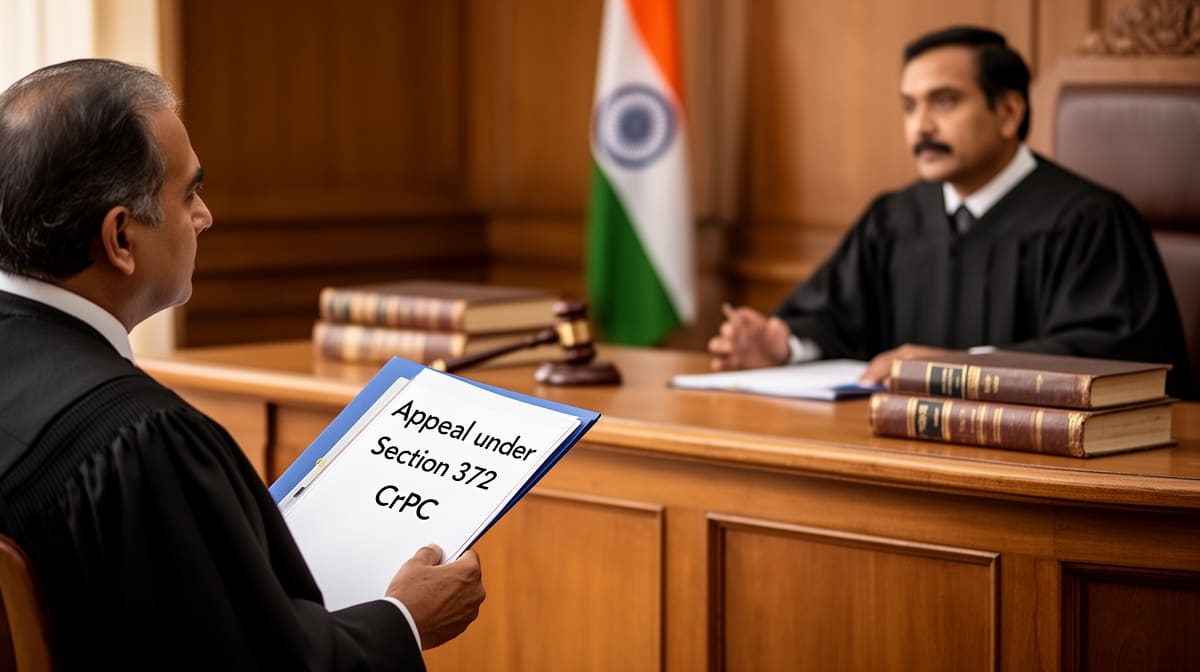
The Madhya Pradesh High Court has clarified that a complainant who is also a victim in a criminal case under Section 420 IPC possesses an independent statutory right to appeal an acquittal under the proviso to Section 372 of the Code of Criminal Procedure, 1973, without needing to invoke Section 378(4). This ruling resolves a procedural ambiguity and reinforces the expanded victim-centric framework introduced by the 2009 amendments to the CrPC.
Background & Facts
The Dispute
The present criminal appeal was filed by the complainant, Vinay Kumar Dubey and others, against an order of acquittal passed by the Judicial Magistrate First Class, Jabalpur, in Criminal Complaint Case No. 3316849/2009. The accused, Premlata Pathak and others, were acquitted of the offence under Section 420 IPC (cheating and dishonestly inducing delivery of property) after a trial based on a private complaint filed by the complainants.
Key Facts
- The private complaint was filed alleging that the accused had dishonestly induced the complainants to transfer money and property under false pretences, with no intention to perform the promised obligations.
- The trial court, after recording evidence and hearing arguments, acquitted the accused on 06.10.2023, holding that the prosecution failed to prove the essential ingredients of Section 420 IPC beyond reasonable doubt.
- The complainants, who were also the victims of the alleged fraud, filed Criminal Appeal No. 15234 of 2023 under Section 378(4) of the CrPC, seeking reversal of the acquittal.
- No advocate appeared on behalf of the appellants during the hearing before the High Court.
Procedural History
- 2009: Private complaint filed under Section 200 CrPC before Judicial Magistrate First Class, Jabalpur (Case No. 3316849/2009)
- 06.10.2023: Trial Court acquitted the accused under Section 420 IPC
- 13.05.2023: Criminal Appeal No. 15234 of 2023 filed before the High Court of Madhya Pradesh at Jabalpur under Section 378(4) CrPC
- 13.05.2026: Hearing before Justice Rajendra Kumar Vani
Relief Sought
The complainant-appellants sought setting aside of the acquittal order and a direction for retrial or conviction of the accused under Section 420 IPC.
The Legal Issue
The central question was whether a complainant-victim in a case under Section 420 IPC can prefer an appeal against an order of acquittal under the proviso to Section 372 of the CrPC, or whether such an appeal is restricted to Section 378(4) CrPC, which requires special leave.
Arguments Presented
For the Appellant/Petitioner
The appellant, though unrepresented, had filed the appeal under Section 378(4) CrPC, implicitly relying on the traditional view that only the State or a complainant with special leave could appeal an acquittal. No specific statutory or precedential arguments were advanced during the hearing.
For the Respondent/State
No appearance was made on behalf of the respondents or the State. No counter-arguments were presented.
The Court's Analysis
The Court examined the maintainability of the appeal not on the merits of the acquittal, but on the procedural question of whether the appeal was correctly filed under Section 378(4) CrPC. The Court relied on the binding precedent of the Supreme Court in Celestium Financial v. A. Gnanasekaran (2025 SCC Online SC 1320), which squarely addressed the scope of the proviso to Section 372 CrPC.
"In the absence of the proviso to Section 372, a victim of an offence could not have filed an appeal as such, unless he was also a complainant, in which event he could maintain an appeal if special leave to appeal had been granted by the High Court... On the other hand, if the victim of an offence... proceeds under the proviso to Section 372 of the CrPC, then... such a victim need not seek special leave to appeal from the High Court."
The Court observed that Section 420 IPC is a non-bailable, cognizable offence where the victim is often the complainant. The proviso to Section 372 CrPC, inserted with effect from 31.12.2009, was designed to empower victims to challenge acquittals independently, irrespective of their status as complainants. The Court held that the complainant in the present case, having suffered the direct consequences of the alleged cheating, qualifies as a victim under Section 2(wa) CrPC.
The Court further noted that Section 378(4) CrPC, which requires special leave, is not the exclusive route for a victim seeking to appeal an acquittal. The proviso to Section 372 CrPC provides a direct, self-contained remedy. The Court emphasized that the legislative intent behind the 2009 amendment was to remove procedural barriers for victims, and this intent must be given full effect.
The Verdict
The appeal filed under Section 378(4) CrPC is dismissed as misdirected. The complainant-appellant is granted liberty to file an appeal under the proviso to Section 372 CrPC before the competent Appellate Court within four months from today. If the appeal is filed within this period, the issue of limitation shall not be raised by the respondents or the Appellate Court. If the appeal was already filed but limitation was pending adjudication, the Appellate Court shall decide limitation as per law. Certified copies of documents shall be returned to the appellant. The trial court record shall be sent back immediately.
What This Means For Similar Cases
Victim Status Trumps Complainant Status for Appeal Rights
- Practitioners must now treat the victim status under Section 2(wa) CrPC as the primary basis for filing an appeal against acquittal, not merely the complainant status
- Even if the complainant is not the victim (e.g., a third-party informant), only the actual victim may invoke the proviso to Section 372
- In Section 420 IPC cases, the victim is almost always the complainant - this dual status strengthens the right to appeal under the proviso
Procedural Efficiency Over Technicality
- Appeals under Section 378(4) CrPC require special leave - a time-consuming, discretionary process
- Appeals under proviso to Section 372 CrPC are summary, non-discretionary, and do not require leave
- Lawyers should now routinely file appeals under Section 372 proviso in all acquittal cases involving victims, even if the complainant has already filed under Section 378(4)
- Courts must not dismiss appeals under Section 372 proviso on grounds of delay if filed within the four-month window granted by this judgment
Clarification on BNSS Transition
- The judgment explicitly references the Bharatiya Nagarik Suraksha Sanhita (BNSS), 2023, which replaces CrPC
- Section 413 BNSS corresponds to Section 372 CrPC - the legal principle remains unchanged
- Practitioners must update their pleadings to cite Section 413 BNSS in cases filed after July 1, 2024, but the precedent applies retroactively to cases initiated under CrPC