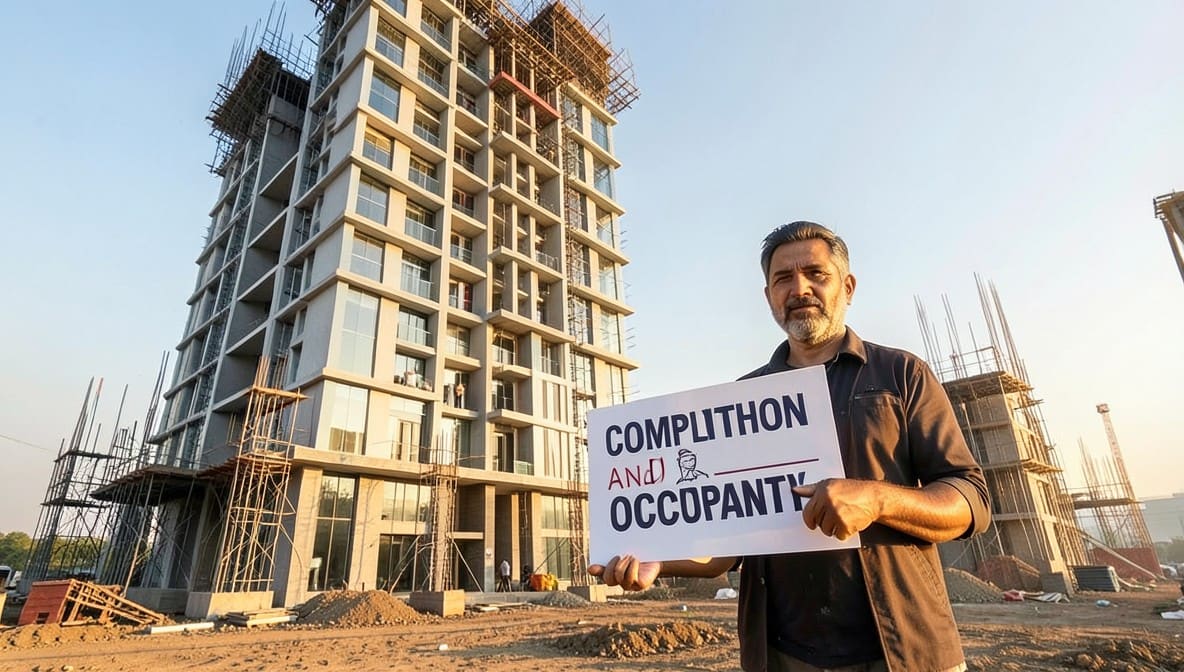
The National Consumer Disputes Redressal Commission (NCDRC) held that Maharashtra Housing and Area Development Authority (MHADA) rendered deficient service and adopted unfair trade practice by unilaterally revising construction costs downward after executing a lease deed, thereby creating an additional liability. The Commission directed MHADA to refund Rs.1,09,50,015 paid under protest by Meera Cooperative Housing Society Ltd. along with Rs.12,79,084 towards erroneously recovered ground rent, both with 6% simple interest from respective payment dates.
Background & Facts
The Dispute
Meera Cooperative Housing Society Ltd. (Complainant) entered into a lease agreement with Maharashtra Housing and Area Development Authority (MHADA) on 29.06.2002 for allotment of land in Oshiwara, Mumbai, to construct a municipal market. The Complainant alleged MHADA subsequently revised the construction cost downward from Rs.13,000 per sq.m to Rs.8,608 per sq.m via letter dated 15.03.2004, demanding differential payment of Rs.1,09,50,015, which was paid under protest on 11.02.2016. MHADA later demanded Rs.4,68,17,134 towards interest via letter dated 29.03.2017.
Key Facts
- The Complainant, a society registered under Maharashtra Cooperative Societies Act, 1960, applied to Government of Maharashtra (GoM) on 10.05.2000 for plot allotment to construct a building for its members.
- GoM directed MHADA on 05.06.2000 to process the application and submit a feasibility report.
- MHADA submitted report on 11.09.2000 recommending premium of Rs.3,226 per sq.m and construction cost of Rs.15,488 per sq.m for the municipal market.
- Allotment letter dated 20.06.2002 allotted plot at provisional rate of Rs.7,350 per sq.m.
- MHADA's letter dated 28.06.2002 calculated premium component at Rs.5,11,63,350, construction cost for 40% of plot area at Rs.3,61,97,200 (based on Rs.13,000 per sq.m), resulting in net premium payable of Rs.1,49,66,150.
- Lease Deed dated 29.06.2002 executed for 30 years, recording premium fixed at Rs.7,350 per sq.m for 6961 sq.m, annual lease rent of Rs.12,79,084, and nominal rent of Rs.30 per annum. The Deed stated Complainant had paid "full price amount of lease premium and lease rent" and contained no clause empowering MHADA to unilaterally revise rates.
- Complainant paid Rs.3,22,35,800 as premium as per contemporaneous record.
- Complainant constructed municipal market at own cost and handed possession to Brihanmumbai Municipal Corporation (BMC) on 13.05.2005; Occupation Certificate issued by BMC on same date.
- MHADA issued NOC to BMC for Occupation Certificate, confirming no dues pending.
- By letter dated 15.03.2004, MHADA revised construction cost to Rs.8,608 per sq.m and demanded differential amount of Rs.1,09,50,015 payable within 30 days.
- Complainant protested this revision via letter dated 06.08.2004.
- MHADA sent reminders on 30.05.2013 (amount due Rs.3,42,27,680 including principal and interest) and 19.01.2016 (amount due Rs.5,21,98,591).
- Complainant paid Rs.1,09,50,015 on 11.02.2016 expressly "under protest" and sought refund.
- MHADA demanded Rs.4,68,17,134 via letter dated 29.03.2017, comprising principal, interest, and protection wall construction cost.
- Notice issued to MHADA on 08.01.2018.
Procedural History
- 10.05.2000: Complainant requested plot allotment from GoM
- 05.06.2000: GoM directed MHADA to process application
- 11.09.2000: MHADA submitted feasibility report to GoM
- 20.06.2002: MHADA issued allotment letter at provisional rate
- 28.06.2002: MHADA worked out financial terms based on Rs.13,000/sq.m construction cost
- 29.06.2002: Lease Deed executed between parties
- 13.05.2005: Construction completed and handed over to BMC; Occupation Certificate issued
- 15.03.2004: MHADA revised construction cost and demanded differential amount
- 06.08.2004: Complainant protested MHADA's revision
- 30.05.2013: MHADA reminded of amount due including interest
- 19.01.2016: MHADA demanded Rs.5,21,98,591
- 11.02.2016: Complainant paid Rs.1,09,50,015 under protest
- 29.03.2017: MHADA demanded Rs.4,68,17,134
- 08.01.2018: Notice issued to MHADA
- 11.08.2026: Case heard on merits; judgment reserved
- 08.10.2026: Judgment pronounced
Relief Sought
Complainant sought: (a) Declaration that MHADA rendered deficient service and adopted unfair trade practice; (b) Refund of Rs.1,09,50,015 paid under protest with interest; (c) Refund of Rs.12,79,084 towards erroneously recovered ground rent; (d) Compensation of Rs.10,00,000 for mental harassment; (e) Direction that no amount be demanded by MHADA; (f) Direction to MHADA to refund amounts with interest; (g) Any other relief deemed fit.
The Legal Issue
The central question was whether MHADA's unilateral downward revision of construction cost from Rs.13,000 per sq.m to Rs.8,608 per sq.m after execution of the Lease Deed dated 29.06.2002 constituted deficient service and unfair trade practice under the Consumer Protection Act, 1986, and whether the complaint was maintainable despite limitation arguments and lack of prior statutory notice under the Maharashtra Housing and Area Development Act, 1976.
Arguments Presented
For the Complainant
The Complainant contended that the Lease Deed dated 29.06.2002 was a complete and final contract superseding all prior negotiations, and MHADA had no right under the Deed to unilaterally revise rates. It argued MHADA's action of demanding additional amounts based on internal Resolution No. 5981 dated 10.11.2003 was illegal and amounted to deficiency in service and unfair trade practice. The Complainant emphasized that the payment of Rs.1,09,50,015 on 11.02.2016 was made expressly "under protest" and clearly stated non-liability, thus not validating MHADA's claim. It further argued that MHADA's issuance of NOC for Occupation Certificate constituted an admission that all dues were paid, estopping MHADA from claiming outstanding amounts. Regarding limitation, the Complainant asserted that MHADA's persistent illegal demands from 2002 onwards created a continuing cause of action, defeating limitation objections.
For the Respondent/MHADA
MHADA contended that the construction cost was always "provisional" and subject to final determination by the Authority, and the Lease Deed did not mention the Rs.13,000 per sq.m rate, thus MHADA was within its rights to apply Resolution No. 5981 dated 10.11.2003. It argued the Complainant acquiesced to demands by making the payment and was now seeking unjust enrichment. MHADA maintained the complaint was barred by limitation as the cause of action arose on 15.03.2004 when the first demand for differential amount was made. It further contended the complaint was not maintainable for want of mandatory two months' statutory notice under Section 173 of the Maharashtra Housing and Area Development Act, 1976, and that the dispute pertained to a pricing issue outside the ambit of the Consumer Protection Act as MHADA did not render any "service" to the Complainant.
The Court's Analysis
The NCDRC first addressed maintainability, rejecting MHADA's limitation objection. It held that MHADA's persistent demands starting from 2002, including the 2004 demand and subsequent interest demands, established a continuing cause of action, noting: "The OPs have raised a series of demands, starting from 2002, then 2004, then 2013, 2016, and 2017, each giving rise to a fresh cause of action. A continuing cause of action is established when the OPs persist in their illegal demands." Regarding Section 173 of the MHADA Act, the Commission relied on the Supreme Court's decision in Ethiopian Airlines v. Ganesh Narain Saboo, (2011) 8 SCC 539, to hold that consumer proceedings under the Consumer Protection Act are a special remedy and statutory notice requirements applicable to civil actions cannot be mechanically imported to defeat the special remedy created under the Act.
On the core issue, the Commission found the Lease Deed dated 29.06.2002 superseded all prior allotment letters and negotiations. It emphasized: "The Lease Deed clearly states that the Complainant had paid the 'full price amount of lease premium and lease rent.' It does not contain any clause empowering the OPs to unilaterally revise the rates or demand additional amounts for the construction of the municipal market." The Commission held MHADA estopped from challenging the lease terms after accepting the Complainant's performance: "The Complainant had constructed the Municipal Market and handed it over to BMC free of cost. It is impermissible for the Opposite Party, after accepting that performance, to retrospectively rewrite the financial terms." It further concluded that MHADA's unilateral downward revision of construction cost after lease execution was legally unsustainable, stating: "A subsequent resolution may operate prospectively in accordance with law; it cannot be utilised as an instrument for reopening concluded contracts and creating liabilities which did not exist on the date of the transaction." The Commission affirmed that MHADA, as a statutory authority providing services relating to allotment, development, and management of properties, rendered "service" within the meaning of Section 2(1)(o) of the Consumer Protection Act, 1986, citing LDA v. M.K. Gupta, (1994) 1 SCC 243.
The Verdict
The Complainant succeeded in its core claims. The NCDRC held that MHADA rendered deficient service and adopted unfair trade practice by unilaterally revising construction cost from Rs.13,000 per sq.m to Rs.8,608 per sq.m after lease execution and demanding differential amount. It directed MHADA to refund Rs.1,09,50,015 (Rupees One Crore Nine Lakh Fifty Thousand Fifteen Only) paid under protest by the Complainant on 11.02.2016, along with simple interest at 6% per annum from the date of payment until actual refund. Additionally, MHADA was directed to refund Rs.12,79,084 (Rupees Twelve Lakhs Seventy Nine Thousand Eighty Four Only) towards erroneously recovered ground rent, with simple interest at 6% per annum from 29.06.2002 (date of Lease Deed execution) until actual refund. The Commission ordered that payments under this direction shall be made within two months from the judgment date (08.10.2026), failing which the total amounts payable shall carry interest at 9% per annum until actual payment. Parties were directed to bear their respective legal costs.
What This Means For Similar Cases
Contractual Sanctity Post-Execution
This judgment reinforces that statutory authorities cannot unilaterally alter financial terms of executed contracts through subsequent policy resolutions. Practitioners must ensure lease/deed agreements explicitly record all agreed terms, including construction costs and premiums, to prevent retrospective revisions. Where authorities attempt post-execution alterations, the payment made under protest preserves the right to refund, as established by the NCDRC's reliance on the principle that "payment made under protest cannot be converted into an admission of liability."
Continuing Cause of Action Defeats Limitation
The NCDRC's rejection of the limitation objection provides a crucial template for cases involving persistent demands. Lawyers should document all demand notices and payments made under protest to demonstrate a continuing cause of action, particularly when authorities revive stale claims after years. As the Commission held: "The OPs have not been taken by surprise and have been fully aware of the dispute," negating limitation defenses where authorities remain engaged in the controversy.
Statutory Authorities as "Service Providers" Under CPA
The judgment clarifies that entities like MHADA, engaged in land allotment, development, and property management, render "service" within the Consumer Protection Act's scope. This expands consumer remedies against statutory authorities beyond traditional trader-service provider dynamics. Practitioners should scrutinize whether authorities perform functions like site allotment, infrastructure development, or property management that confer tangible benefits to consumers, thereby attracting CPA jurisdiction even where core activities involve immovable property.
NCDRC's Approach to Interest on Refunds
The Commission's award of 6% simple interest from the respective payment dates (11.02.2016 for protest payment and 29.06.2002 for ground rent) provides a clear benchmark for interest calculation in refund cases. Notably, it rejected compound interest claims, applying simple interest only until actual payment, with a penal rate of 9% p.a. applicable only after the two-month compliance period expires. This structured approach aids in precise quantification of relief in similar consumer disputes involving delayed refunds.