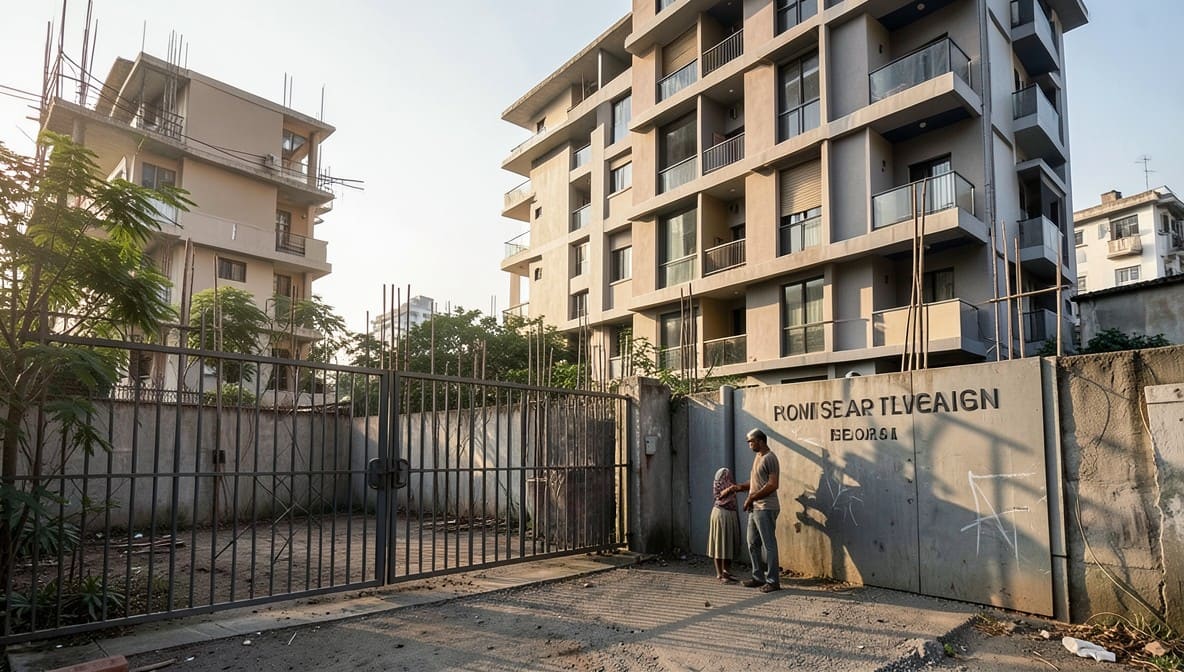
The Maharashtra State Consumer Commission has affirmed that developers in housing redevelopment projects are liable for deficiency in service when they fail to deliver promised flats or pay agreed transit compensation. This judgment clarifies that members surrendering their existing homes for redevelopment are unequivocally consumers under the Consumer Protection Act, 1986, and cannot be dismissed as mere investors.
Background & Facts
The Dispute
The dispute arose from the redevelopment of The Bombay Postal Employees Co-operative Housing Society Ltd. in Andheri (East), Mumbai. The Complainants, Smt. Parag Kamlesh Doshi and Mr. Kamlesh Shashikant Doshi, were members of the Society who owned two residential units: Flat No. 3 on the first floor, A-Wing (490 sq.ft. carpet area) and Flat No. 25 on the ground floor, D-Wing (335 sq.ft. carpet area). The Society entered into a Development Agreement dated 07.08.2007 with M/s. Rite Developers, a partnership firm comprising Opponents No. 1 to 3, for the redevelopment of Wings A, B, C, and D.
Key Facts
- On 11.05.2009, a Tripartite Agreement was executed between the Society, M/s. Rite Developers, and the Complainants for Flat No. 3, A-Wing.
- Clause 4 of the Tripartite Agreement mandated that the Developers pay Rs. 20,000 per month as transit compensation for 24 months, increasing by 20% thereafter until possession of the new flat was handed over.
- Clause 5 mandated payment of a corpus fund of Rs. 1,98,470 upon receipt of vacant possession.
- The Complainants vacated Flat No. 3 on 15.05.2009 and handed over possession to the Developers.
- The Developers paid the corpus fund and transit compensation of Rs. 20,000/month for 24 months (up to 14.05.2011), then increased it to Rs. 24,000/month for the next 12 months (up to June 2012).
- From July 2012 onwards, the Developers ceased payment of transit compensation.
- The Complainants were promised Flat No. 503, A-Wing (548 sq.ft. carpet area) as their new allotment under the Tripartite Agreement.
- The Developers completed construction of A-Wing in 2014 but refused to hand over possession of Flat No. 503 to the Complainants.
- The Developers sold Flat No. 503 to a third party, Mr. Pritesh S. Vakil, without the Complainants’ consent.
- The Complainants also claimed entitlement to a new flat in lieu of Flat No. 25, D-Wing, which they purchased from Parul Harish Patel via an Agreement for Sale dated 18.06.2009, but no Tripartite Agreement was executed for this flat.
- The Complainants sent multiple legal notices dated 07.04.2015, 15.03.2017, and others, demanding possession, payment of arrears, and execution of agreements.
- The Developers denied liability, claiming the Complainants were investors, not consumers, and that the purchase of Flat No. 25 was not disclosed to them until 2015.
- The Developers produced deeds dated 31.05.2014 wherein the Complainants transferred rights in two rooms (Room No. 9 and 10) for consideration, but these were unrelated to the Tripartite Agreement.
Procedural History
- 11.05.2009: Tripartite Agreement executed for Flat No. 3, A-Wing.
- 15.05.2009: Complainants vacated Flat No. 3 and handed possession to Developers.
- 04.10.2009: Share certificate for Flat No. 25, D-Wing transferred to Complainants by the Society.
- 14.05.2011: End of initial 24-month transit compensation period.
- June 2012: Last payment of increased transit compensation (Rs. 24,000/month).
- 2014: A-Wing construction completed; Flat No. 503 sold to third party.
- 18.02.2015: Complainants wrote to Society seeking original Tripartite Agreement.
- 02.03.2015: Second letter to Society regarding the Agreement.
- 07.04.2015: Legal notice sent to Developers demanding possession, arrears, and agreement for Flat No. 25.
- 27.04.2015: Developers replied, offering Rs. 40,00,000 for surrender of Room Nos. 9 and 10.
- 06.06.2015: Complainants’ rejoinder sent.
- 10.08.2015: Developers invoked arbitration under deeds dated 31.05.2014.
- 08.11.2016: Joint meeting held at neighbor’s residence; proposed settlement of Rs. 51,00,000.
- 20.03.2017: Developers replied to notice, denying partnership status.
- 13.05.2026: Judgment delivered by Maharashtra State Consumer Commission.
The Parties' Positions
For the Complainants
- They are consumers under Section 2(d) of the Consumer Protection Act, 1986.
- They surrendered their only residential property (Flat No. 3) in reliance on the Developers’ promises.
- The Developers breached the Tripartite Agreement by failing to deliver Flat No. 503 and ceasing transit compensation.
- The sale of Flat No. 503 to a third party constitutes fraud and unfair trade practice.
- They are entitled to the corpus fund, transit compensation arrears, interest, and compensation for mental agony.
- The failure to execute a Tripartite Agreement for Flat No. 25 further aggravates the deficiency.
For the Respondents (Developers)
- The Complainants are not consumers but investors with multiple properties.
- The purchase of Flat No. 25 was not disclosed to them until 2015, and no Tripartite Agreement was executed for it.
- The Complainants had already transferred rights in Room Nos. 9 and 10 via registered deeds in 2014.
- The claim is barred by limitation due to 6 - 9 years of inaction.
- The Society, not the Developers, is responsible for allotment of flats.
- The Complainants hindered redevelopment and are liable for liquidated damages under the Development Agreement.
Relief Sought
The Complainants sought:
- Handover of Flat No. 503, A-Wing, or its market value.
- Payment of transit compensation arrears from July 2012 to date at Rs. 24,000/month with interest.
- Payment of corpus fund for Flat No. 25, D-Wing.
- Compensation for mental agony and harassment.
- Litigation costs.
- Declaration of deficiency in service and unfair trade practice.
The Legal Issue
The central question was whether members of a co-operative housing society who surrender their residential units for redevelopment are 'consumers' under the Consumer Protection Act, 1986, and whether a developer’s failure to deliver the promised flat and pay agreed transit compensation constitutes deficiency in service.
Arguments Presented
For the Appellant/Petitioner
The Complainants relied on the settled principle that redevelopment agreements involve a service relationship where the consideration is the surrender of a residential unit. They cited State of Maharashtra v. M/s. R. K. Builders and Smt. Sunita Devi v. M/s. DLF Ltd. to argue that the transaction is not commercial but residential, and the mere ownership of multiple properties does not negate consumer status. They emphasized that the Developers’ sale of the promised flat to a third party was fraudulent and violated the spirit of the Tripartite Agreement.
For the Respondent/State
The Developers argued that the Complainants were real estate investors due to their ownership of multiple flats and rooms, and that the purchase of Flat No. 25 was not communicated to them, making any obligation for that unit void. They contended that the Complainants’ delay of over six years in raising the issue barred the claim under the Limitation Act, and that the deeds of surrender of Room Nos. 9 and 10 indicated a commercial intent.
The Court's Analysis
The Commission rejected the Developers’ argument that the Complainants were investors. It held that the nature of the transaction - not the number of properties owned - determines consumer status. The Complainants surrendered their only residential unit (Flat No. 3) in exchange for a promised new flat and monthly compensation, which is a classic service transaction under Section 2(d) of the Act.
"The relationship between a housing society member and a developer under a redevelopment agreement is well-settled. The existing members of a society surrender their original homes - their only tangible security - to the developer in exchange for a new, redeveloped unit and temporary transit facilities. This transaction is a 'service' as defined under the Act."
The Commission found the Developers’ sale of Flat No. 503 to a third party to be a gross violation of trust and an unfair trade practice. The failure to register the Tripartite Agreement and conceal the original document further demonstrated bad faith. The Developers’ claim of limitation was dismissed because the cause of action continued with each month of non-payment and non-delivery, and the Complainants had persistently pursued redressal since 2015.
The Commission also noted that while the Society had a supervisory role, the primary contractual obligations rested with the Developers. The failure to pay transit compensation from July 2012 and the refusal to deliver the promised flat constituted clear deficiency in service under Section 2(g) of the Act.
The Verdict
The Complainants succeeded in part. The Commission ordered:
- The Opponents No. 1 to 3 to hand over peaceful and vacant possession of Flat No. 503, A-Wing, or an identical flat of 548 sq.ft. carpet area in the same building.
- Alternatively, if no such flat is available, the Opponents shall pay the market value of a 548 sq.ft. carpet area flat in the same locality as per the Ready Reckoner on the date of the order.
- Payment of transit compensation arrears from July 2012 until actual settlement at Rs. 24,000 per month, with 9% interest per annum, within three months of the order.
- Payment of Rs. 20,000 as compensation for mental agony and harassment.
- Payment of Rs. 25,000 towards litigation costs.
What This Means For Similar Cases
Consumer Status Is Not Denied by Multiple Property Ownership
- Practitioners must argue that ownership of multiple residential units does not convert a person into an investor under the CPA 1986.
- The key test is whether the transaction involves surrender of a primary residence for redevelopment, not the number of properties owned.
- Evidence of commercial intent (e.g., frequent buying/selling, rental income from all units) must be proven by the developer - mere possession is insufficient.
Transit Compensation Is a Core Service Obligation
- Monthly transit compensation is not a gratuitous benefit but a contractual service obligation tied to the surrender of possession.
- Failure to pay it, even after 24 months, constitutes continuing deficiency in service.
- Interest at 9% p.a. is now a standard remedy for delayed payments in redevelopment cases.
Sale of Redeveloped Flat to Third Party Is Fraudulent
- Developers cannot sell flats earmarked for original members under Tripartite Agreements.
- Such acts attract liability for unfair trade practice and mental agony compensation.
- Courts will not permit developers to profit from their own breach by transferring promised units to third parties.