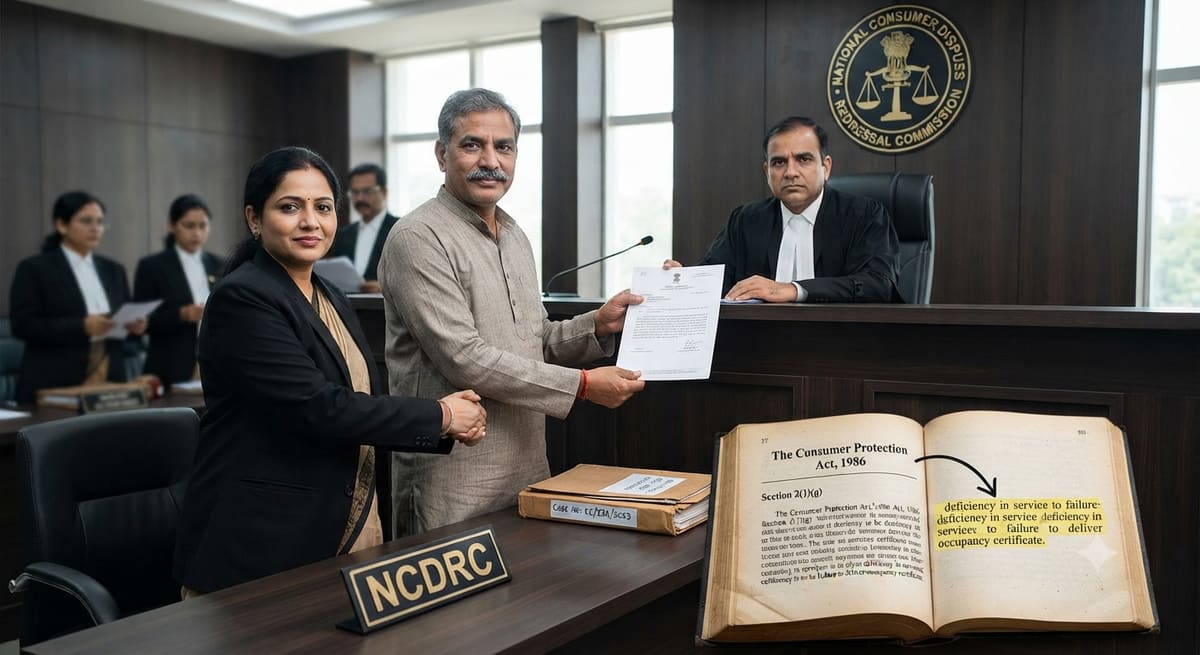
The National Consumer Disputes Redressal Commission has reaffirmed that builders cannot unilaterally cancel allotments after substantial payments are made, nor can they retain excess amounts without justification. This judgment clarifies the interplay between contractual obligations, statutory consumer rights, and the limits of forfeiture under the Consumer Protection Act, 2019.
Background & Facts
The Dispute
The dispute arose between the appellants, Experion Developers Private Limited and Experion Hospitality Private Limited (collectively "OPs"), and the respondents, Preeti Yadav and Pushpendra Kumar Yadav ("Complainants"), concerning the purchase of Flat No. 703 in Tower-2 of the "Experion Capital" project in Gomti Nagar, Lucknow. The Complainants alleged that the OPs engaged in unfair trade practices by demanding excessive payments, cancelling the allotment without legal basis, and failing to deliver possession with statutory certificates.
Key Facts
- The Complainants applied for allotment on 25.12.2017 and paid an initial amount of Rs. 5,00,000.
- Flat No. 703 was allotted on 06.01.2018, and a provisional allotment letter was issued on 17.03.2018.
- The Agreement for Sale was executed on 10.07.2018, specifying a carpet area of 111.41 sq. mts and a total sale consideration of Rs. 1,13,68,681, payable under a Construction Linked Payment Plan.
- Possession was promised on or before 30.11.2022, along with Completion Certificate (CC) and Occupancy Certificate (OC).
- The Complainants made cumulative payments totaling Rs. 1,34,98,422.11 (including TDS), which they claimed exceeded the agreed sale consideration by Rs. 21,29,741.11.
- On 05.04.2022, the OPs issued an offer of possession demanding an additional Rs. 28,81,524.70, which the Complainants rejected as arbitrary.
- On 16.09.2022, the OPs cancelled the allotment and forfeited Rs. 29,49,933, citing non-payment of the demanded amount.
- The Complainants asserted that the OPs later admitted the cancellation was erroneous and continued to communicate with them, including demanding maintenance charges in 2023.
- The Complainants made further payments in June-July 2023, bringing their total payment to Rs. 1,34,98,422.11.
- The OPs refunded Rs. 29,49,933 via RTGS/NEFT on 08.02.2024, but the Complainants returned the amount, indicating rejection of the cancellation.
- The OPs claimed to have obtained a Completion Certificate dated 07.01.2022 but failed to produce a valid Occupancy Certificate.
Procedural History
- 25.12.2017: Complainants applied for allotment.
- 06.01.2018: Flat allotted.
- 17.03.2018: Provisional allotment letter issued.
- 10.07.2018: Agreement for Sale executed.
- 05.04.2022: OPs issued offer of possession with additional demand.
- 16.09.2022: OPs cancelled allotment and forfeited Rs. 29,49,933.
- June-July 2023: Complainants made additional payments.
- 08.02.2024: OPs refunded Rs. 29,49,933; Complainants returned the amount.
- 2023: Complaint No. 257 of 2023 filed before State Consumer Disputes Redressal Commission, Uttar Pradesh.
- 07.06.2024: State Commission allowed complaint, directing possession, refund, interest, and compensation.
- 22.01.2026: First Appeal No. 567 of 2024 reserved.
- 12.05.2026: Judgment pronounced by National Consumer Disputes Redressal Commission.
Relief Sought
The Complainants sought: delivery of possession with CC and OC, refund of excess payment of Rs. 21,29,741.11 with interest, compensation for mental agony and unfair trade practice, and litigation costs. The OPs sought dismissal of the complaint on grounds of lack of jurisdiction, invalid consumer status, lawful cancellation, and absence of deficiency.
The Legal Issue
The central questions were: (1) Whether the Complainants qualify as "consumers" under the Consumer Protection Act, 2019, despite alleged speculative intent? (2) Does the State Commission have pecuniary jurisdiction when the consideration paid exceeds Rs. 50,00,000 but is below Rs. 2,00,00,000? (3) Can a builder cancel an allotment and forfeit payments after substantial performance by the buyer, and is such forfeiture reasonable? (4) Is the award of multiple compensations for a single deficiency permissible?
Arguments Presented
For the Appellant/Petitioner
The appellants contended that the complaint was not maintainable because: (a) the Complainants were investors, not consumers, as they had booked multiple units; (b) the value of consideration paid was only Rs. 98,54,888 (prior to cancellation), placing the matter below the State Commission’s jurisdiction; (c) the project was RERA-registered (UPRERAPRJ 4224), and thus the Consumer Commission lacked jurisdiction; (d) the cancellation on 16.09.2022 was lawful under Clause 14 of the Agreement and Sections 51 and 52 of the Indian Contract Act, 1872; (e) the excess payment claim was invalid as it included statutory taxes, parking, and common area charges; (f) the award of Rs. 10,00,000 compensation was arbitrary and duplicative; and (g) subsequent payments made after cancellation were unauthorized and could not revive the contract.
For the Respondent/State
The respondents argued that: (a) they were bona fide consumers, as there was no evidence of speculative intent; (b) the total consideration paid was Rs. 1,34,98,422.11, squarely within the State Commission’s jurisdiction; (c) the cancellation was invalid as the OPs continued to communicate and accept payments post-cancellation, implying revocation; (d) the OPs failed to provide a valid Occupancy Certificate, rendering the offer of possession incomplete; (e) the forfeiture of Rs. 29,49,933 was punitive and disproportionate; (f) the demand for Rs. 28,81,524.70 was arbitrary and constituted unfair trade practice; and (g) the State Commission’s order was well-reasoned and based on documentary evidence.
The Court's Analysis
The National Consumer Disputes Redressal Commission undertook a comprehensive analysis of jurisdiction, consumer status, contractual obligations, and the reasonableness of forfeiture.
On jurisdiction, the Court held that the value of consideration paid, not the value of relief claimed, determines the pecuniary jurisdiction of Consumer Fora under Section 58(1)(a)(i) of the Consumer Protection Act, 2019. The Court relied on the binding precedent in Rutu Mihir Panchal & Ors. vs. Union of India & Ors. (2025 LiveLaw (SC) 503), which clarified that the statutory intent was to adopt an objective, transaction-based standard to prevent artificial inflation of claims. The Court found that even the OPs’ own admission of Rs. 98,54,888 paid prior to cancellation placed the matter within the State Commission’s jurisdiction (above Rs. 50,00,000 and below Rs. 2,00,00,000). The subsequent payments made in 2023, accepted and acknowledged by the OPs through continued communication, formed part of the transaction and could not be excluded for jurisdictional purposes.
Regarding consumer status, the Court rejected the appellants’ claim that the Complainants were investors. The Court noted that mere assertion of multiple bookings, without documentary proof of resale intent or commercial use, was insufficient to dislodge the statutory presumption of consumer status. The Court emphasized that the Act protects individuals purchasing goods or services for personal use, and the absence of evidence to the contrary meant the Complainants were consumers.
On the validity of cancellation, the Court observed that the OPs’ conduct after 16.09.2022 - continuing to demand maintenance charges, accepting further payments, and later refunding the forfeited amount - demonstrated that the cancellation was neither final nor bona fide. The Court held that such conduct amounted to implied revocation of the cancellation. The forfeiture of Rs. 29,49,933 was found to be punitive and disproportionate, in violation of the principle laid down in Godrej Projects Development Limited v. Anil Karlekar & Ors. (2025 LiveLaw (SC) 150), which requires forfeiture to be reasonable and compensatory, not penal.
The Court also found that the offer of possession on 05.04.2022 was incomplete, as no Occupancy Certificate was produced or communicated. A mere Completion Certificate does not satisfy statutory obligations under RERA or the Act. The Court noted that the OPs failed to discharge their burden of proving delivery of a complete, legally compliant unit.
On compensation, the Court critically examined the State Commission’s award of Rs. 10,00,000 alongside interest on excess payment and delay compensation. Citing DLF Homes Panchkula Pvt. Ltd. Vs. D.S. Dhanda (CA Nos. 4910-4941 of 2019), the Court held that multiple compensations for a single deficiency are impermissible. The Court stated:
"The award of Rs. 10,00,000 as additional compensation for mental agony and unfair trade practice, when interest and refund are already being granted, amounts to double recovery and is not justifiable under the law."
The Court instead relied on Arifur Rehman Khan & Ors. vs. DLF Southern Homes Pvt Ltd & Ors. (2020) 16 SCC 512, which prescribed 6% simple interest per annum as standard delay compensation from the due date of possession until actual delivery with OC.
The Verdict
The appeal was allowed in part. The National Consumer Disputes Redressal Commission set aside the State Commission’s award of Rs. 10,00,000 compensation but upheld the core directions. The OPs are directed to: (1) deliver physical possession of Flat No. 703 with valid Completion Certificate and Occupancy Certificate within 30 days; (2) pay delay compensation at 6% simple interest per annum on Rs. 1,13,68,681 from 01.12.2022 until the date of possession with OC, payable within two months; (3) refund Rs. 21,29,741.11 with 9% simple interest per annum from the date of each deposit until refund, payable within two months; (4) pay litigation costs of Rs. 50,000. In case of default, interest on delay compensation shall increase to 9% per annum, and on refund, to 12% per annum.
What This Means For Similar Cases
Consumer Status Cannot Be Assumed Based on Alleged Speculation
- Practitioners must now demand concrete evidence - such as resale agreements, rental records, or business registrations - to challenge consumer status.
- Mere allegations of multiple bookings are insufficient; the burden lies on the builder to prove commercial intent.
- In all cases involving real estate, the default position is consumer protection unless proven otherwise.
Jurisdiction Is Determined by Actual Consideration Paid, Not Claimed Relief
- Lawyers must calculate jurisdiction based on total payments made under the agreement, including post-cancellation amounts if accepted by the builder.
- Any attempt to artificially truncate payments to avoid State Commission jurisdiction will be rejected.
- The Rutu Mihir Panchal precedent now governs all jurisdictional challenges in consumer forums.
Forfeiture Must Be Reasonable, Not Punitive
- Builders cannot forfeit more than actual loss incurred; forfeiture exceeding 10-15% of total consideration is likely to be struck down.
- Post-cancellation conduct, such as accepting payments or continuing communication, may revive the contract and invalidate forfeiture.
- All forfeiture clauses must be proportionate and documented; punitive clauses are void under Section 74 of the Indian Contract Act, 1872.
Delay Compensation Must Be Singular and Statutorily Anchored
- Multiple awards for the same deficiency (e.g., interest + compensation + costs) are impermissible.
- The 6% simple interest standard from Arifur Rehman Khan is now the benchmark for delay in possession.
- Compensation for mental agony must be exceptional and supported by medical or psychological evidence.
RERA Does Not Oust Consumer Forum Jurisdiction
- Builders cannot invoke RERA registration to avoid consumer complaints.
- The Supreme Court’s ruling in Today Homes & Infrastructure Pvt. Ltd. v. Ajay Nagpal remains binding.
- Consumers may pursue remedies under both RERA and the Consumer Protection Act simultaneously.