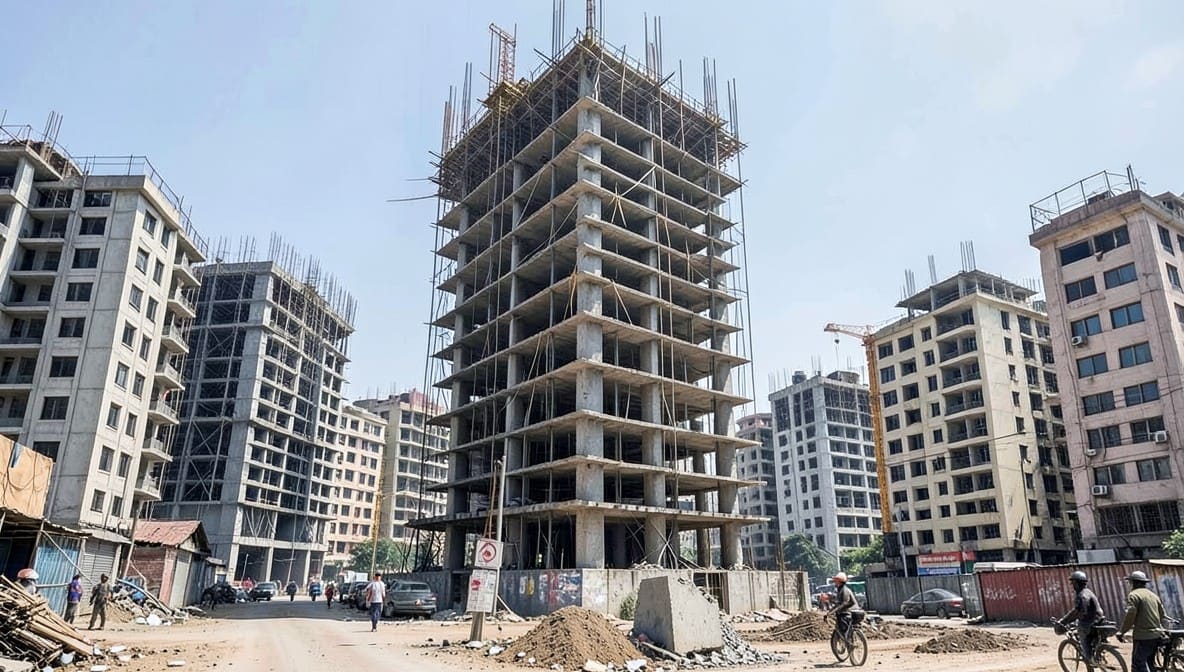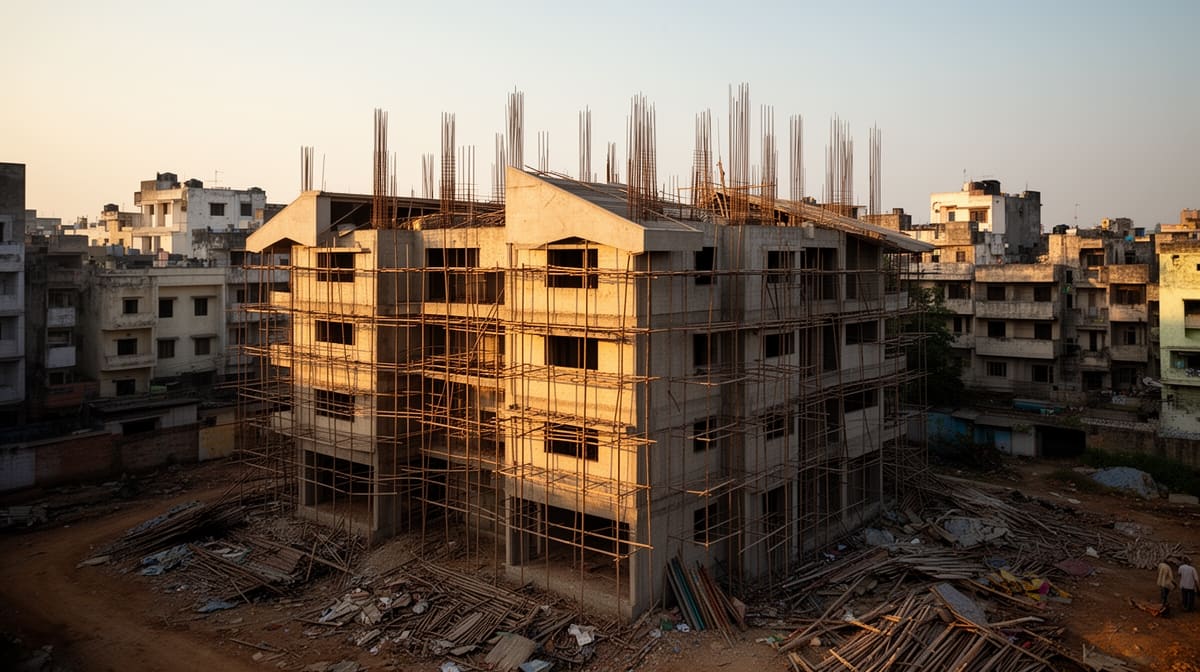
The Bombay High Court has reaffirmed that unauthorized construction cannot be shielded by the passage of time, administrative neglect, or claims of substantial investment. In a decisive ruling, the Court emphasized that binding precedents from the Supreme Court leave no room for leniency where building regulations have been flagrantly violated.
Background & Facts
The Dispute
The petitioners, residents of Nagpur, constructed structures - particularly Poonam Chamber - without obtaining statutory approvals under the Maharashtra Regional and Town Planning Act, 1966. Notices were issued by the Nagpur Municipal Corporation (NMC) in 2004, demanding demolition. Despite multiple opportunities to regularize or appeal, the petitioners withdrew a Letters Patent Appeal in 2015 and took no further legal action.
Procedural History
- 2004: NMC issued notice alleging unauthorized construction
- 2006: Petitioners filed Letters Patent Appeal (LPA No. 81/2006), later withdrawn with liberty to pursue other remedies
- 2016: Petitioners sent informal communication to NMC seeking reconsideration of plans; no formal application under Section 44 or 53(3) of the MRTP Act was filed
- 2025: NMC issued fresh notice under Circular dated 22-9-2025, invoking State Government directives
- 2026: Writ Petitions filed challenging the notice, arguing delay and lack of due process
Relief Sought
The petitioners sought quashing of the demolition notice, claiming that the passage of time, absence of prior enforcement, and investment in construction entitled them to protection. They also requested an opportunity to regularize the structure.
The Legal Issue
The central question was whether administrative delay or petitioners’ inaction can legitimize an unauthorized construction under the Maharashtra Regional and Town Planning Act, 1966, in light of binding Supreme Court rulings.
Arguments Presented
For the Petitioner
The petitioners contended that:
- The NMC’s failure to act for over a decade constituted acquiescence
- Substantial investment in construction warranted protection under principles of legitimate expectation
- The 2025 circular did not reference key Supreme Court judgments, rendering it procedurally flawed
- Withdrawal of LPA in 2015 was not an abandonment of rights but a strategic choice
They relied on Pranay Sethi to argue that inconsistent administrative action should not be used against them.
For the Respondent
The NMC and State Government argued that:
- No statutory approval was ever granted for the construction
- The petitioners never filed a formal application under Section 44 or Section 53(3) of the MRTP Act
- The 2025 circular was issued in compliance with State directives, which themselves derived authority from Supreme Court judgments
- The petitioners’ inaction after 2015 precluded any claim of legitimate expectation
They cited Sunbeam High Tech Developers and Rajendra Kumar Barjatya to assert that unauthorized construction cannot be protected by delay.
The Court's Analysis
The Court undertook a rigorous examination of Supreme Court jurisprudence on unauthorized construction. It held that the judgments in Sunbeam High Tech Developers v. Municipal Corporation of Greater Mumbai and Rajendra Kumar Barjatya v. U.P. Avas Evam Vikas Parishad are not merely persuasive but binding precedents on all municipal authorities in Maharashtra.
"In a catena of decisions, this Court has categorically held that illegally or unauthorized construction cannot be perpetuated. If the construction is made in contravention of the Acts/Rules, it would be construed as illegal and unauthorized construction, which has to be necessarily demolished. It cannot be legitimized or protected solely under the ruse of the passage of time or citing inaction of the authorities..."
The Court rejected the petitioners’ claim of legitimate expectation, noting that such doctrine cannot override statutory mandates. The absence of any formal application under Section 44 or Section 53(3) of the MRTP Act rendered any claim of regularization legally untenable.
The Court further observed that the State’s 2025 circular failed to incorporate the detailed procedural safeguards mandated in Sunbeam High Tech Developers, particularly regarding notice, opportunity to be heard, and evidence collection. However, this procedural deficiency did not benefit the petitioners, as their own conduct - withdrawal of appeal and failure to pursue remedies - had already extinguished any claim to relief.
The Court emphasized that due process must be followed, but it cannot be weaponized by those who have deliberately ignored statutory obligations for over a decade.
The Verdict
The petitioners’ challenge was dismissed. The Court held that unauthorized construction cannot be protected by delay, inaction, or lack of regularization, and that Supreme Court precedents bind municipal authorities. The petitioners were granted one final opportunity to submit documents before the NMC, subject to deposit of Rs. 10 lakh as security.
What This Means For Similar Cases
Unauthorized Construction Cannot Be Legitimized by Delay
- Practitioners must advise clients that no claim of legitimate expectation arises from administrative inaction
- Courts will not entertain arguments that "everyone else did it" or "no one stopped us"
- The burden remains on the builder to prove statutory compliance, not on authorities to prove violation
Procedural Compliance Is Non-Negotiable
- Municipalities must follow Sunbeam High Tech Developers protocols: proper notice, opportunity to respond, documented evidence
- Failure to comply by authorities does not validate the illegal construction
- Petitioners cannot exploit procedural lapses by authorities to gain substantive rights
Formal Applications Under MRTP Act Are Mandatory
-
Informal communications or letters to municipal offices do not constitute applications under Section 44 or Section 53(3)
-
Practitioners must ensure clients file formal, stamped applications with supporting documents
-
Without such filings, regularization claims are legally void
-
Always verify whether a structure has a valid sanctioned plan
-
Advise clients to act immediately upon receiving a notice - delay is fatal
-
Do not rely on oral assurances or informal correspondence from municipal officers