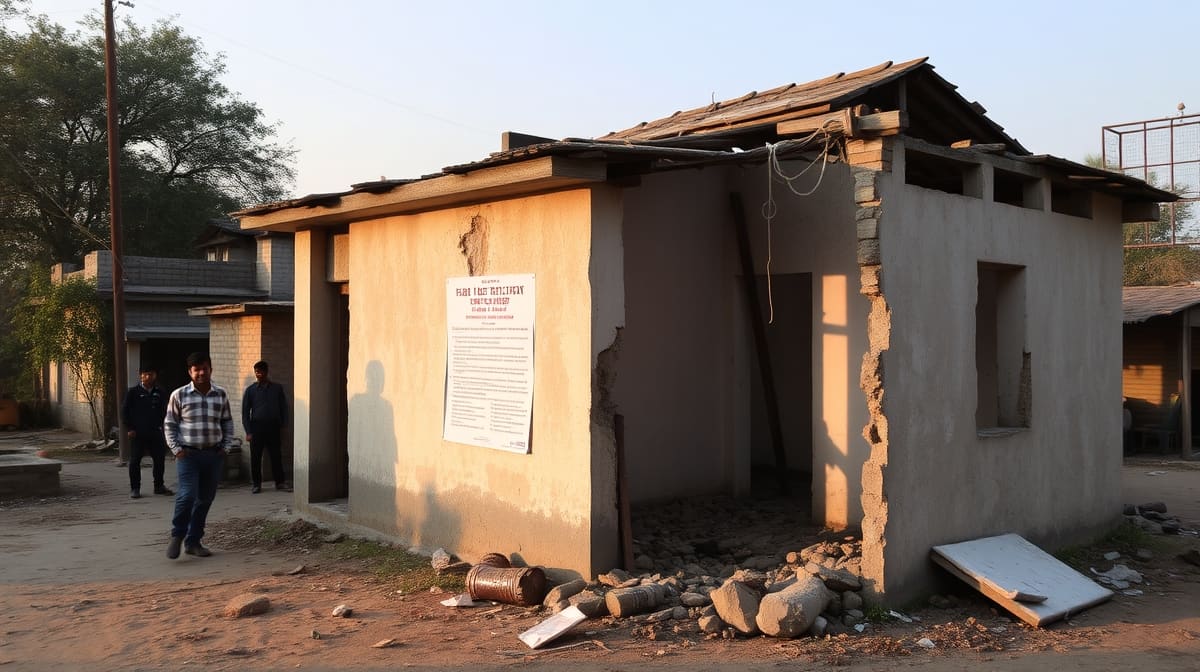
The Allahabad High Court has clarified that contempt proceedings cannot be maintained against a district magistrate when a non-party statutory authority issues a demolition notice, even where the court had previously directed the magistrate to consider a tenant’s representation. The judgment underscores the limits of judicial enforcement against entities not before the court and reinforces procedural boundaries in land acquisition disputes.
Background & Facts
The Dispute
The applicant, Abdul Bari, is a tenant occupying Shop No. CK 69/27, Resham Katra, Dalmandi, Varanasi. He feared demolition of the shop due to a road-widening project undertaken by the Varanasi Development Authority (VDA). He filed Writ-C No. 42189 of 2025 seeking protection of his tenancy rights.
Key Facts
- The shop is located in an area earmarked for road widening under state-led urban development
- The applicant is not the owner but a tenant with no direct legal title to the property
- On 24.11.2025, a coordinate Bench of the High Court in Mukhtar Ahmad v. State of U.P. held that only the landlord, as the real aggrieved person, could challenge demolition orders
- The court in Mukhtar Ahmad directed tenants to approach their landlords, who in turn must approach the competent authority for redressal
- The applicant relied on this precedent to seek similar relief in his own case
Procedural History
- 01.12.2025: Writ-C No. 42189 of 2025 disposed of by the High Court with the following directions:
- Tenant must approach landlord for representation to the competent authority
- If landlord files representation, the authority must decide it in accordance with law
- Tenant granted two weeks to ensure landlord files representation
- 29.01.2026: Applicant filed a representation before the District Magistrate, Varanasi, seeking protection of tenancy rights
- 17.04.2026: Varanasi Development Authority issued a demolition notice directly to the applicant, bypassing the landlord and the District Magistrate
- 14.05.2026: Applicant filed Contempt Application No. 2960 of 2026 alleging violation of the 01.12.2025 order
- 14.05.2026: Personal affidavit of District Magistrate, Varanasi filed, stating the order was not disobeyed; VDA’s notice was issued independently
The Parties' Positions
- Applicant (Abdul Bari): Argued that the VDA’s notice violated the High Court’s directive that only the District Magistrate, upon landlord’s representation, could act. He claimed the DM’s inaction on his January 2026 representation amounted to contempt.
- Respondents (Sri Satyendra Kumar and 6 Others): Contended that VDA is a statutory authority not party to the original writ petition and therefore not bound by its order. The DM had not refused to act; the representation was merely pending.
Relief Sought
The applicant sought initiation of contempt proceedings against the District Magistrate and the VDA for violating the 01.12.2025 order. He also sought immediate stay of the demolition notice and direction to decide his representation within a fixed timeframe.
The Legal Issue
The central question was whether the issuance of a demolition notice by the Varanasi Development Authority - a non-party to the original writ petition - constitutes contempt of court against the District Magistrate, and whether the pendency of a representation before the DM amounts to disobedience of the court’s directive.
Arguments Presented
For the Appellant/Petitioner
The applicant’s counsel, Quazi Mohammad Akaram and Shoar Mohammad Khan, argued that the High Court’s 01.12.2025 order was clear and specific: any representation by the landlord must be considered by the District Magistrate, and no other authority could act unilaterally. The VDA’s notice on 17.04.2026, issued directly to the tenant, circumvented this judicial directive. The DM’s failure to decide the representation filed on 29.01.2026, despite the two-week timeline implied by the court, amounted to wilful disobedience.
For the Respondent/State
Sri Bipin Bihari Pandey, learned Chief Standing Counsel, submitted that the Varanasi Development Authority is a statutory body empowered under the Uttar Pradesh Urban Planning and Development Act, 1973, to issue demolition notices independently. It was never impleaded as a party in the original writ petition and therefore cannot be held in contempt for actions taken in its statutory capacity. The District Magistrate had not refused to act - the representation was merely pending consideration, which does not equate to disobedience.
The Court's Analysis
The Court examined the nature of the 01.12.2025 order and its scope. It noted that the order was not a mandatory injunction directed at any specific authority but a procedural guidance based on the precedent in Mukhtar Ahmad. The court emphasized that contempt requires a clear, unambiguous order that is wilfully disobeyed.
"The direction issued was not a prohibitory or mandatory injunction against any statutory authority, but a procedural observation that the landlord, if moved, should approach the competent authority. The Varanasi Development Authority, not being a party to the writ petition, cannot be bound by its terms."
The Court further held that the District Magistrate’s inaction, if any, was due to administrative delay, not wilful defiance. The representation filed on 29.01.2026 remained pending, and no evidence was presented to show that the DM had refused to act or acted contrary to the court’s direction.
The Court also distinguished between the jurisdiction of the District Magistrate and the statutory powers of the VDA. While the former is an administrative authority under the state’s governance structure, the latter operates under a separate statutory framework with independent powers of enforcement.
The Court concluded that the applicant’s remedy lay in challenging the VDA’s notice through appropriate legal channels, not through contempt proceedings against a non-party.
The Verdict
The contempt application was dismissed. The Court directed the District Magistrate, Varanasi, to decide the representation filed by the applicant on 29.01.2026 within two weeks from today. The applicant was granted one week to file a reply to the VDA’s demolition notice dated 17.04.2026, and the Secretary of the Varanasi Development Authority was directed to decide the matter within the next two weeks after receipt of the reply.
What This Means For Similar Cases
Contempt Cannot Be Used Against Non-Parties
- Practitioners must identify the actual party bound by a court order before filing contempt proceedings
- Statutory authorities not impleaded in original proceedings cannot be held in contempt for actions taken under their independent statutory powers
- Contempt applications against district magistrates for delays by third-party agencies are legally unsustainable
Representation Pendency ≠ Disobedience
- Merely because a representation remains pending does not constitute wilful disobedience of a court order
- Courts expect reasonable administrative timelines; absence of malafide or refusal to act negates contempt
- Applicants must distinguish between administrative delay and judicial defiance
Tenant Rights Require Strategic Litigation
- Tenants cannot directly challenge demolition orders unless they have independent legal standing
- The correct route is through the landlord, who must be the one to approach the competent authority
- Legal strategy must focus on compelling the landlord to act, not on punishing non-party authorities