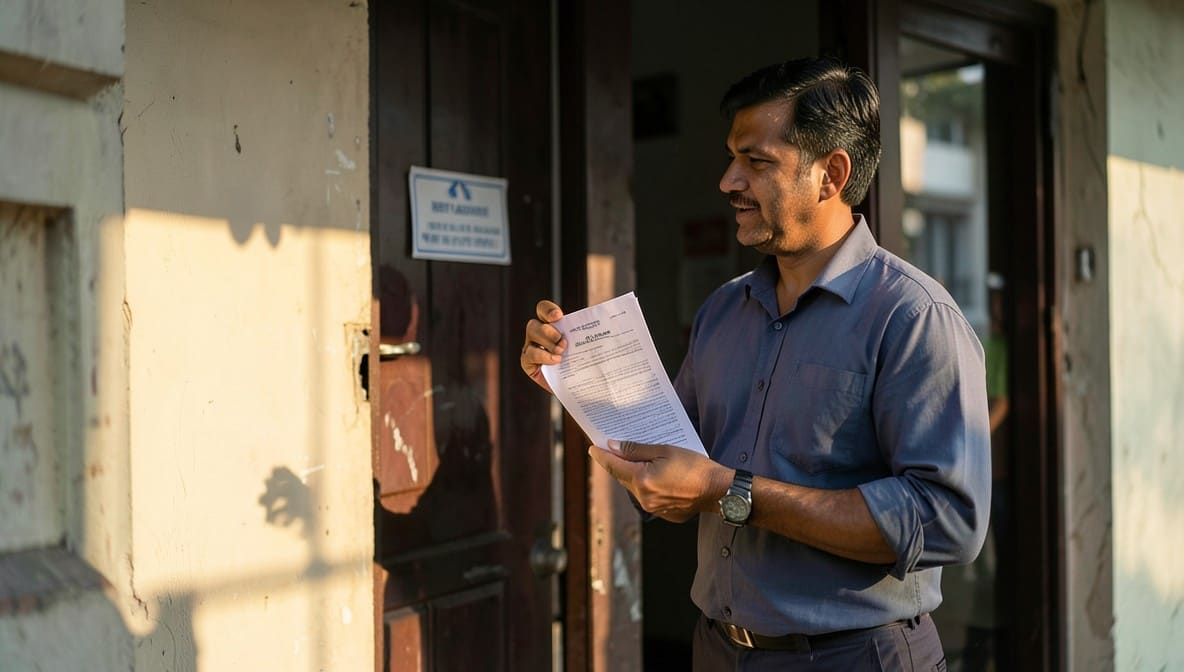
The Allahabad High Court has affirmed that persons in possession of premises claiming independent tenancy rights cannot be dispossessed merely because they are not parties to the original eviction proceedings. The judgment underscores the necessity of procedural fairness under the U.P. Urban Buildings (Regulation of Letting, Rent and Eviction) Act, 1972, even when eviction orders are executed against former tenants.
Background & Facts
The Dispute
The dispute arises from eviction proceedings initiated by the private respondents, legal heirs of the original landlord, against Rishi Dev Pandey, the original tenant of a residential premises in Sultanpur. Upon Rishi Dev Pandey’s death, his legal heirs were brought on record as respondents in the proceedings under Section 21(1)(a) of the U.P. Urban Buildings (Regulation of Letting, Rent and Eviction) Act, 1972 (Act 13 of 1972). The Prescribed Authority initially dismissed the release application, but the Appellate Court allowed the landlord’s appeal on 25.08.2021, thereby reversing the dismissal and ordering eviction.
Key Facts
The original tenant, Rishi Dev Pandey, died prior to the final order
The legal heirs of Rishi Dev Pandey were impleaded and contested the release application
The Appellate Court’s order dated 25.08.2021 directed eviction of the original tenant and his legal heirs
The petitioners, Arvind Pandey @ Narayan Prasad and two others, claim to be bona fide tenants in possession of the same premises, not deriving title from Rishi Dev Pandey or his heirs
The petitioners have been residing in the premises independently since at least 2018, paying rent directly to the landlord
On 13.04.2022, the petitioners filed an application before the Prescribed Authority seeking recognition of their independent tenancy rights and stay of execution
The application (Annexure No. 2) remains pending without any hearing or adjudication
Execution proceedings under Section 23 of the Act have been initiated against the original tenant’s legal heirs
The petitioners were not impleaded in the original or appellate proceedings
Procedural History
2012: Release application filed under Section 21(1)(a) of the U.P. Urban Buildings Act
25.08.2021: Appellate Court allowed the landlord’s appeal and ordered eviction of Rishi Dev Pandey’s legal heirs
07.04.2026: Prescribed Authority issued notice of execution against the premises, without considering the petitioners’ pending application
13.04.2022: Petitioners filed application before Prescribed Authority claiming independent tenancy
2021: Writ Petition No. 25761 of 2021 filed by Rishi Dev Pandey’s heirs challenging the appellate order; dismissed by High Court
29.04.2026: Present petition under Article 227 filed before Allahabad High Court, Lucknow Bench
The Parties' Positions
The petitioners assert they are independent tenants with no legal connection to Rishi Dev Pandey or his heirs. They claim possession based on direct tenancy, rent receipts, and continuous occupation. They argue that execution of the eviction order against them violates principles of natural justice and due process under the Act.
The respondents contend that the petitioners are merely stalling tactics by persons who have no legal title. They argue that the eviction order is valid against the premises and that the petitioners, not being parties to the proceedings, have no locus standi to interfere with execution.
Relief Sought
The petitioners sought:
Declaration that the impugned order dated 07.04.2026 is not binding upon them
Direction to the Prescribed Authority to decide their pending application dated 13.04.2022 expeditiously
Restraint on coercive action against them until their application is decided
The Legal Issue
Can a Prescribed Authority proceed with execution of an eviction order against persons who are not parties to the original proceedings and who have filed a pending application claiming independent tenancy rights under the U.P. Urban Buildings Act, 1972?
Arguments Presented
For the Petitioner
The learned counsel argued that the petitioners are not successors or legal heirs of the original tenant but independent occupants with their own tenancy rights. They cited State of U.P. v. Ram Swarup and Rajendra Kumar v. Smt. Kamla Devi to establish that the Act protects bona fide tenants regardless of their connection to the original tenant. The application filed on 13.04.2022 raises factual questions regarding possession and tenancy that require adjudication before any coercive action. Execution without hearing violates Article 14 and Article 21 of the Constitution and the principles of natural justice under the Act.
For the Respondent
The respondents’ counsel contended that the eviction order is final and binding on the premises, irrespective of who is in possession. They argued that the petitioners, not being parties to the proceedings, cannot raise new claims at the execution stage. The pending application is an afterthought designed to delay enforcement. The High Court had already dismissed the legal heirs’ challenge in Writ Petition No. 25761 of 2021, reinforcing the finality of the appellate order.
The Court's Analysis
The Court acknowledged that while the eviction order against the original tenant and his heirs is valid and enforceable, it does not automatically extend to third parties in possession claiming independent rights. The Court emphasized that the Act is a protective statute designed to safeguard tenants, and its procedural safeguards must be strictly followed.
"The Prescribed Authority cannot proceed to execute an order of eviction against persons who are not parties to the proceedings and who have raised a claim of independent tenancy through a pending application, without affording them a reasonable opportunity to be heard."
The Court noted that the petitioners had submitted documentary evidence, including rent receipts and affidavits, to prima facie establish their independent possession. To allow execution without adjudicating their claim would render the statutory protection under the Act illusory. The Court further held that the application dated 13.04.2022 raises triable issues of fact that must be resolved by the Prescribed Authority.
The Court explicitly declined to express any opinion on the merits of the petitioners’ claim, stressing that its role was to ensure procedural fairness, not to adjudicate the underlying tenancy dispute.
The Verdict
The petition was disposed of with the following directions:
The Prescribed Authority shall hear and decide the petitioners’ application dated 13.04.2022 on 30.04.2026 and on a day-to-day basis thereafter
No adjournments shall be granted; the matter shall be decided within one week from 29.04.2026
No coercive action against the petitioners shall be taken until the application is decided
This protection applies only to the petitioners and does not affect execution proceedings against the original tenant or his legal heirs
The petitioners undertook not to seek any adjournment
What This Means For Similar Cases
Tenancy Claims Must Be Heard Before Execution
Practitioners must file applications under Section 21(1)(a) or Section 23(2) of the U.P. Urban Buildings Act whenever third parties claim independent tenancy
Execution proceedings cannot proceed against non-parties without adjudication of their claim
Courts must treat such applications as substantive, not procedural, and provide full opportunity of hearing
Documentary Evidence Is Critical
Rent receipts, witness statements, and possession affidavits form the core of prima facie proof of independent tenancy
Oral assertions without documentation are unlikely to suffice
Courts will not entertain belated claims at the execution stage unless supported by credible evidence
Procedural Compliance Is Non-Negotiable
The Act’s procedural safeguards are mandatory, not directory
Failure to implead persons in possession constitutes a fatal irregularity
Any eviction order executed against non-parties is liable to be set aside under Article 227