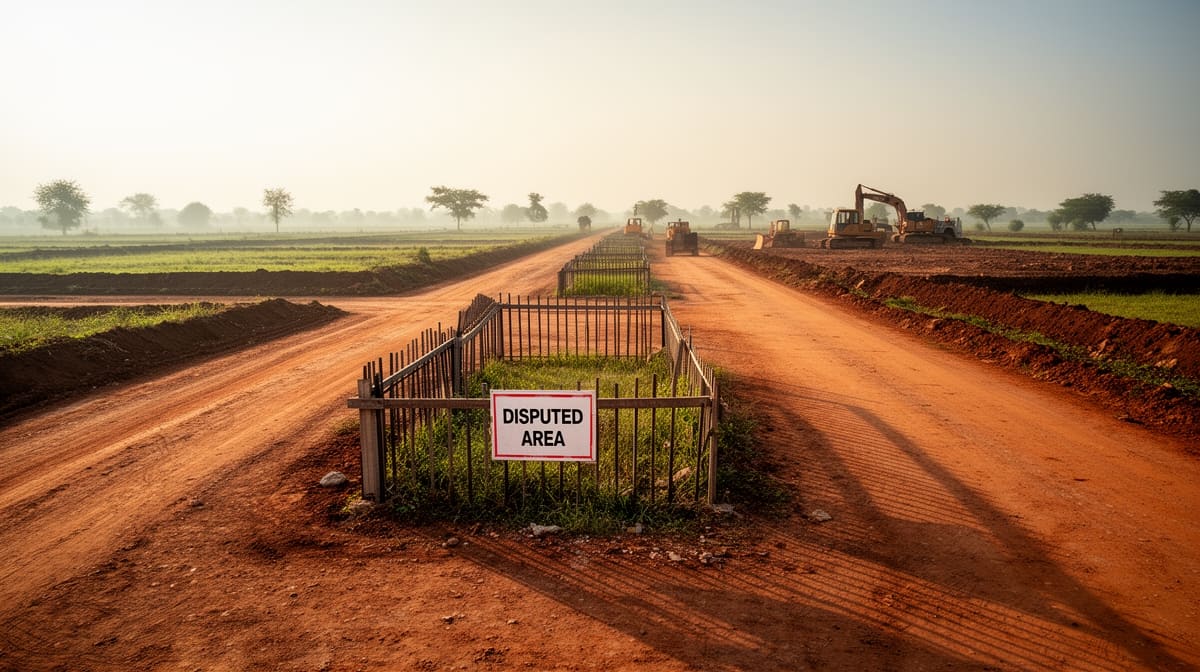
The Bombay High Court has reaffirmed the principle that equity demands parity in interim relief when competing property claims are pending adjudication. In a significant ruling, the Court held that neither party should be permitted to alter the status quo by creating third-party interests, as this could render the final decree infructuous and lead to multiplicity of proceedings. This judgment provides crucial guidance on the application of temporary injunctions under Order 39 of the Code of Civil Procedure, 1908 in property disputes.
Background & Facts
The Dispute
The case revolves around a property dispute between the appellants, who acquired agricultural land in Kalyan through a registered conveyance, and the respondents, who claim rights over the same property under a 50-year lease deed that expired in 2018. The appellants sought recovery of possession and a permanent injunction against the respondents creating third-party interests. The respondents, however, claimed rights under an unregistered agreement dated 1994 and had earlier filed a suit for specific performance.
Procedural History
The dispute progressed through multiple legal proceedings:
- 2017: Respondents filed Special Civil Suit No. 194 of 2017 for specific performance and declaration that the appellants' conveyance was null and void.
- 2022: Trial Court granted interim injunction in favor of respondents, restraining appellants from creating third-party rights.
- 2023: Appellants filed Special Civil Suit No. 18 of 2023 for recovery of possession and permanent injunction.
- 3 May 2023: Trial Court rejected appellants' application for temporary injunction against respondents creating third-party rights, leading to this appeal.
Relief Sought
The appellants sought an interim injunction restraining the respondents from creating any third-party rights in the suit property pending final adjudication, arguing that such action would cause irreparable injury and lead to multiplicity of proceedings.
The Legal Issue
The central question before the Court was whether, in a property dispute where both parties assert competing claims and their suits are pending adjudication, equity demands that neither party be permitted to create third-party interests in the property, thereby altering the status quo.
Arguments Presented
For the Appellants
The appellants contended that:
- The lease deed under which the respondents claimed rights had expired in 2018, rendering their continued occupation unauthorized.
- Permitting the respondents to create third-party interests would lead to irreparable injury and multiplicity of proceedings.
- The appellants were bona fide purchasers without notice of the unregistered 1994 agreement, and their rights under the registered conveyance deserved protection.
- The Trial Court had already restrained the appellants from creating third-party rights in an earlier order, and parity demanded similar relief against the respondents.
For the Respondents
The respondents argued that:
- The appellants had suppressed material facts, including knowledge of the 1994 agreement, and were thus not entitled to discretionary relief.
- The 1994 agreement, though unregistered, conferred rights that the appellants were aware of, as evidenced by their reply to a legal notice.
- There was no material to show that the respondents intended to create third-party rights, and the appellants' apprehensions were speculative.
The Court's Analysis
The Court examined the principles governing temporary injunctions under Order 39 of the Code of Civil Procedure, 1908, emphasizing the triple test of prima facie case, balance of convenience, and irreparable injury, as established in Dalpat Kumar v. Prahlad Singh.
"When both parties assert competing rights over the same property and their respective Suits are pending adjudication, equity demands that neither side be permitted to alter the status quo by creating third-party interests pending trial."
The Court relied on Maharwal Khewaji Trust (Regd.) v. Baldev Dass, which held that in disputes relating to immovable property, courts should ordinarily maintain the status quo to preserve the subject matter of litigation. Permitting alienation at the interim stage would effectively grant final relief to one side without trial.
The Court also addressed the respondents' contention that the appellants had suppressed material facts. It held that mere non-reference to the 1994 agreement in the plaint did not amount to deliberate suppression, especially since the plaint referred to the respondents' pending suit. The Court further noted that an unregistered agreement cannot confer proprietary rights capable of enforcement, citing Suraj Lamp & Industries Pvt. Ltd. v. State of Haryana and K.B. Saha & Sons Pvt. Ltd. v. Development Consultant Ltd.
The Verdict
The Bombay High Court allowed the appeal and set aside the impugned order dated 3 May 2023. The Court restrained the respondents from creating any third-party rights, title, or interest in the suit property pending the final disposal of the suit. The Trial Court was directed to dispose of the suit expeditiously.
What This Means For Similar Cases
Parity in Interim Relief Is Mandatory
The judgment underscores that in property disputes with competing claims, courts must ensure parity in interim relief. Practitioners should argue that:
- Permitting one party to create third-party interests while restraining the other alters the status quo and confers an unwarranted advantage.
- Such an imbalance may render the final adjudication infructuous, as held in Maharwal Khewaji Trust (Regd.) v. Baldev Dass.
Unregistered Agreements Cannot Confer Proprietary Rights
- An unregistered agreement, even if known to a subsequent purchaser, cannot override rights acquired under a registered conveyance.
- Courts will not impute knowledge of superior rights based on unregistered documents, as clarified in Suraj Lamp & Industries Pvt. Ltd. v. State of Haryana.
Status Quo Must Be Preserved Pending Adjudication
- The judgment reinforces the principle that the subject matter of litigation must be preserved until final adjudication.
- Practitioners must emphasize that interim relief should not grant substantive rights to either party, as this would preempt the trial.