Topic

jurisdictional error

Jurisdictional error in Indian law occurs when a court or tribunal acts beyond its legally defined authority, rendering its order void. This page provides latest judgments, case analyses, and updates from Indian courts on jurisdictional limits under statutes like SARFAESI, Income-tax, RERA.

15 articlesLatest 1 week ago
Section 151 Income Tax Act | Reassessment Beyond 3 Years Requires PCCIT/CCIT Sanction, Not PCIT Approval : ITAT Kolkata
Case Law Analysis
|Income Tax Appellate Tribunal

Section 151 Income Tax Act | Reassessment Beyond 3 Years Requires PCCIT/CCIT Sanction, Not PCIT Approval : ITAT Kolkata

ITAT Kolkata held that reassessment beyond three years under Section 148 mandates PCCIT or CCIT sanction under Section 151; PCIT approval is jurisdictionally invalid. The tribunal quashed a notice where only PCIT approval was obtained, reinforcing the strict hierarchy for time-barred proceedings and protecting taxpayers from procedurally flawed orders.

Section 16 FCRA Renewal Refusal Must Observe Natural Justice | FCRA Certificate Renewal : Calcutta HC
Case Law Analysis
|Calcutta High Court

Section 16 FCRA Renewal Refusal Must Observe Natural Justice | FCRA Certificate Renewal : Calcutta HC

The High Court set aside the July 2026 order denying renewal of a foreign contribution registration, finding the authority failed to record a satisfaction of mind and breached natural-justice principles. It ordered a fresh hearing, underscoring that FCRA renewal decisions must be reasoned and afford the applicant a fair chance to be heard. NGOs and societies holding FCRA certificates are directly impacted.

Section 143(2) Notice Mandatory for Reassessment | Non-Compliance Vitiates Assessment Under Section 144C : ITAT Mumbai
Case Law Analysis
|Income Tax Appellate Tribunal

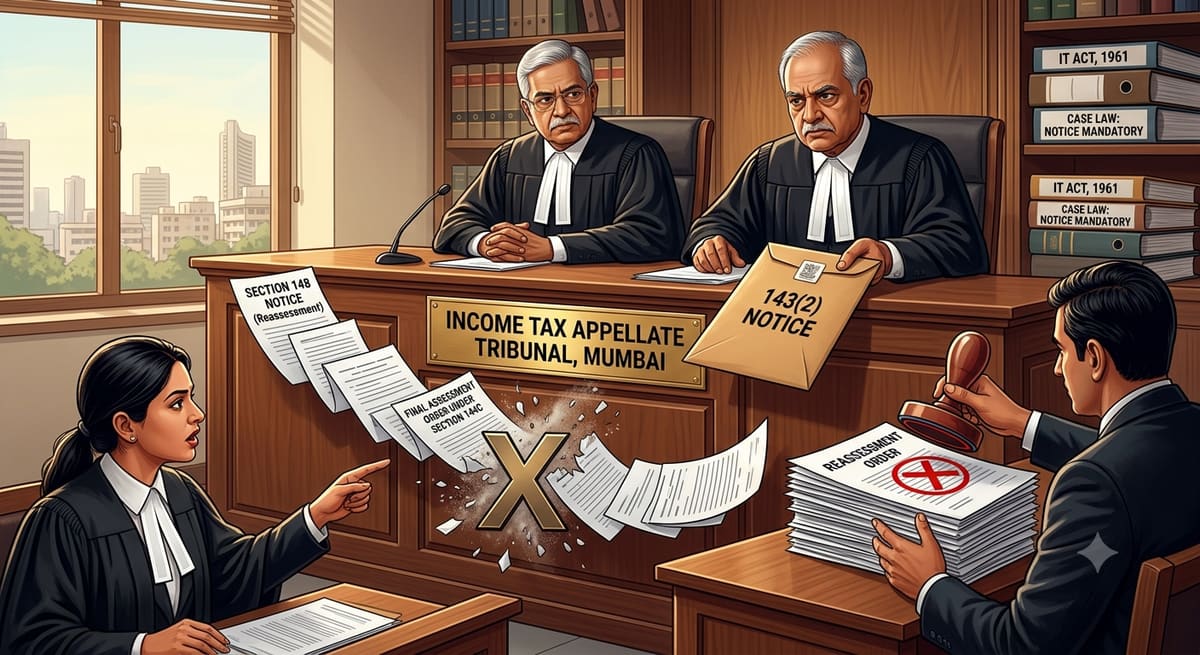
Section 143(2) Notice Mandatory for Reassessment | Non-Compliance Vitiates Assessment Under Section 144C : ITAT Mumbai

ITAT Mumbai rules that failure to issue a mandatory notice under Section 143(2) during reassessment proceedings renders the entire assessment void ab initio. The tribunal held that issuing a demand notice alongside a draft assessment order under Section 144C without adhering to procedural safeguards constitutes a jurisdictional error, impacting all taxpayers undergoing reassessment.

Caste Validity Certificate | Scrutiny Committees Lack Authority to Cancel Certificates Without Pre-Independence Evidence: Bombay HC
Case Law Analysis
|Bombay High Court

Caste Validity Certificate | Scrutiny Committees Lack Authority to Cancel Certificates Without Pre-Independence Evidence: Bombay HC

The Bombay High Court has ruled that Scheduled Tribe Scrutiny Committees cannot cancel caste validity certificates based on vigilance reports alone, as they lack statutory power to review previously issued certificates. The judgment mandates that pre-independence documentary proof, not post-facto investigations, must govern caste claims under the Maharashtra Caste Certificate Act, 2000 - protecting thousands of tribal claimants from arbitrary cancellations.

Section 148A Income-tax Act | Jurisdiction Void if Reassessment Based on Erroneous Search Data Without Application of Mind : ITAT Delhi
Case Law Analysis
|Income Tax Appellate Tribunal

Section 148A Income-tax Act | Jurisdiction Void if Reassessment Based on Erroneous Search Data Without Application of Mind : ITAT Delhi

The ITAT Delhi has struck down a reassessment and penalty under Section 271AAC, ruling that jurisdiction under Section 148A cannot be established using factually incorrect search data when the Assessing Officer fails to apply independent mind. This sets a critical precedent for taxpayers facing reassessments triggered by flawed intelligence, reinforcing that procedural legitimacy requires more than just copied data.

Section 23 PSCC Act | Serious Title Disputes Require Plaint Return, Not Merits-Based Dismissal : Allahabad HC
Case Law Analysis
|Allahabad High Court

Section 23 PSCC Act | Serious Title Disputes Require Plaint Return, Not Merits-Based Dismissal : Allahabad HC

The Allahabad High Court has ruled that when a Small Cause Court encounters a bona fide, documentary-supported title dispute, it must return the plaint under Section 23 of the PSCC Act rather than decide it on merits. This prevents jurisdictional overreach and preserves the civil court’s exclusive authority over title adjudication, safeguarding landlords and tenants alike from summary adjudication of complex ownership claims.

Section 219 U.P. Land Revenue Act | Locus Standi & Sufficient Cause Mandatory for Condonation of Delay in Revision Petitions : Allahabad HC
Case Law Analysis
|Allahabad High Court

Section 219 U.P. Land Revenue Act | Locus Standi & Sufficient Cause Mandatory for Condonation of Delay in Revision Petitions : Allahabad HC

Allahabad HC rules that a non-party lacks locus standi to file a revision petition under Section 219 of the U.P. Land Revenue Act, and inordinate delay without 'sufficient cause' cannot be condoned. The judgment reinforces procedural safeguards, barring frivolous or delayed challenges by third parties in revenue disputes.

U.P. Revenue Code Section 210 | Revision Petition Inadmissible Against Section 38(1) Orders; Appeal Under Section 38(4) Is Exclusive Remedy : Allahabad HC
Case Law Analysis
|Allahabad High Court

U.P. Revenue Code Section 210 | Revision Petition Inadmissible Against Section 38(1) Orders; Appeal Under Section 38(4) Is Exclusive Remedy : Allahabad HC

Allahabad HC clarifies that orders passed under Section 38(1) of the U.P. Revenue Code can only be challenged via appeal under Section 38(4), rendering revision under Section 210 legally unsustainable. The ruling reinforces procedural compliance in revenue disputes, impacting property record corrections and fraudulent entry challenges.

Haryana Contractual Employees Act 2024 | Termination After Acquittal in Internal Enquiry Illegal; Reinstatement Mandated : Punjab & Haryana HC
Case Law Analysis
|Punjab and Haryana High Court

Haryana Contractual Employees Act 2024 | Termination After Acquittal in Internal Enquiry Illegal; Reinstatement Mandated : Punjab & Haryana HC

The Punjab & Haryana High Court ruled that termination of a contractual employee under the Haryana Contractual Employees (Security of Service) Act, 2024, is invalid if the employee is acquitted in an internal enquiry. The court mandated reinstatement with continuity of service, reinforcing statutory protections for contractual workers against arbitrary termination.

Section 153C IT Act Mandatory for Reassessment Based on Search Evidence | ITAT Delhi Bars Section 147 Route : ITAT Delhi
Case Law Analysis
|Income Tax Appellate Tribunal

Section 153C IT Act Mandatory for Reassessment Based on Search Evidence | ITAT Delhi Bars Section 147 Route : ITAT Delhi

ITAT Delhi rules that reassessment proceedings triggered by evidence from a search under Section 132 must strictly follow Section 153C of the Income Tax Act. Reassessment under Section 147 is invalid if it relies on search materials, reinforcing jurisdictional exclusivity for such cases. This precedent binds tax authorities to adhere to the prescribed procedure, impacting all reassessment cases involving search-derived evidence.

Maintenance Tribunal Exclusive Jurisdiction for Eviction Under Senior Citizens Act | Punjab & Haryana HC Sets Aside ADC Orders
Case Law Analysis
|Punjab and Haryana High Court

Maintenance Tribunal Exclusive Jurisdiction for Eviction Under Senior Citizens Act | Punjab & Haryana HC Sets Aside ADC Orders

The Punjab & Haryana High Court ruled that eviction applications under the Maintenance and Welfare of Parents and Senior Citizens Act, 2007 must be filed exclusively before the Maintenance Tribunal-cum-Sub-Divisional Magistrate. Orders passed by the Additional Deputy Commissioner were held jurisdictionally invalid, clarifying the statutory forum for senior citizen eviction disputes.

SARFAESI Act Section 13 | Oral Directions by DRT Cannot Validate Possession Restoration Without Written Order : Bombay HC
Case Law Analysis
|Bombay High Court

SARFAESI Act Section 13 | Oral Directions by DRT Cannot Validate Possession Restoration Without Written Order : Bombay HC

Bombay High Court rules that restoration of possession under the SARFAESI Act must strictly follow statutory procedures; oral directions or informal assurances from the Debt Recovery Tribunal are jurisdictionally invalid. The judgment reinforces that secured creditors cannot be compelled to relinquish possession based on unwritten assurances, safeguarding procedural fairness in debt recovery.