Topic

Cenvat Credit

Cenvat Credit under Indian indirect tax law allows manufacturers and service providers to claim credit for taxes paid on inputs used in producing goods or rendering output services.

76 articlesLatest September 2026
Processed Milk Is Intermediate Product, Not Exempted Final Product | Sets Aside CENVAT Credit Demand Under Rule 6 : CESTAT Chennai
Case Law Analysis
|Custom, Excise & Service Tax Tribunal

Processed Milk Is Intermediate Product, Not Exempted Final Product | Sets Aside CENVAT Credit Demand Under Rule 6 : CESTAT Chennai

CESTAT Chennai ruled that processed milk is an intermediate product, not an exempted final product, so Rule 6 of the CENVAT Credit Rules does not trigger credit reversal. The decision sets aside the tax demand on Lotte India, clarifying that captive consumption of processed milk in confectionery manufacture does not attract CENVAT credit liability.

Credit on inputs from units exempt under Notification 01/2010-CE cannot be denied before Rule 12 amendment; extended limitation not available | CENVAT credit eligibility : CESTAT Chandigarh
Case Law Analysis
|Custom, Excise & Service Tax Tribunal

Credit on inputs from units exempt under Notification 01/2010-CE cannot be denied before Rule 12 amendment; extended limitation not available | CENVAT credit eligibility : CESTAT Chandigarh

CESTAT ruled that manufacturers can claim CENVAT credit on duty-paid inputs sourced from units exempt under Notification 01/2010-CE, even for periods before the Rule 12 amendment. The tribunal also rejected the revenue's attempt to invoke an extended limitation period, safeguarding businesses from retroactive credit denial.

CENVAT Credit Reversal Mandatory for Common Inputs Used in Investment Activity | Investment Not a 'Service' Under Rule 14, CCR: CESTAT
Case Law Analysis
|Custom, Excise & Service Tax Tribunal

CENVAT Credit Reversal Mandatory for Common Inputs Used in Investment Activity | Investment Not a 'Service' Under Rule 14, CCR: CESTAT

CESTAT rules that when common input services are used for both taxable services and non-service investment activities like securities trading, proportionate reversal of CENVAT credit is mandatory. This clarifies a critical boundary in indirect tax compliance for financial institutions and corporate entities with dual-use expenditures, preventing unjustified credit claims on non-taxable activities.

Cenvat Credit Rules, 2004 | Credit Permitted for Reverse Charge on Imported Services Before July 2012: CESTAT
Case Law Analysis
|Custom, Excise & Service Tax Tribunal

Cenvat Credit Rules, 2004 | Credit Permitted for Reverse Charge on Imported Services Before July 2012: CESTAT

CESTAT has ruled that taxpayers could lawfully utilize Cenvat credit to discharge service tax liability under the reverse charge mechanism for imported services prior to July 2012, overturning departmental demands and clarifying a critical ambiguity in pre-GST compliance. This decision protects businesses that relied on existing rules and sets a precedent for retrospective interpretation of credit utilization in indirect tax regimes.

Cenvat Credit Rules, 2004 | Insurance, Travel, Telecom & Accommodation Services for Export-Oriented IT Services Qualify as Input Services : CESTAT Chennai
Case Law Analysis
|Custom, Excise & Service Tax Tribunal

Cenvat Credit Rules, 2004 | Insurance, Travel, Telecom & Accommodation Services for Export-Oriented IT Services Qualify as Input Services : CESTAT Chennai

CESTAT Chennai rules that ancillary services like air travel, cab rentals, telecom, insurance, and accommodation directly supporting export of IT services qualify as eligible input services under Rule 2(r) of the Cenvat Credit Rules, 2004. This expands the scope of claimable credits for IT exporters, removing arbitrary disallowances based on perceived lack of direct nexus and aligning with the intent of export promotion under service tax law.

POPS Rules | Direct Contract with Overseas Principal Excludes Intermediary Status, Entitles Cenvat Credit: CESTAT Chandigarh
Case Law Analysis
|Custom, Excise & Service Tax Tribunal

POPS Rules | Direct Contract with Overseas Principal Excludes Intermediary Status, Entitles Cenvat Credit: CESTAT Chandigarh

CESTAT Chandigarh rules that Genpact Services LLC, providing BPO services directly to an overseas principal under a single contract, does not qualify as an 'intermediary' under the Place of Provision of Services Rules. The ruling entitles the appellant to Cenvat credit refunds worth ₹14.55 crore, setting a precedent for service exporters with direct overseas contracts.

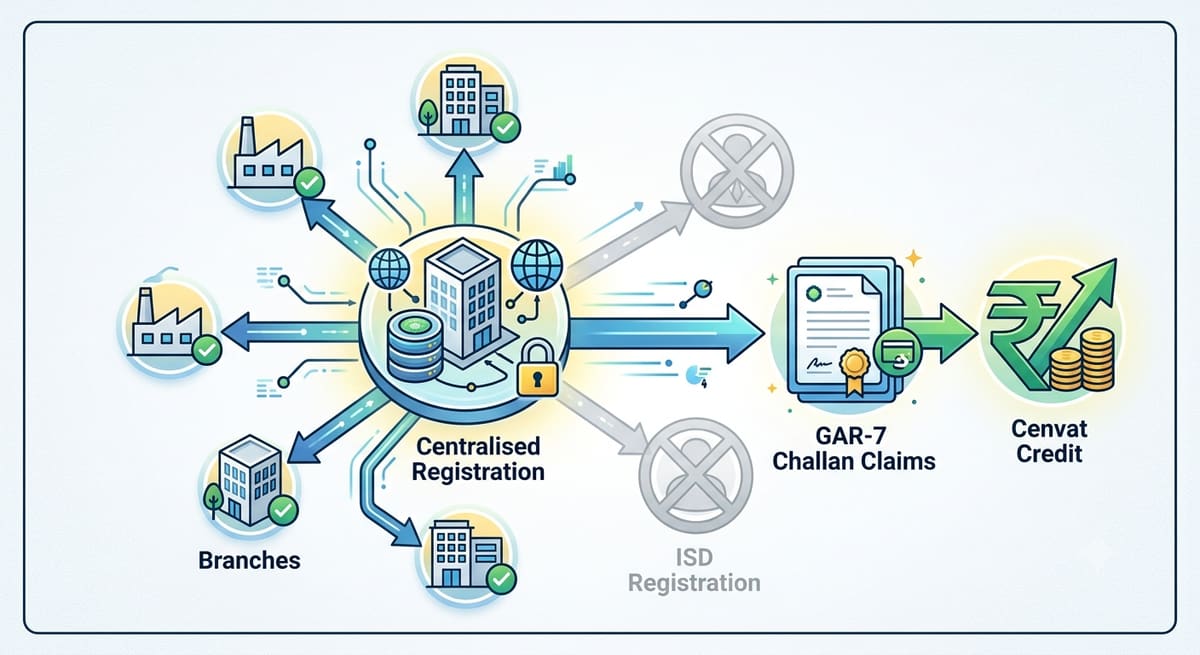
Cenvat Credit | Centralised Registration Allows GAR-7 Challan Claims Without ISD Registration: CESTAT Chandigarh
Case Law Analysis
|Custom, Excise & Service Tax Tribunal

Cenvat Credit | Centralised Registration Allows GAR-7 Challan Claims Without ISD Registration: CESTAT Chandigarh

Taxpayers with centralised registration can claim Cenvat credit using GAR-7 challans even without ISD registration, as CESTAT Chandigarh prioritises substantive entitlement over procedural compliance. This ruling empowers large multi-unit businesses to streamline input tax credit claims without the added burden of separate ISD setup, significantly reducing administrative friction under the erstwhile service tax regime.

Service Tax on Export of Services | Recipient’s Location Outside India Determines Tax Exemption : CESTAT Kolkata
Case Law Analysis
|Custom, Excise & Service Tax Tribunal

Service Tax on Export of Services | Recipient’s Location Outside India Determines Tax Exemption : CESTAT Kolkata

CESTAT Kolkata rules that services rendered in India to a foreign recipient qualify as 'export of services' and are exempt from service tax if payment is received in foreign exchange. The ruling sets aside a ₹4.55 crore tax demand, reinforcing that taxability hinges on the recipient’s location, not the place of performance.

CENVAT Credit on Capital Goods | Eligibility Based on Post-Registration Use, Not Receipt Date: CESTAT Kolkata
Case Law Analysis
|Custom, Excise & Service Tax Tribunal

CENVAT Credit on Capital Goods | Eligibility Based on Post-Registration Use, Not Receipt Date: CESTAT Kolkata

CESTAT Kolkata ruled that CENVAT credit on capital goods like tippers is valid if used for taxable services after registration, even if purchased and received earlier. This removes the department’s arbitrary denial of credit based on pre-registration acquisition, empowering service providers to claim rightful input tax credits without being penalized for timing mismatches.

CENVAT Credit on Leadership Fees in Consortium Projects Admissible if Not Exclusively for Exempt Activities | CESTAT Hyderabad
Case Law Analysis
|Custom, Excise & Service Tax Tribunal

CENVAT Credit on Leadership Fees in Consortium Projects Admissible if Not Exclusively for Exempt Activities | CESTAT Hyderabad

CESTAT Hyderabad rules that service tax paid on leadership fees in consortium turnkey projects qualifies for CENVAT credit, provided the services are not exclusively linked to exempt manufacturing activities and tax was properly discharged under reverse charge. This clarifies the eligibility of indirect service costs in complex infrastructure contracts, impacting consortium-based EPC players nationwide.

CENVAT Credit Admissible on Third-Party Owned Capital Goods Used in Manufacturing | CESTAT Hyderabad
Case Law Analysis
|Custom, Excise & Service Tax Tribunal

CENVAT Credit Admissible on Third-Party Owned Capital Goods Used in Manufacturing | CESTAT Hyderabad

CESTAT Hyderabad has ruled that CENVAT credit can be availed on duty-paid capital goods used in manufacturing, even when those goods are owned by a third party under lease and permanently installed in the factory. This clarifies that ownership, not usage or immovability, is not a barrier to credit - a critical win for manufacturers relying on leased infrastructure.

CENVAT Credit Admissible for Ore Processing Services Despite 15% Waste Discard | CESTAT Clarifies 'Incidental to Manufacture' Under CCR
Case Law Analysis
|Custom, Excise & Service Tax Tribunal

CENVAT Credit Admissible for Ore Processing Services Despite 15% Waste Discard | CESTAT Clarifies 'Incidental to Manufacture' Under CCR

CESTAT rules that CENVAT credit on services like transportation and crushing of ore remains valid even when up to 15% of material is discarded as waste, as long as the services are directly incidental to the manufacture of final goods. This clarifies that the threshold of material yield does not disqualify input service eligibility under Rule 2(l) of CCR, benefiting mining-integrated manufacturers across steel and mineral industries.