The Bombay High Court has clarified that the pendency of civil suits concerning unauthorized construction or FSI violations cannot be used to indefinitely delay or deny statutory deemed conveyance to a cooperative housing society under Section 11 of the Maharashtra Ownership Flats Act, 1963. This judgment reinforces the statutory obligation of the Competent Authority to act on clear documentary evidence of land entitlement, irrespective of unrelated construction disputes.
Background & Facts
The Dispute
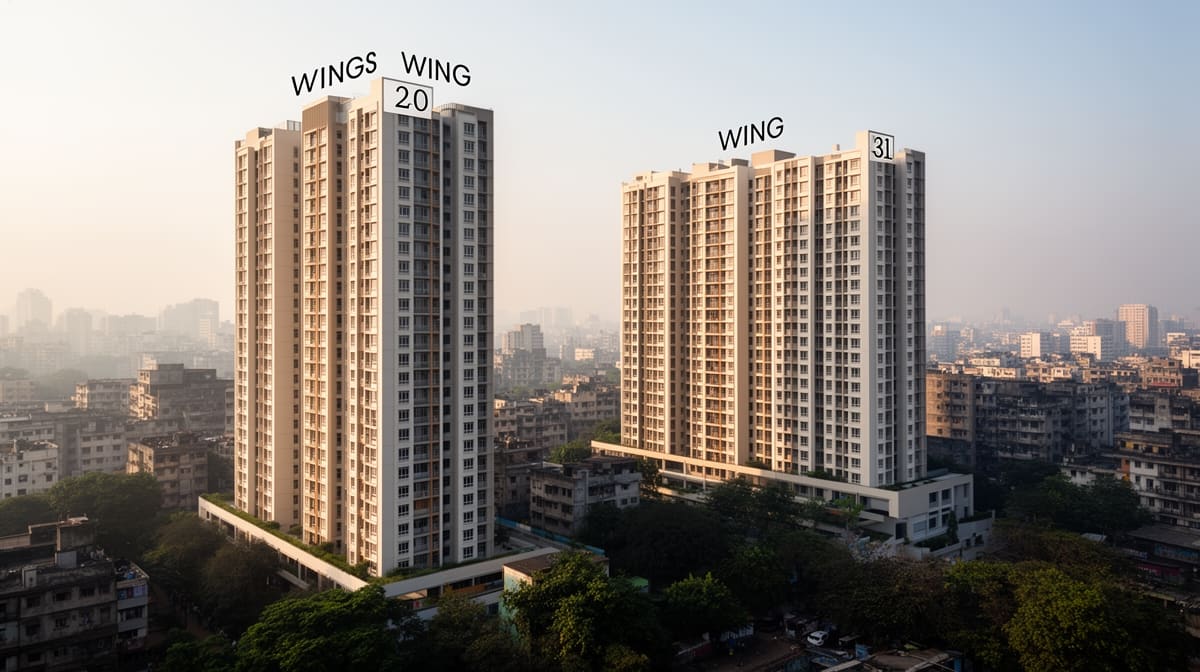
The petitioner, Quantum Park Cooperative Housing Society Limited, sought unilateral deemed conveyance of land bearing CTS No. D/1084/B/2/A (3,635.4 sq.m.) and the two residential buildings - Wing A and Wing B - constructed thereon. The society was formed after the promoters sold flats to purchasers and handed over possession. Despite registration of sale agreements and receipt of full consideration, the promoters failed to execute conveyance, prompting the society to file an application under Section 11 of the Maharashtra Ownership Flats Act.
Procedural History
- 2010: Quantum Park Cooperative Housing Society Limited registered under the Maharashtra Cooperative Societies Act.
- 2021: Petitioner filed Application No.127 of 2021 before the District Deputy Registrar (Respondent No.10) seeking deemed conveyance.
- 22 April 2022: Competent Authority rejected the application on two grounds: (1) the claimed area (4,242.90 sq.m.) exceeded the society’s alleged entitlement (3,635.10 sq.m.); and (2) pendency of civil suits concerning illegal construction.
- 2025: Writ Petition No.10220 of 2025 filed under Article 227 challenging the rejection order.
Relief Sought
The petitioner sought a declaration of entitlement to deemed conveyance of CTS No. D/1084/B/2/A (3,635.4 sq.m.) and the buildings thereon, along with a direction to the Competent Authority to issue the conveyance certificate.
The Legal Issue
The central question was whether the pendency of civil suits alleging FSI violations and unauthorized construction can legally bar the Competent Authority from granting deemed conveyance under Section 11 of the Maharashtra Ownership Flats Act, and whether the Authority must consider subdivided land records when determining the area liable for conveyance.
Arguments Presented
For the Petitioner
Learned counsel argued that the Competent Authority erred by ignoring official records: the Slum Rehabilitation Authority’s order permitting subdivision, the City Survey Officer’s MR Plan No. C Office 2K CTS Vashi 949 of 2003, and registered Agreements for Sale referencing IRDLY (corresponding to CTS No. D/1084/B/2/A). Counsel emphasized that Section 11 MOFA mandates a statutory duty to convey land based on recorded title and possession, not on unrelated construction disputes. The Authority was obligated to grant conveyance at least for the identified sub-parcel of 3,635.4 sq.m., even if the larger claim was contested.
For the Respondent
Respondent No.2 contended that the construction of the 13th and 14th floors in Wing A involved unlawful diversion of FSI originally allocated to Wing B, as per sanctioned plans and Occupation Certificates. It argued that any conveyance must be subject to the outcome of Commercial Suit No.178 of 2021, which seeks to declare such construction illegal. The promoters asserted that the land title itself was clouded by unauthorized FSI adjustments, making conveyance premature.
The Court's Analysis
The Court conducted a rigorous analysis of statutory intent and documentary evidence. It held that Section 11 MOFA is a remedial provision designed to protect flat purchasers from promoter inaction. The Competent Authority’s role is not to adjudicate complex construction disputes but to determine whether the society is entitled to conveyance of the land and building based on recorded title and possession.
"The exercise required was a careful identification of the correct CTS sub number and its corresponding area. Had that exercise been undertaken, the Authority would have found that the documentary record supported conveyance of the admitted sub parcel."
The Court emphasized that subdivision of land under SRA orders and subsequent recording in official registers transforms the parent CTS number into distinct, identifiable parcels. The MR Plan, SRA orders, and registered sale deeds collectively established that Wings A and B stand on CTS No. D/1084/B/2/A. The Authority’s failure to isolate this sub-parcel and its reliance on the larger, unrefined CTS No. D/1084/B/2 demonstrated non-application of mind.
Regarding the pending civil suits, the Court drew a critical distinction: disputes over FSI misuse and unauthorized floors relate to the manner of construction, not the identity of the land. The civil suits do not challenge the society’s ownership of the sub-parcel; they challenge whether the building complies with planning norms. The Court held that deemed conveyance does not validate illegal construction - it merely transfers the promoter’s interest in the land to the society, subject to existing liabilities. Any illegal construction can still be challenged and remedied in civil court.
The Agreement for Sale dated 5 September 2017, which explicitly linked the buildings to IRDLY (i.e., CTS No. D/1084/B/2/A), was treated as a strong contemporaneous commercial document corroborating the society’s claim. The Authority’s disregard for this document was deemed legally untenable.
The Verdict
The petitioner won. The Bombay High Court quashed the Competent Authority’s order and held that the society is entitled to unilateral deemed conveyance of CTS No. D/1084/B/2/A (3,635.4 sq.m.) and the buildings thereon. The Competent Authority was directed to issue the conveyance certificate within four weeks. All rights of parties in pending civil suits were expressly kept open.
What This Means For Similar Cases
Deemed Conveyance Is Not Conditional on Construction Compliance
- Practitioners must argue that Section 11 MOFA is triggered by land title and possession, not by building violations.
- Competent Authorities cannot refuse conveyance on grounds of pending FSI or floor-related litigation.
- Even if construction is later declared illegal, the conveyance remains valid; remedies lie in civil court, not in blocking statutory relief.
Subdivision Records Are Conclusive for Land Identification
- When land is subdivided under SRA or municipal orders, the parent CTS number loses its indivisible character.
- Registered sale deeds and MR Plans must be treated as primary evidence of land identity.
- Authorities must identify and grant conveyance for the specific sub-parcel on which the building stands, even if the larger parcel is contested.
Statutory Duty Overrides Civil Litigation Delays
- Pendency of civil suits cannot be used as a procedural shield to delay conveyance indefinitely.
- The Act’s purpose - to protect flat purchasers - is defeated if conveyance is held hostage to unrelated litigation.
- Practitioners should file writ petitions under Article 227 where authorities misuse pendency as a reason to avoid statutory duty.