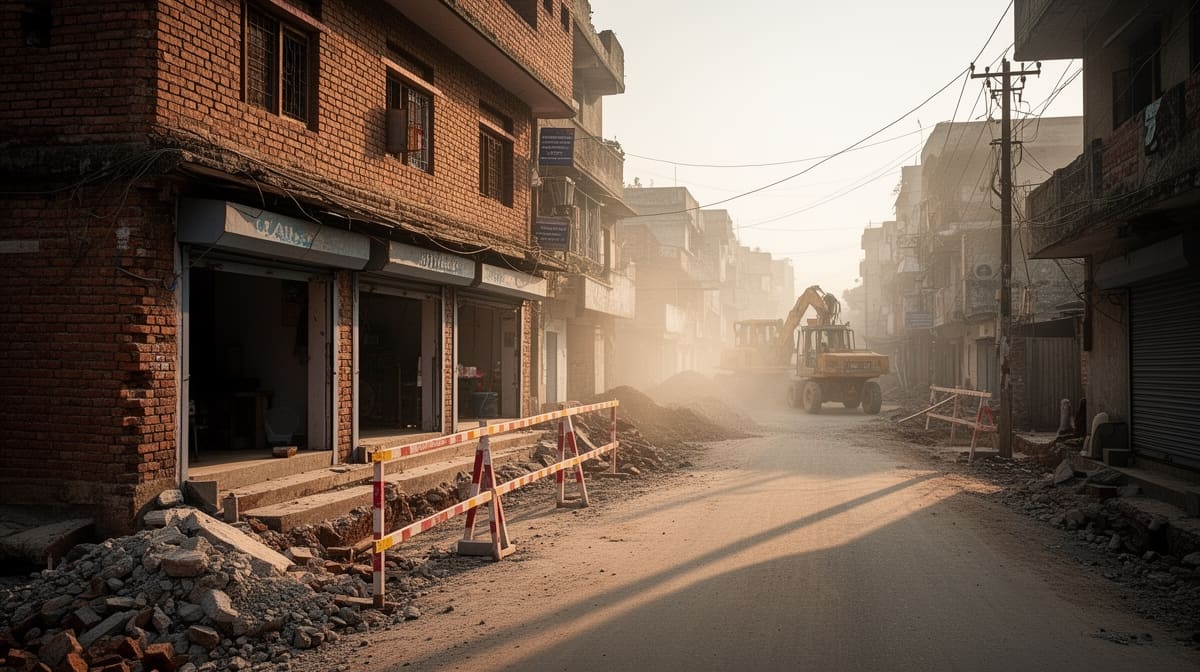
The Bombay High Court set aside municipal notices that attempted to acquire a portion of a privately owned factory for a proposed road widening, holding that Sections 297 and 299 of the Mumbai Municipal Corporation Act, 1888 cannot be invoked where the land does not constitute an existing public street.
Background & Facts
The Dispute
The petitioners, Newkem Products Corporation (a partnership firm) and its managing partner Nimish Sura, own a 13,337-sq-metre property at Lake Road, Bhandup (West), Mumbai, which includes a factory and ancillary structures. The Municipal Corporation of Greater Mumbai (MCGM) issued notices dated 5 July 2024 and 1 April 2025 under the Mumbai Municipal Corporation Act, 1888, proposing to prescribe a 12.20-metre-wide regular line of Aatmaram Bhoir Marg and to acquire the portion of the petitioners’ land lying between points C and D for a connector road between Gamdevi Road and Lake Road.
Key Facts
- 1957: Petitioners began exclusive possession, occupation and enjoyment of the property.
- 25 August 2022: MCGM proposed a fresh road line widening the existing 9.15-metre road to 12.20 metres.
- 5 July 2024: Public notice issued showing the proposed 12.20-metre regular line (A-B-C-D).
- 25 July 2024: Petitioners submitted objections to the proposal and requested a hearing.
- 7 October 2024: Public hearing held; petitioners reiterated objections, emphasizing long-standing private possession.
- 1 April 2025: Respondents (Chief Engineer and Assistant Commissioner) issued possession notice under Section 299, demanding hand-over of land between points C and D, including walls, hedge, platform and verandah.
- 22 April 2025: Petitioners filed objections to the possession notice.
- 22 April 2025: The Court granted liberty to withdraw Writ Petition (L) No.10861 of 2025 and file a fresh petition, which became the present Writ Petition No.540 of 2026.
- 20 July 2025: Affidavit-in-reply filed by respondents citing representation by an elected public representative.
- 11 August 2026: Judgment pronounced.
Procedural History
- 5 July 2024: Public notice issued by MCGM under the Act.
- 1 April 2025: Possession notice issued under Section 299.
- 22 April 2025: Petitioners filed objections; Court allowed withdrawal of earlier writ petition and liberty to file a fresh petition.
- 22 April 2025: Fresh Writ Petition No.540 of 2026 filed before the High Court.
- 5 August 2026: Matter reserved for judgment.
- 11 August 2026: Judgment delivered, quashing the notices and dismissing interim applications No.2562 of 2026 and No.6738 of 2025.
Parties' Positions
- Petitioners argued that the land between points C and D is private, has never been a public street, and that acquisition would split a functioning factory, causing irreparable loss. They relied on Steel Plant Pvt. Ltd. v. Municipal Corporation of Greater Mumbai and contended that Sections 297(1)(b) and 299 cannot apply.
- Respondents contended that the proposed connector serves a public purpose by linking two major roads, that the statutory procedure under Sections 3(x), 291, 299 and 301 was duly followed, and that compensation would be payable.
Relief Sought
The petitioners sought quashing of the notices dated 5 July 2024 and 1 April 2025, a declaration that the statutory provisions could not be used to acquire the land between points C and D, and dismissal of the interim applications.
The Legal Issue
Whether Section 297 and Section 299 of the Mumbai Municipal Corporation Act, 1888 empower the municipal authority to prescribe a regular line and acquire land that does not form part of an existing public street, specifically the portion of the petitioners’ factory between points C and D.
Arguments Presented
For the Petitioners
- Asserted that the land in question is private and has never been a public street; therefore, the statutory power to prescribe a regular line cannot be invoked.
- Emphasised that acquisition would sever the factory’s operational units, including gas pipes and electrical installations, causing disproportionate hardship.
- Relied on Steel Plant Pvt. Ltd. v. Municipal Corporation of Greater Mumbai to argue that the statutory provision is limited to land within the regular line of an existing street.
- Highlighted the lack of any concrete public benefit, noting that the proposed connector would save only about 400 metres and that the existing road is heavily encroached, with no evidence of steps to widen it to the statutory 9.15 metres.
For the Respondents
- Maintained that the proposal forms part of the Development Plan and that the municipal corporation has statutory authority under Sections 3(x), 291, 299 and 301 to acquire land for road widening.
- Argued that the connector would alleviate traffic congestion, reduce pollution, and provide public access to a municipal garden, thereby serving a legitimate public interest.
- Stated that compensation would be payable under the Act, mitigating any hardship to the petitioners.
- Relied on the wording of Sections 297(1)(a) and (1)(b) to contend that a fresh line may be prescribed even where the existing road is inadequate.
The Court's Analysis
The Court first affirmed the factual matrix: the petitioners have been in exclusive possession of the property since 1957, and the segment between points C and D forms an integral part of their factory. It then examined the scope of Section 297 and Section 299.
"Section 297 of the Act empowers the Commissioner to prescribe a regular line of a street. Section 297 (1)(a) expressly refers to the power to prescribe a line on each side of any public street. Section 297 (1)(b) permits a fresh line to be prescribed in substitution of a road line already prescribed. Section 299 enables the Commissioner, after following the prescribed procedure, to take possession of land which lies within the regular line of a public street, subject to the conditions contained therein."
The Court held that the statutory language ties the power to existing public streets. The land between points C and D, while shown in the sanctioned Development Plan as part of the proposed road, has never been a public street nor has it ever been used as such. Consequently, the provision cannot be stretched to treat private factory land as a public street.
The Court distinguished the present case from Steel Plant by noting that there too the land was not an existing street. It further observed that the alleged public purpose was illusory: the proposed connector would save merely 400 metres, the existing road is already encroached, and no steps were taken to widen it to the statutory minimum. The presence of essential factory infrastructure (gas pipes, electrical rooms, buried cables) reinforced the private character of the land.
Thus, the Court concluded that the municipal authority had exceeded its statutory jurisdiction and that the notices seeking possession were ultra vires.
The Verdict
The petition is partly allowed. The notices dated 5 July 2024 and 1 April 2025 issued under Section 299 of the Mumbai Municipal Corporation Act, 1888 are quashed and set aside insofar as they seek possession of the petitioners’ land between points C and D. Interim Application (Lodging) No.2562 of 2026 and Interim Application No.6738 of 2025 are disposed of.
What This Means For Similar Cases
Statutory Power Limited to Existing Streets
- Courts will scrutinise whether the land claimed under Sections 297/299 is part of an already existing public street before permitting acquisition.
- Mere inclusion of land in a Development Plan does not convert private property into a public street.
Public Interest Must Be Real and Substantial
- Authorities must demonstrate a concrete public benefit, not a speculative or marginal advantage, to justify invoking the acquisition provisions.
- Quantitative benefits (e.g., distance saved) should be substantiated with evidence.
Procedural Safeguards Against Abuse
-
Affected owners can successfully challenge possession notices by showing continuous private possession and the absence of any statutory easement.
-
Detailed objections, public hearings, and affidavits are critical tools to contest municipal proposals.
-
Verify the existence of a public road before invoking Sections 297/299.
-
Document all historical possession and usage of the land.
-
Demand concrete data on public benefit and cost-benefit analysis.
-
Prepare to cite precedents such as Steel Plant Pvt. Ltd. v. Municipal Corporation of Greater Mumbai.