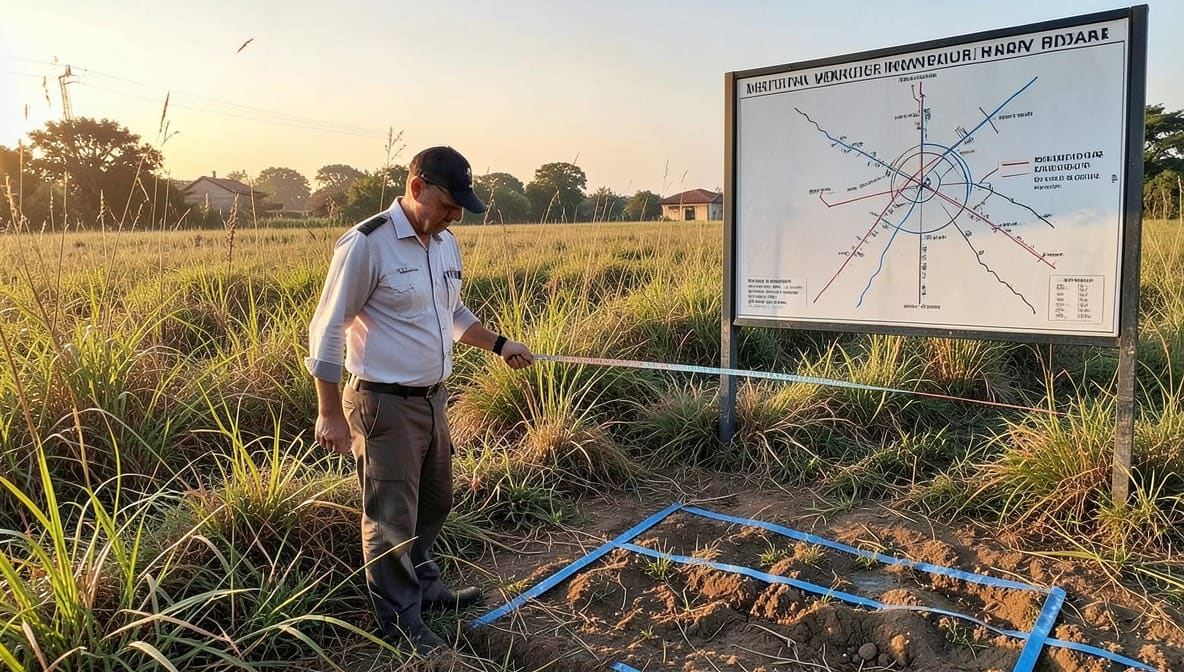
The Madhya Pradesh High Court has reaffirmed that municipal authorities cannot unilaterally mark private land for public road construction without adhering to mandatory procedural safeguards under the Municipal Corporation Act. This ruling reinforces the foundational principle that even in infrastructure projects, due process is non-negotiable.
Background & Facts
The Dispute
The petitioner, Madan Singh, owns land bearing Survey No. 58/1/1 situated at Village-Bada Bangarda, Tehsil-Hatod, District-Indore. Respondent No. 2, the Indore Municipal Corporation, allegedly entered upon this land without any prior notice, without fixing a central line as required by law, and without initiating any proceedings under the Madhya Pradesh Municipal Corporation Act, 1956. The petitioner contends that portions of his land are being marked for the proposed 45-meter Master Plan Road, thereby threatening his proprietary rights.
Key Facts
- The petitioner is the lawful owner of Survey No. 58/1/1 at Village-Bada Bangarda
- No formal notice was issued to the petitioner under Section 305 of the Municipal Corporation Act
- No central line was demarcated or published for the proposed 45-meter road
- No opportunity to file objections was granted to the petitioner
- No committee report was shared with the petitioner prior to marking of land
- The Corporation claims it is acting in public interest under its statutory duties
Procedural History
- The writ petition was filed on an unspecified date in 2026 before the High Court of Madhya Pradesh at Indore
- No prior administrative order, notice, or decision had been issued against the petitioner
- The petitioner sought immediate restraint on the Corporation’s actions
- The respondents contended that no final order had been passed, rendering the petition premature
The Parties' Positions
For the Petitioner
The petitioner argued that the Corporation’s actions constituted an illegal encroachment on private property, violating his fundamental right to property under Article 300A of the Constitution and the procedural mandates of Section 305 of the Municipal Corporation Act. He emphasized that marking land without notice or hearing amounted to a de facto acquisition without due process.
For the Respondent/State
The Indore Municipal Corporation contended that no final order had been passed against the petitioner, and that the mere marking of land for a master plan road was a preliminary, non-final step. It argued that the petition was premature and that the Corporation would comply with Section 305 before taking any coercive action.
Relief Sought
The petitioner sought a writ of prohibition to restrain the Corporation from marking or interfering with his land until due process under Section 305 was completed. He also sought a direction to supply him with the committee report and an opportunity to file objections.
The Legal Issue
The central question was whether a municipal corporation can proceed to mark private land for a proposed road under the Municipal Corporation Act without first issuing a notice, affording a hearing, and providing access to the committee report as mandated by Section 305.
Arguments Presented
For the Petitioner
The petitioner relied on the doctrine of natural justice and the requirement of procedural fairness under Article 14 of the Constitution. He cited Maneka Gandhi v. Union of India to argue that even statutory powers must be exercised in a fair and reasonable manner. He emphasized that Section 305 of the Municipal Corporation Act explicitly requires notice and hearing before any action affecting property rights. The mere assertion of public purpose, he argued, cannot override statutory procedure.
For the Respondent/State
The State countered that no final order had been passed, and that the marking of land was only a preliminary survey step, not a final decision. It contended that the petition was premature and that the Corporation was acting in accordance with its statutory duty under Section 305, which would be followed before any coercive action. It argued that judicial intervention at this stage would impede public infrastructure development.
The Court's Analysis
The Court examined the language and intent of Section 305 of the Madhya Pradesh Municipal Corporation Act, which provides that no land shall be acquired or used for public purposes without notice to the affected person and an opportunity to be heard. The Court held that the act of marking land for a proposed road is not a mere administrative formality but a critical step that directly affects property rights. The Court observed that even if no final order has been passed, the irreversible act of marking land without procedural safeguards constitutes a violation of statutory and constitutional norms.
"The very act of marking the land for a proposed road, without notice, without hearing, and without sharing the committee report, amounts to a de facto interference with the petitioner’s property rights, which cannot be countenanced under the rule of law."
The Court rejected the argument that the petition was premature, noting that the harm caused by unlawful marking is immediate and irreparable. The Court emphasized that statutory procedures are not optional steps but mandatory conditions precedent to any action affecting private rights. The Corporation’s duty under Section 305 is not discretionary but obligatory.
The Verdict
The writ petition was disposed of with the following directions: The Indore Municipal Corporation shall issue a formal notice under Section 305 of the Municipal Corporation Act to the petitioner, afford him a reasonable opportunity to file objections, and supply him with the committee report upon which any action is proposed. Only after considering the petitioner’s objections shall the Corporation pass a final order. No further action on the land shall be taken until this procedure is completed.
What This Means For Similar Cases
Procedural Compliance Is Non-Negotiable
- Practitioners must now insist on strict adherence to Section 305 before any land marking or survey in municipal projects
- Mere public interest claims cannot override statutory notice and hearing requirements
- Any preliminary marking of land without notice is actionable under Article 226
Committee Reports Must Be Disclosed
- Affected landowners have a right to access the committee report before filing objections
- Withholding such reports violates the principle of audi alteram partem
- Failure to supply the report renders any subsequent order voidable
Writ Jurisdiction Applies Even Without Final Order
- Courts will intervene when statutory procedures are bypassed, even if no final order exists
- Irreversible acts like land marking constitute sufficient grounds for writ relief
- The doctrine of prejudice applies: harm caused by procedural violation is actionable regardless of final outcome