The Bombay High Court has affirmed that landowners whose property is reserved for public roads under a sanctioned development plan are entitled to compensation under the Maharashtra Regional and Town Planning Act, 1966, regardless of whether the layout was approved before municipal incorporation. This ruling clarifies a long-standing ambiguity regarding the vesting of open land in planning authorities and reinforces the principle that acquisition for public purpose cannot be无偿.
Background & Facts
The Dispute
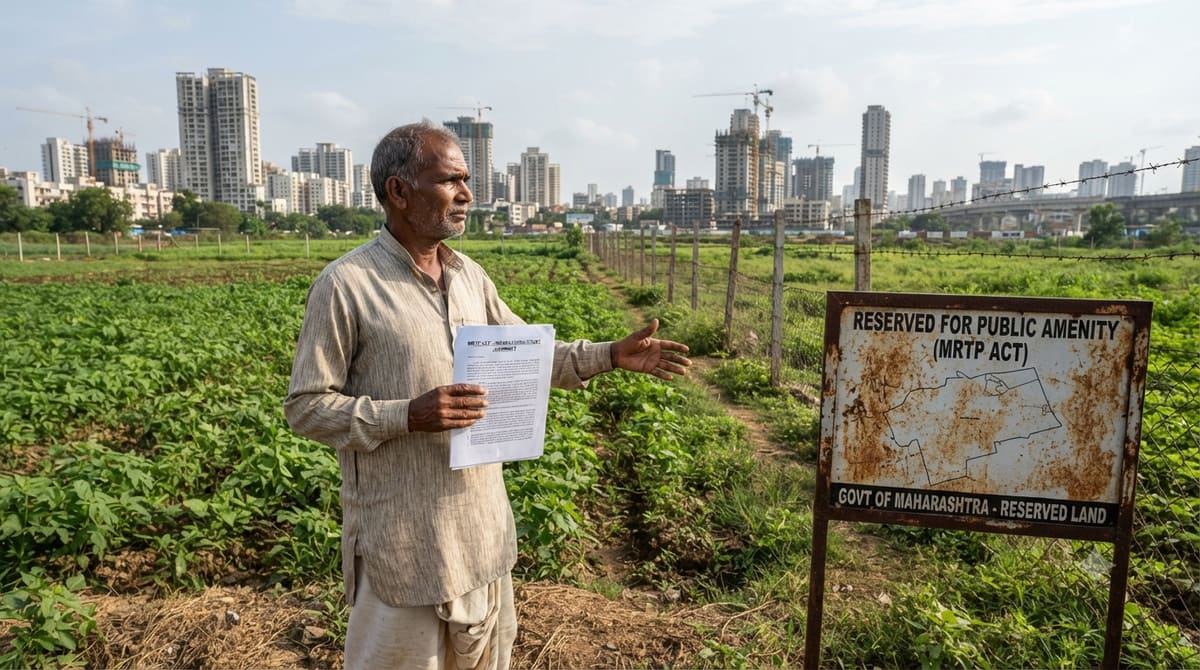
The petitioner, Suresh Kisan Bari, is the owner of land bearing Survey No. 151/1, admeasuring 27,000 square meters, situated in village Pimprala, Taluka and District Jalgaon. The land was originally part of a non-agricultural layout approved prior to the establishment of the Jalgaon Municipal Corporation. After the Municipal Corporation was constituted, the land was included within its jurisdiction and subsequently reserved for two public roads - an 18-meter and a 30-meter wide Development Plan road - under the sanctioned Development Plan of Jalgaon City.
Key Facts
- The petitioner’s layout was sanctioned by the Jalgaon Municipal Council before the Municipal Corporation was established on 11.09.1987.
- The sanctioned Development Plan for the extended area of Jalgaon City was approved under Section 31 of the MRTP Act on 11.02.2002 and came into force w.e.f. 07.04.2002.
- Survey No. 151/1 was specifically reserved for the 18-meter and 30-meter roads in the sanctioned plan.
- On 10.01.2013, the petitioner applied to the Jalgaon Municipal Corporation for Transferable Development Rights (T.D.R.) of 4,875 square meters, as permitted under municipal policy.
- On 11.02.2014, the Corporation rejected the T.D.R. application, citing incomplete documentation and requested submission of further papers within 15 days.
- On 31.03.2014, the petitioner withdrew his T.D.R. application and instead requested compensation for the reserved land.
- On 30.03.2016, the Municipal Corporation passed Resolution No. 424, deciding that the value of the petitioner’s land would be determined by a three-member committee and compensation would be paid through private negotiation.
- No further action was taken by the Corporation after Resolution No. 424.
- The petitioner’s land remains reserved and unusable for any private purpose, while the road alignment has been implemented.
Procedural History
- 10.01.2013: Petitioner applies for T.D.R. with Jalgaon Municipal Corporation.
- 11.02.2014: Corporation rejects T.D.R. application for lack of documents.
- 31.03.2014: Petitioner writes requesting compensation instead of T.D.R.
- 30.03.2016: Municipal Corporation passes Resolution No. 424 to assess compensation.
- 01.10.2018: Affidavit-in-reply filed by Respondents 1 to 4.
- 20.07.2017: Writ Petition No. 5343 of 2017 filed before the Bombay High Court, Aurangabad Bench.
- 23.04.2026: Judgment reserved.
- 07.05.2026: Judgment pronounced.
The Parties' Positions
Petitioner’s Position: The reservation of land for public roads constitutes an acquisition under Section 127 of the MRTP Act, entitling him to compensation. The failure to act on Resolution No. 424 violates his fundamental right to just compensation. He relies on State of Maharashtra v. Bhimashankar Sidramappa Chippa and Sow. Ratnabai v. State of Maharashtra to argue that open land in a sanctioned layout does not vest in the planning authority free of cost.
Respondents’ Position: The land was part of a layout approved before municipal incorporation, and the roads were part of the original sanctioned plan. No formal acquisition occurred. The petitioner availed benefits such as exemption from open space and road frontage norms. Under Regulation 40.3(iii) of the Development Control and Promotion Regulations for D-Class Municipal Corporations, T.D.R. is not available for pre-existing layouts. Hence, no compensation is payable.
Relief Sought
The petitioner sought:
- A direction to Respondent No. 5 to implement Resolution No. 424 dated 30.03.2016 within one month;
- Compensation for the reserved land under Section 127 of the MRTP Act;
- Payment of compensation in accordance with law.
The Legal Issue
The central question was whether Section 127 of the Maharashtra Regional and Town Planning Act, 1966 entitles a landowner to compensation when his land is reserved for public roads under a sanctioned Development Plan, even if the layout was approved prior to the establishment of the Municipal Corporation and the landowner had previously availed developmental benefits.
Arguments Presented
For the Petitioner
The petitioner’s counsel relied on two key judgments: State of Maharashtra v. Bhimashankar Sidramappa Chippa (2009 SCC Online Bom 707) and Sow. Ratnabai w/o Damodhar More v. State of Maharashtra (Writ Petition No. 481/2006, decided 16.06.2011). In both cases, this Court held that the mere imposition of a condition in a layout sanction order - requiring transfer of open space to the planning authority - does not result in free vesting of land. The Court emphasized that acquisition for public purpose under the MRTP Act requires compensation. The petitioner argued that reservation of land for roads constitutes de facto acquisition, triggering the obligation to pay compensation under Section 127. He further contended that the Municipal Corporation’s Resolution No. 424 constituted a binding admission of liability.
For the Respondent/State
The State and Municipal Corporation argued that the land was part of a pre-existing layout approved before the Municipal Corporation’s jurisdiction began. The roads were integral to the original sanctioned plan, and no separate acquisition process was initiated. The petitioner had benefited from relaxed norms on open space and road frontage, which were granted in exchange for dedicating land for public use. Regulation 40.3(iii) of the Development Control and Promotion Regulations explicitly excludes T.D.R. for such layouts, and since T.D.R. was the only statutory remedy available, no compensation claim arises. They further contended that Section 127 applies only to formal acquisition proceedings, not to land reserved under a Development Plan.
The Court's Analysis
The Court undertook a detailed examination of the statutory framework under the MRTP Act and relevant precedents. It noted that Section 127 empowers the Planning Authority to acquire land for public purposes, including roads, and mandates compensation. The Court rejected the respondents’ argument that reservation without formal acquisition proceedings negates the obligation to pay compensation.
"The mere fact that the land was part of a sanctioned layout does not mean that the owner has irrevocably surrendered his right to compensation. The State cannot appropriate private property for public use without paying just compensation."
The Court distinguished the respondents’ reliance on Regulation 40.3(iii), clarifying that this provision governs eligibility for T.D.R., not the right to compensation under Section 127. The two remedies are distinct: T.D.R. is a compensatory mechanism for development rights, while Section 127 provides for monetary compensation for actual acquisition or reservation of land.
The Court further held that the Municipal Corporation’s Resolution No. 424, passed after the petitioner’s request for compensation, was a clear acknowledgment of liability. The failure to implement it amounted to a violation of the petitioner’s legitimate expectation and substantive rights.
The judgments in Bhimashankar Chippa and Ratnabai were affirmed as binding precedents. The Court emphasized that the principle of equity and the constitutional guarantee under Article 300A (right to property) require that no landowner be deprived of property without compensation, regardless of the procedural history of the layout.
The Verdict
The writ petition was allowed. The Court directed the Jalgaon Municipal Corporation to pay compensation to the petitioner for his reserved land bearing Survey No. 151/1, in accordance with law, within a period of 12 weeks from the date of judgment. No costs were awarded. The Corporation was also directed to implement Resolution No. 424 dated 30.03.2016 by constituting the three-member committee and concluding private negotiations for valuation.
What This Means For Similar Cases
Compensation Is Mandatory for Reserved Land
- Practitioners must now argue that reservation under a Development Plan under the MRTP Act constitutes acquisition under Section 127, triggering an automatic obligation to pay compensation.
- Municipalities cannot rely on pre-incorporation layout approvals to deny compensation - the timing of approval is irrelevant to the right to compensation.
- The mere existence of T.D.R. provisions does not extinguish the right to monetary compensation under Section 127.
Resolution as Binding Admission of Liability
- A municipal resolution acknowledging liability for compensation (e.g., Resolution No. 424) creates a legally enforceable obligation.
- Delay in implementation after such a resolution constitutes a violation of legitimate expectation and may attract writ jurisdiction.
- Petitioners should cite such resolutions as evidence of admission of liability in future litigation.
T.D.R. and Compensation Are Independent Remedies
- T.D.R. is a development incentive, not a substitute for compensation.
- Landowners may pursue both remedies concurrently, or choose one over the other.
- Municipalities cannot use T.D.R. eligibility rules to deny compensation claims under Section 127.