The Madhya Pradesh High Court’s interim order in Naryan Maratha v. State of Madhya Pradesh underscores a critical procedural safeguard in urban governance: enforcement of penal provisions against illegal colonization cannot be delegated to administrative officers lacking judicial authority. This ruling reinforces the separation between executive action and judicial punishment under statutory frameworks.
Background & Facts
The Dispute
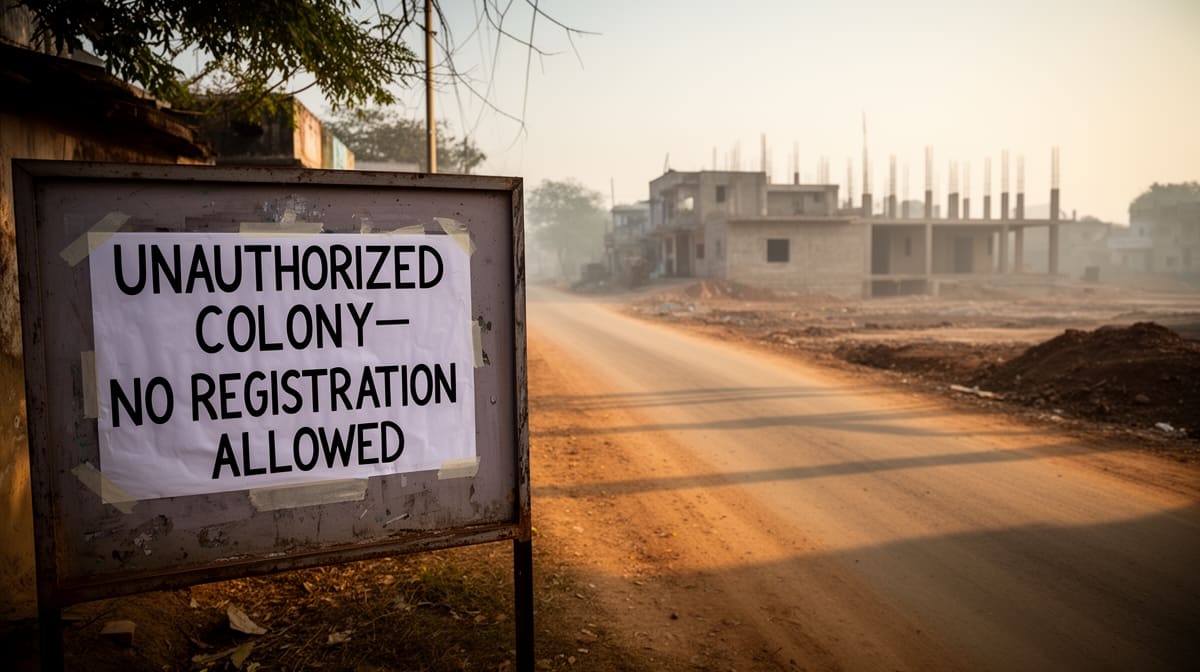
The petitioner, Naryan Maratha, challenged coercive action taken by the Collector and Sub-Divisional Officer (Revenue) to remove construction in an unauthorized colony. The respondents issued notices and initiated removal proceedings under the Colony Development Rules, 2021, while simultaneously threatening penal action under Section 339-C of the M.P. Municipalities Act, 1961. The petitioner contended that these officials, though empowered to remove structures, were not authorized to initiate criminal complaints or impose fines.
Procedural History
- The impugned orders were issued by Respondent No. 2 (Collector) and Respondent No. 3 (Sub-Divisional Officer, Revenue)
- Petitioner filed a writ petition seeking stay on enforcement of penal proceedings
- Counsel relied on a prior interim order in W.P. No. 49713/2025, where this Court had granted similar relief
- No criminal complaint had been filed before a court; enforcement was being carried out administratively
Relief Sought
The petitioner sought an interim stay on all penal proceedings initiated by the revenue authorities, arguing that only a court of law can impose punishment under Section 339-C(3), and that administrative officers cannot act as prosecutors or sentencing authorities.
The Legal Issue
The central question was whether Section 339-C(3) of the M.P. Municipalities Act, 1961, permits revenue officers to initiate criminal complaints and impose fines for illegal colonization, or whether such powers are exclusively vested in the court.
Arguments Presented
For the Petitioner
The petitioner’s counsel argued that Section 339-C(3) explicitly states that "the Court may, in passing the judgment... order the accused to pay... compensation" and that the offence is cognizable only when prosecuted before a judicial forum. Reliance was placed on Rule 22(4) of the Colony Development Rules, 2021, which mandates that the competent authority file a complaint in the police station for "penal action under the relevant provisions of the Act" - but does not empower the authority to adjudicate or impose punishment. The petitioner emphasized that administrative action cannot usurp judicial function.
For the Respondent/State
The State did not contest the legal interpretation of Section 339-C(3) but argued that initiating a police complaint was a preliminary step to enable prosecution, not an act of punishment. Counsel maintained that the removal of structures and filing of complaints were distinct acts, and that the latter was merely procedural, not substantive.
The Court's Analysis
The Court examined the statutory language of Section 339-C(3) and found that the power to impose imprisonment and fine is expressly vested in "the Court". The phrase "in passing the judgment" leaves no ambiguity: punishment is a judicial act. The Court distinguished between the executive’s power to remove illegal constructions and the judiciary’s exclusive authority to impose penal consequences.
"The Court may, in passing the judgment in respect of any such offence, order the accused to pay to the Council, such amount of compensation..."
This language, the Court held, is not merely permissive but prescriptive - it conditions compensation on judicial determination. The State’s argument that filing a complaint is merely procedural was rejected as legally untenable, since Section 339-C(3) makes the offence cognizable only upon court-initiated proceedings. The Court further noted that Rule 22(4) of the Colony Development Rules, 2021, requires filing a complaint for "penal action" - but does not authorize the authority to determine guilt or sentence. To permit revenue officers to act as prosecutors or sentencing bodies would violate the principle of separation of powers and the doctrine of audi alteram partem.
The Verdict
The petitioner succeeded. The Court stayed all penal proceedings initiated by the Collector and Sub-Divisional Officer, holding that only a court can impose punishment under Section 339-C(3). Administrative authorities may remove structures and file complaints, but they cannot determine liability or fix compensation.
What This Means For Similar Cases
Judicial Punishment Cannot Be Delegated
- Practitioners must challenge any administrative order that imposes or threatens fines, imprisonment, or compensation under penal statutes requiring judicial adjudication
- Filing a police complaint is permissible, but any subsequent coercive action (e.g., asset attachment, forced payment) without court order is ultra vires
- In writ petitions, cite Section 339-C(3) and Rule 22(4) together to demonstrate the mismatch between executive action and judicial mandate
Competent Authority ≠ Punishing Authority
- Identify the specific statutory provision granting punishment power - always check if it says "Court" or "Authority"
- If the statute uses "Court", treat any administrative penalty as void ab initio
- In cases involving RERA, Municipal Acts, or land use violations, this precedent applies analogously where judicial discretion is statutorily mandated
Procedural Compliance Is Non-Negotiable
- Before initiating penal action, ensure the complaint is filed before a magistrate, not merely with police
- Revenue officers must limit themselves to evidence collection and forwarding complaints
- Petitioners in similar cases should seek immediate stay on coercive recovery orders pending judicial determination