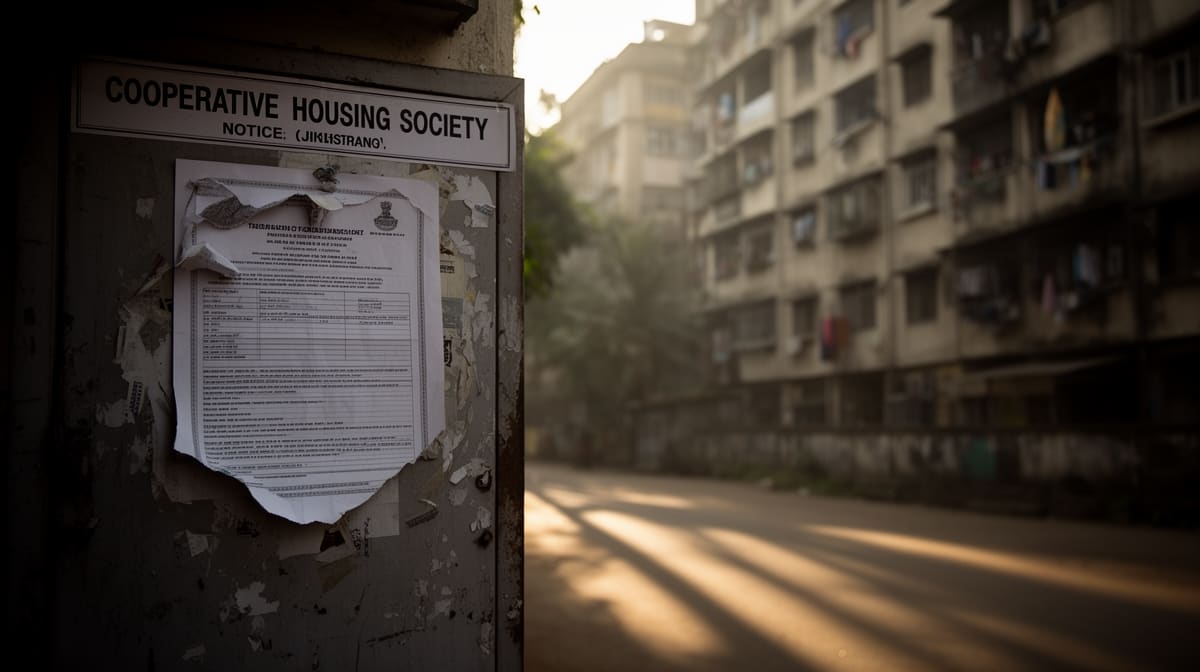
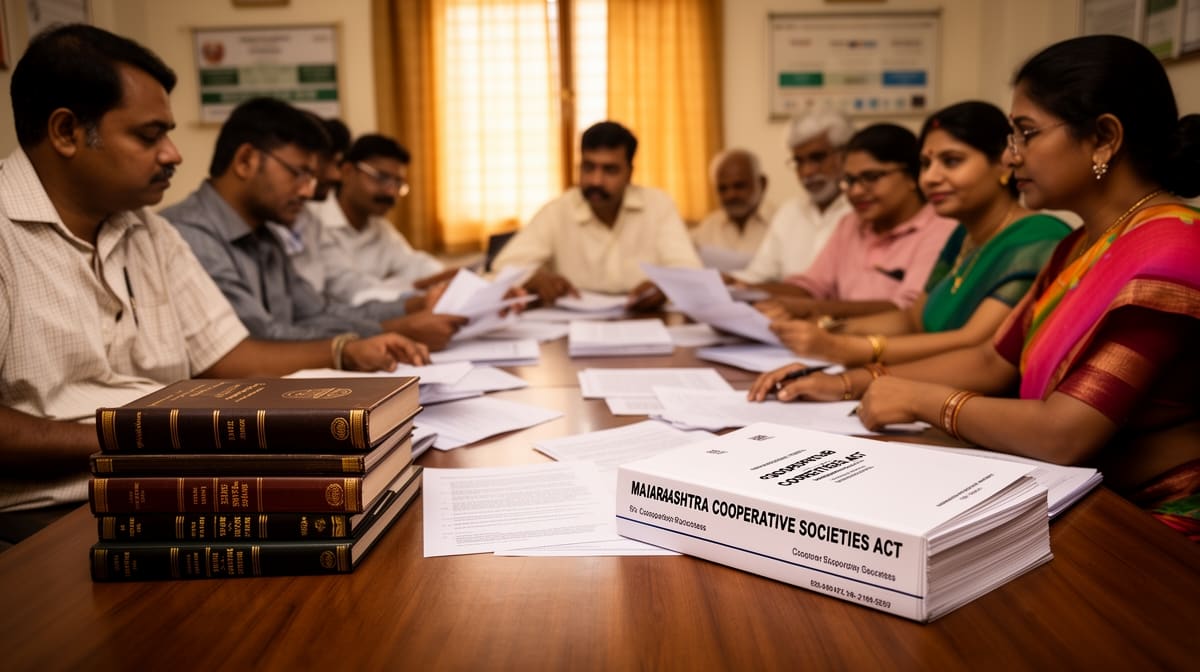
The Bombay High Court has clarified that the de-registration of a co-operative housing society under Section 21-A of the Maharashtra Co-operative Societies Act, 1960, cannot be justified merely on the basis of disputed title documents or the mere filing of a criminal complaint. The judgment reinforces that such drastic action is permissible only where the society’s registration itself was procured by fraud or misrepresentation at the time of application.
Background & Facts
The Dispute
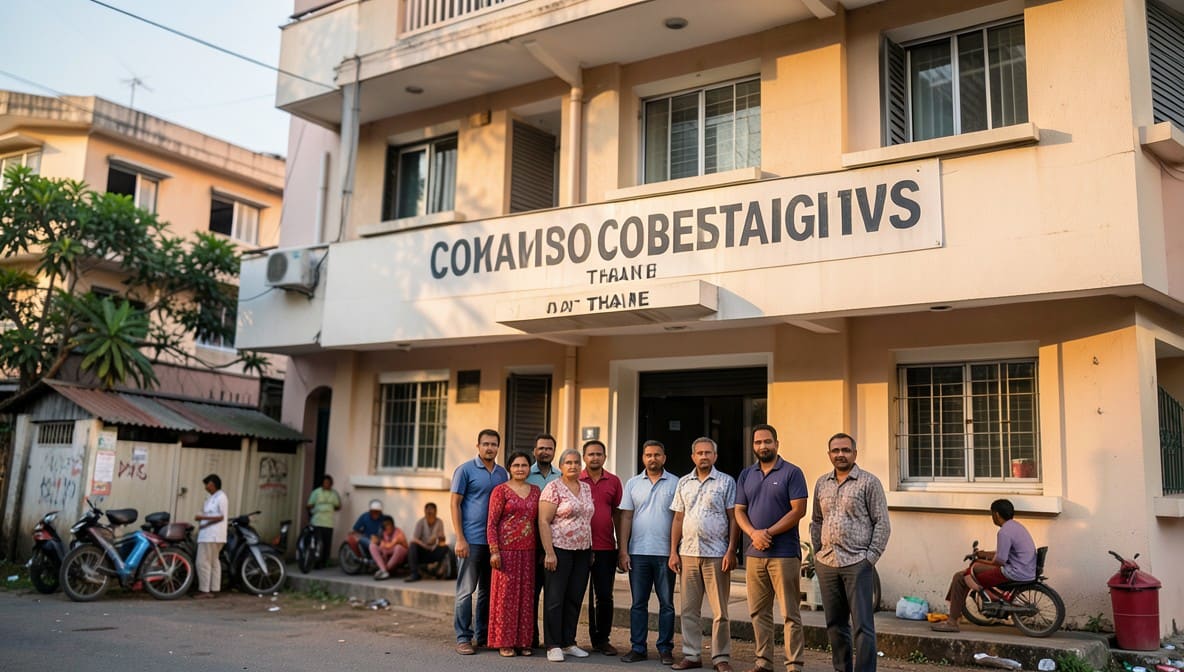
The dispute arose from conflicting claims over the ownership and development rights of land in Sector 20, Nerul, Navi Mumbai. The land was originally leased to Shankar Thakur and Rakhmabai Thakur by CIDCO on 1 April 2003. On 27 June 2003, Rakhmabai Thakur executed a General Power of Attorney in favor of her husband, authorizing him to deal with the plot. On 9 August 2003, an application for development permission was submitted, and Navi Mumbai Municipal Corporation granted a commencement certificate on 30 October 2003. On 6 December 2003, a development agreement was executed between the landowners and Mohan Kashiram Kadam, the promoter, on a principal-to-principal basis. A power of attorney was also executed in favor of the promoter to facilitate development.
Key Facts
- The building was constructed after obtaining sanctioned plans from CIDCO
- An occupation certificate was issued on 11 August 2006
- All 20 residential flats were sold between 2005 and 2006 under registered agreements
- The four commercial shop premises were sold in 2010, with possession handed over to purchasers
- The society, Matsyaghandha CHS Limited, was registered on 8 March 2011 under Section 10 of the Maharashtra Ownership Flats Act, 1963 (Registration No. 3802)
- On 4 July 2011, the society filed an application for deemed conveyance under Section 11(3) of MOFA
- On 6 February 2012, two documents - a gift deed and an agreement for sale - were executed in favor of Usha Hanmant Wakshe and Nilesh Laxman Thakur
- A criminal complaint alleging forgery was lodged by Rakhmabai Thakur on 7 September 2012
- An FIR was registered on 7 December 2012 following a court order
- The Joint Registrar rejected the application for de-registration on 10 March 2014
- The Co-operative Minister, acting as appellate authority, allowed the appeal and ordered de-registration on 12 September 2014
- Writ petitions were filed on 11 November 2014 challenging the de-registration order
- Shankar Thakur died in November 2018; his legal heirs did not seek impleadment
- Rakhmabai Thakur withdrew her criminal complaint on 20 February 2022, which was dismissed by the Magistrate on 28 February 2022
- Rakhmabai Thakur passed away on 23 October 2022
- The only remaining respondents are Usha Hanmant Wakshe and Nilesh Laxman Thakur, who are not members of the society but claim possession of two shop premises
Procedural History
- 01.04.2003: CIDCO leases land to Shankar and Rakhmabai Thakur
- 27.06.2003: Rakhmabai Thakur executes General Power of Attorney in favor of Shankar Thakur
- 09.08.2003: Application for development permission submitted
- 30.10.2003: Commencement certificate issued by NMMC
- 06.12.2003: Development agreement executed between landowners and Mohan Kashiram Kadam
- 06.12.2003: Power of attorney executed in favor of promoter
- 2005 - 2006: Sale of all 20 residential flats completed
- 2010: Sale of four commercial shop premises completed
- 11.08.2006: Occupation certificate issued by NMMC
- 24.07.2009: Consumer complaint filed at Thane Consumer Forum
- 18.11.2009: Consumer Forum directs promoter to register society
- 09.02.2011: Application for society registration filed
- 08.03.2011: Society registered as Matsyaghandha CHS Limited (No. 3802)
- 04.07.2011: Application for deemed conveyance filed under MOFA
- 06.02.2012: Alleged gift deed and agreement for sale executed in favor of Usha Wakshe and Nilesh Thakur
- 07.09.2012: Criminal complaint filed by Rakhmabai Thakur alleging forgery
- 07.12.2012: Court directs registration of FIR
- 10.03.2014: Joint Registrar rejects de-registration application
- 25.07.2014: Appeal filed before Co-operative Minister
- 12.09.2014: Minister allows appeal and orders de-registration
- 11.11.2014: Writ Petitions filed in Bombay High Court
- 20.02.2022: Rakhmabai Thakur withdraws criminal complaint
- 28.02.2022: Magistrate dismisses complaint
- 23.10.2022: Rakhmabai Thakur dies
- 15.10.2025: Final hearing before Bombay High Court
The Parties' Positions
Petitioners (Society Members and Promoter): Argued that the society was validly formed by flat and shop purchasers who had paid full consideration, taken possession, and sought collective management. They contended that title disputes between landowners and promoter are civil matters and cannot justify de-registration under Section 21-A. They emphasized that no fraud was committed at the time of registration.
Respondents (Usha Wakshe and Nilesh Thakur): Contended that the society’s registration was vitiated due to non-compliance with Rule 4 of the Maharashtra Co-operative Societies Rules, 1961, alleged discrepancies in the identity of the chief promoter, and the authenticity of the development agreement and power of attorney. They relied on the existence of an FIR and pending civil suits as evidence of fraud.
Relief Sought
The petitioners sought quashing of the order dated 12 September 2014 directing de-registration of the society and restoration of the Joint Registrar’s order dated 10 March 2014, which had rejected the de-registration application. The promoter also sought dismissal of his own writ petition (WP 10193/2014), which challenged the FIR and criminal proceedings.
The Legal Issue
The central question was whether the appellate authority under Section 21-A of the Maharashtra Co-operative Societies Act, 1960, could order de-registration of a co-operative housing society based on disputed title documents, pending civil litigation, or the mere filing of an FIR, without establishing that the registration itself was procured by fraud or misrepresentation at the time of application.
Arguments Presented
For the Petitioner
Mr. Shreepad Murthy argued that Section 21-A permits de-registration only where the registration was obtained by a false statement or suppression of material fact at the time of application. He emphasized that the society was formed by genuine purchasers who had paid full consideration, taken possession, and were residing in the building. He cited Rameshwar Cooperative Housing Society Limited v. Divisional Joint Registrar to argue that the misrepresentation must go to the root of registration and not merely relate to collateral disputes. He contended that title disputes, even if genuine, are civil matters and cannot be adjudicated in a summary proceeding under Section 21-A.
For the Respondent
Mr. Surel Shah and Mr. Kishor Patil argued that the society’s registration was invalid due to non-compliance with Rule 4 of the MCS Rules, 1961, which required the landowners to be impleaded as parties. They also pointed to inconsistencies in the identity of the chief promoter and alleged fabrication of documents. They relied on Waghamay Mahila Machchimar Sahakari Sanstha to argue that such irregularities amounted to fraud under Section 21-A. They further contended that the registration of an FIR and pending criminal proceedings substantiated the claim of fraud.
The Court's Analysis
The Court undertook a rigorous analysis of Section 21-A and its legislative intent. It held that the provision is not a general remedy for resolving property disputes but a narrow tool to address fraud at the time of registration. The Court emphasized that the test is not whether disputes exist, but whether the society would have been registered but for the alleged falsehood.
"Section 21-A does not give a wide and unlimited power to reopen everything. It is meant only for situations where the very registration of the society is based on some false statement or suppression of important fact. It is not meant to decide each and every dispute connected with property."
The Court distinguished between procedural irregularities and substantive fraud. It held that non-compliance with Rule 4, or a discrepancy in the name of the chief promoter, does not automatically constitute fraud unless it can be shown that the Registrar would have refused registration had the true facts been disclosed. The Court noted that the society was formed by actual purchasers who had paid consideration and taken possession - facts that remained unchanged regardless of title disputes.
The Court further rejected the reliance on the FIR as proof of fraud. It observed:
"A criminal complaint and a de-registration proceeding are not the same. They operate in different fields. The mere existence of an FIR cannot be treated as proof of fraud. It is only an allegation at that stage."
The Court also considered the withdrawal of the criminal complaint by Rakhmabai Thakur in 2022, noting that while subsequent events cannot override the authority’s decision at the time, they cast significant doubt on the credibility of the allegations. The Court emphasized that de-registration affects the rights of innocent members and must be reserved for cases where the society had no legal basis to exist from inception.
The Court concluded that the appellate authority had erred by conflating civil title disputes with fraud under Section 21-A. It held that such disputes must be resolved in civil courts, not through summary de-registration proceedings.
The Verdict
The writ petition filed by the society members succeeded. The Bombay High Court quashed and set aside the order dated 12 September 2014 directing de-registration of Matsyaghandha CHS Limited. The order dated 10 March 2014 of the Joint Registrar, rejecting the de-registration application, was restored. The writ petition filed by the promoter was dismissed. All pending interim applications were disposed of as infructuous. There was no order as to costs.
What This Means For Similar Cases
De-Registration Requires Fraud at Registration, Not Later Disputes
- Practitioners must now argue that Section 21-A cannot be invoked merely because title disputes, civil suits, or FIRs arise after registration
- The burden is on the applicant to prove that the registration was procured by deception at the time of application
- Post-registration disputes over development agreements, powers of attorney, or conveyance are civil matters and must be adjudicated in civil courts
FIRs Are Not Proof of Fraud in Co-operative Proceedings
- The mere registration of an FIR cannot be treated as conclusive evidence of fraud under Section 21-A
- Authorities must independently assess whether the registration was obtained by misrepresentation, not rely on criminal allegations
- Courts will scrutinize whether the alleged fraud was material enough to have prevented registration had it been known
Procedural Irregularities ≠ Fraud
- Non-compliance with Rule 4 or discrepancies in promoter details do not automatically amount to fraud
- Such defects may require explanation or internal correction but do not justify de-registration unless they go to the root of eligibility
- The existence of genuine purchasers who paid consideration and took possession is a decisive factor in validating registration