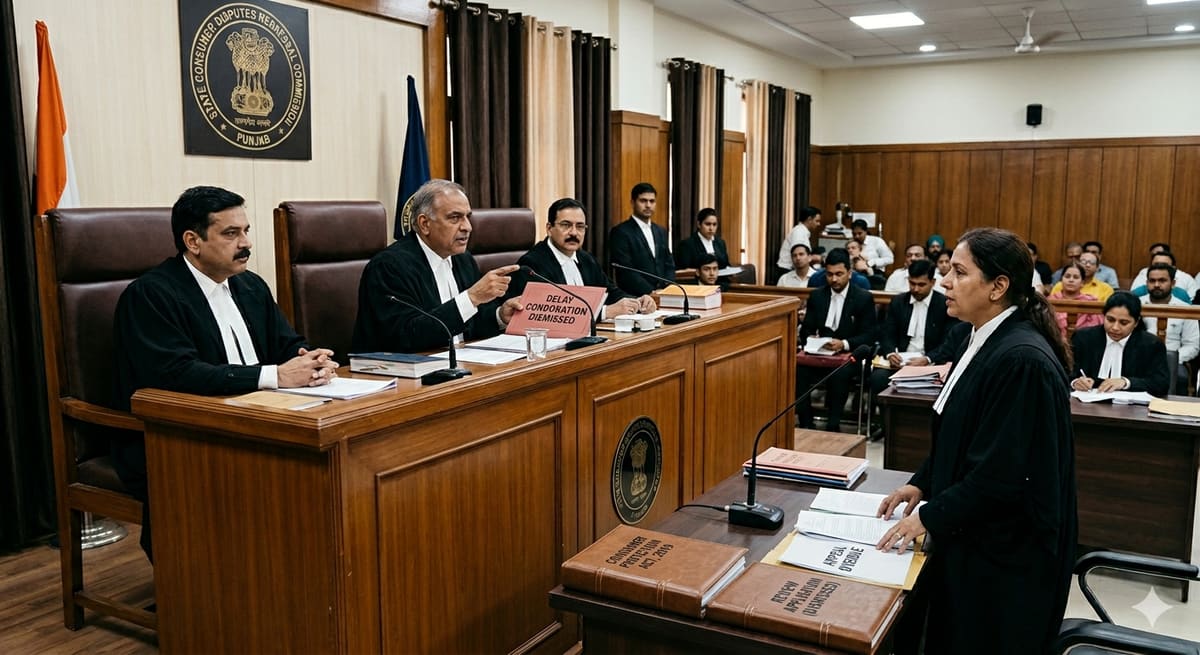
The State Consumer Disputes Redressal Commission, West Bengal, has dismissed an appeal seeking condonation of a 775-day delay in preferring an appeal against an ex parte order passed by the District Consumer Disputes Redressal Commission, Hooghly. The appellants failed to provide a legally cognizable justification for the unexplained period of delay, despite claiming financial constraints and initial contest in execution proceedings. The Commission held that casual or vague explanations do not suffice for macroscopic delays under the Consumer Protection Act, 2019.
Background & Facts
The Genesis
The appellants, M/s Parivar Enclave, are a real estate developer engaged in the construction and sale of residential properties. The respondent, Ms. Kalpana Bagchi, entered into an agreement for the purchase of a residential unit in a project developed by the appellants. The underlying transaction involved the execution of a deed of conveyance and delivery of vacant possession of the subject property.
Key Facts
- The respondent filed a consumer complaint (Complaint No. DC/312/CC/251/2022) before the District Consumer Disputes Redressal Commission, Hooghly, seeking execution of the deed of conveyance, delivery of vacant possession, and compensation of Rs. 1,50,000.
- The complaint was disposed of ex parte on 05.12.2023, directing the appellants to execute and register the deed of conveyance, deliver vacant possession, and pay compensation.
- The appellants claimed they were unaware of the ex parte order until served with a notice of execution proceedings on 20.09.2024.
- The appellants entered appearance in the execution proceedings on 20.09.2024 and contested the matter until 02.04.2026.
- The appellants alleged financial constraints prevented them from filing the appeal within the limitation period of 45 days.
- The appellants eventually filed the appeal on 04.01.2026, seeking condonation of the delay.
Procedural History
- 05.12.2023: Ex parte order passed by District Consumer Disputes Redressal Commission, Hooghly, in Complaint No. DC/312/CC/251/2022.
- 20.09.2024: Notice of execution proceedings served upon the appellants.
- 20.09.2024 to 02.04.2026: Appellants contested the execution proceedings.
- 04.01.2026: Memorandum of appeal filed before the State Consumer Disputes Redressal Commission, West Bengal.
- SC/19/IA/297/2026: Application for condonation of delay filed.
- SC/19/IA/298/2026: Application for stay of proceedings filed.
- 21.07.2026: Order passed by the State Consumer Disputes Redressal Commission, West Bengal.
Relief Sought
The appellants sought condonation of the 775-day delay in preferring the appeal and prayed for the appeal to be heard on merits. The respondent opposed the condonation application, contending that the explanation offered for the delay was insufficient and lacked bona fides.
The Legal Issue
The central question was whether the appellants had provided a sufficient cause within the meaning of Section 69 of the Consumer Protection Act, 2019 to condone the delay of 775 days in preferring the appeal against the ex parte order.
Arguments Presented
For the Appellant
The appellants contended that the entire period of delay was duly explained in their application for condonation of delay. They argued that they were unaware of the ex parte order until served with the notice of execution proceedings on 20.09.2024. The appellants claimed they contested the execution proceedings from 20.09.2024 to 02.04.2026 and sought professional counsel thereafter. They alleged financial constraints prevented them from filing the appeal within the limitation period. The appellants relied on judgments of the Hon'ble Supreme Court in Esha Bhattacharjee v. Managing Committee of Raghunathpur Nafar Academy and Collector, Land Acquisition, Anantnag v. Mst. Katiji to support their plea for condonation of delay.
For the Respondent
The respondent opposed the condonation application, arguing that the explanation offered by the appellants was insufficient and lacked bona fides. The respondent contended that the appellants failed to explain the delay from the date of the ex parte order until 20.09.2024 and that the period from 20.09.2024 to 02.04.2026 was spent in contesting the execution proceedings rather than filing the appeal. The respondent relied on judgments of the Hon'ble National Consumer Disputes Redressal Commission in Sri Nimai Mitra v. Aparna Banerjee and Silver City Housing and Infrastructure Limited v. Ajay Jagga to argue that condonation of delay cannot be claimed as a matter of right.
The Court's Analysis
The Commission examined the explanation offered by the appellants for the delay in filing the appeal. The Commission noted that the appellants failed to explain the period from the date of the ex parte order (05.12.2023) until 20.09.2024, when they were served with the notice of execution proceedings. The Commission observed that the appellants' explanation for the delay was vague and lacked specific details regarding the timeline of their quest for professional counsel and the extent of their financial constraints.
The Commission relied on the principles enunciated by the Hon'ble Supreme Court in Collector, Land Acquisition, Anantnag v. Mst. Katiji and Esha Bhattacharjee v. Managing Committee of Raghunathpur Nafar Academy. The Commission held that while the doctrine of condonation of delay must be applied in a rational and pragmatic manner, casual or routine explanations do not suffice for macroscopic delays. The Commission noted that the appellants' failure to explain the unexplained period of delay and the vague nature of their explanation rendered their plea for condonation unsustainable.
The Commission also addressed the appellants' contention that the ex parte order was passed without proper service of notice. The Commission held that in consumer cases, notices are dispatched via speed post to the correct address of the opposite party, and the Court draws a legal presumption of valid service if the address matches the actual address. The Commission observed that the appellants failed to prove that the original summon or notice was never sent, was sent to a fraudulent address, or was deliberately manipulated.
"There is no presumption that delay is occasioned deliberately, or on account of culpable negligence, or on account of malafides. A litigant does not stand to benefit by resorting to delay. In fact he runs a serious risk."
"Every day's delay must be explained" does not mean that a pedantic approach should be made. Why not every hour's delay, every second's delay? The doctrine must be applied in a rational common sense pragmatic manner."
The Verdict
The State Consumer Disputes Redressal Commission, West Bengal, dismissed the application for condonation of delay (SC/19/IA/297/2026) and, by necessary consequence, dismissed the attendant appeal (SC/19/FA/44/2026). The Commission held that the appellants failed to offer a legally cognizable justification for the protraction exceeding two years, thereby falling short of the exacting jurisprudence enunciated by the Hon'ble Supreme Court. The Commission directed that a copy of the order be communicated to the jurisdictional District Consumer Disputes Redressal Commission, Hooghly, and supplied to the parties free of cost.
What This Means For Similar Cases
Condonation of Delay Requires Specific and Substantial Explanation
Practitioners must ensure that applications for condonation of delay under Section 69 of the Consumer Protection Act, 2019 provide a specific and substantial explanation for every day of the delay. Vague or casual explanations will not suffice, particularly for macroscopic delays. The explanation must be supported by evidence and should not leave gaps in the timeline.
- Document the timeline: Provide a clear and chronological account of the events leading to the delay, including dates of legal advice sought, financial constraints faced, and steps taken to prosecute the appeal.
- Avoid gaps in explanation: Ensure that the explanation covers the entire period of delay, including the period from the date of the impugned order until the date of knowledge of the order.
Ex Parte Orders and Presumption of Valid Service
The Commission reiterated that in consumer cases, notices are dispatched via speed post to the correct address of the opposite party. The Court draws a legal presumption of valid service if the address matches the actual address. Parties challenging the validity of service must robustly prove that the original summon or notice was never sent, was sent to a fraudulent address, or was deliberately manipulated.
- Challenge service with evidence: If seeking to challenge the validity of service of notice, provide cogent evidence to rebut the presumption of valid service.
- Act promptly upon knowledge: Parties must act promptly upon gaining knowledge of an ex parte order to avoid prejudice to their case.
The Burden of Justifying Delay Lies on the Appellant
The Commission emphasized that the burden of justifying delay lies squarely on the appellant. The explanation offered must be reasonable, credible, and supported by evidence. The Commission held that casual or routine explanations do not suffice for macroscopic delays.
- Provide documentary evidence: Support the explanation for delay with documentary evidence, such as receipts, bank statements, or legal advice letters.
- Avoid vague assertions: Ensure that the explanation is specific and does not rely on vague assertions of financial constraints or lack of knowledge.