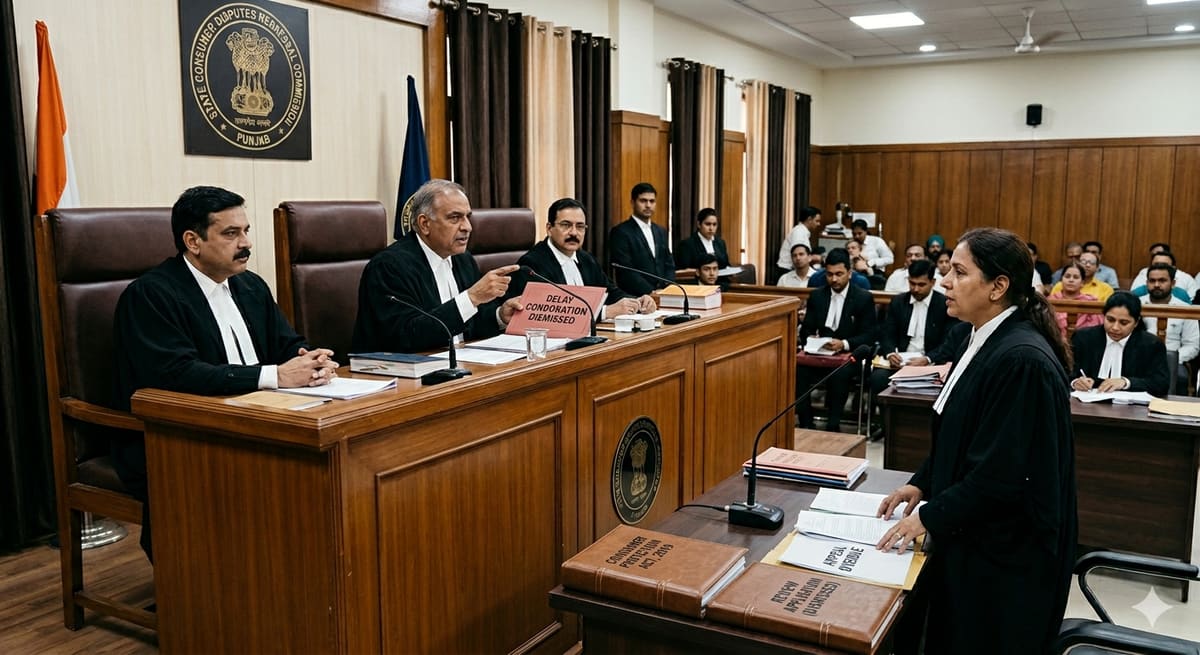
The dismissal of H.D.F.C. Bank’s appeal for inordinate delay underscores a critical principle in consumer law: procedural timelines are not mere formalities but essential safeguards for expeditious justice. This ruling reinforces that delays, even if unintentional, cannot be excused without compelling, day-to-day justification under the Consumer Protection Act, 2019.
Background & Facts
The Dispute
The dispute originated from a complaint filed by Virag Choubey against H.D.F.C. Bank Ltd. before the District Consumer Disputes Redressal Commission, Indore. The nature of the complaint is not detailed in the order, but it resulted in an adverse order against the Bank on 11 October 2023.
Procedural History
The Bank filed an appeal before the Madhya Pradesh State Consumer Disputes Redressal Commission, but only after a delay of 1 year, 11 months, and 8 days - far exceeding the statutory 45-day window. The Bank sought condonation of delay through I.A.-2, filed on 5 March 2026. The State Commission examined the reasons offered and found them inadequate.
Relief Sought
The Bank sought to have its appeal heard on merits by condoning the delay. It also implicitly sought reversal of the District Commission’s order.
The Legal Issue
The central question was whether Section 41 of the Consumer Protection Act, 2019 permits condonation of a delay exceeding 14 months in filing an appeal, absent a clear, documented, and convincing explanation for each phase of the delay.
Arguments Presented
For the Appellant
The Bank argued that the delay arose due to administrative bottlenecks in securing internal approvals, delays in depositing the pre-deposit amount, and the accidental misplacement of case documents by its advocate. Counsel contended that these were non-malicious, operational setbacks, not deliberate neglect, and thus warranted leniency under the doctrine of equitable condonation.
For the Respondent
The Respondent did not file a written reply, but the Commission inferred from the record that the Bank’s explanation lacked specificity and failed to establish a continuous, diligent effort to comply with the limitation period. The absence of any day-to-day account of the delay undermined the claim of sufficient cause.
The Court's Analysis
The State Commission grounded its reasoning in Section 41 of the Consumer Protection Act, 2019, which mandates a 45-day limitation period for appeals and permits extension only if sufficient cause is shown. The Court emphasized that consumer law is designed for speed and accessibility, and prolonged delays defeat this statutory objective.
"The object of expeditious adjudication of consumer disputes will get defeated, if Court was to entertain highly belated petitions filed against orders of Consumer Fora."
The Commission relied on Anshul Aggarwal v. New Okhala Industrial Development Authority (2011 CPJ 63 SC), where the Supreme Court held that special limitation periods in consumer law must be strictly enforced. It further cited the National Consumer Disputes Redressal Commission’s decision in Parsvnath Developers Ltd. v. Arun Kumar Bansal (2024) to affirm that routine administrative delays - no matter how well-intentioned - do not constitute sufficient cause.
The Court rejected the Bank’s explanation that documents were misplaced, noting that professional institutions must maintain robust internal systems. The absence of any contemporaneous records or communication logs further weakened the claim. The Commission concluded that mere non-malice is not enough; diligence and accountability are mandatory.
The Verdict
The appeal was dismissed as barred by limitation. The State Commission held that the delay of over 14 months could not be condoned due to the absence of cogent, convincing, and day-to-day reasons. No costs were awarded.
What This Means For Similar Cases
Condonation Requires Day-to-Day Documentation
- Practitioners must maintain a chronological record of every step taken to file an appeal, including internal approvals, bank transfers, and advocate communications.
- Generic claims like "administrative delay" or "document misplacement" will not suffice without supporting evidence.
Institutional Accountability Is Non-Negotiable
- Corporations and financial institutions cannot rely on internal inefficiencies as excuses for non-compliance.
- Legal teams must implement mandatory internal timelines with reminders and audit trails for all consumer forum filings.
Strict Limitation Overrides Equitable Considerations
- Courts will not balance hardship against delay; the statutory period is the baseline.
- Even if the merits of the appeal are strong, failure to meet the 45-day window without justification is fatal.