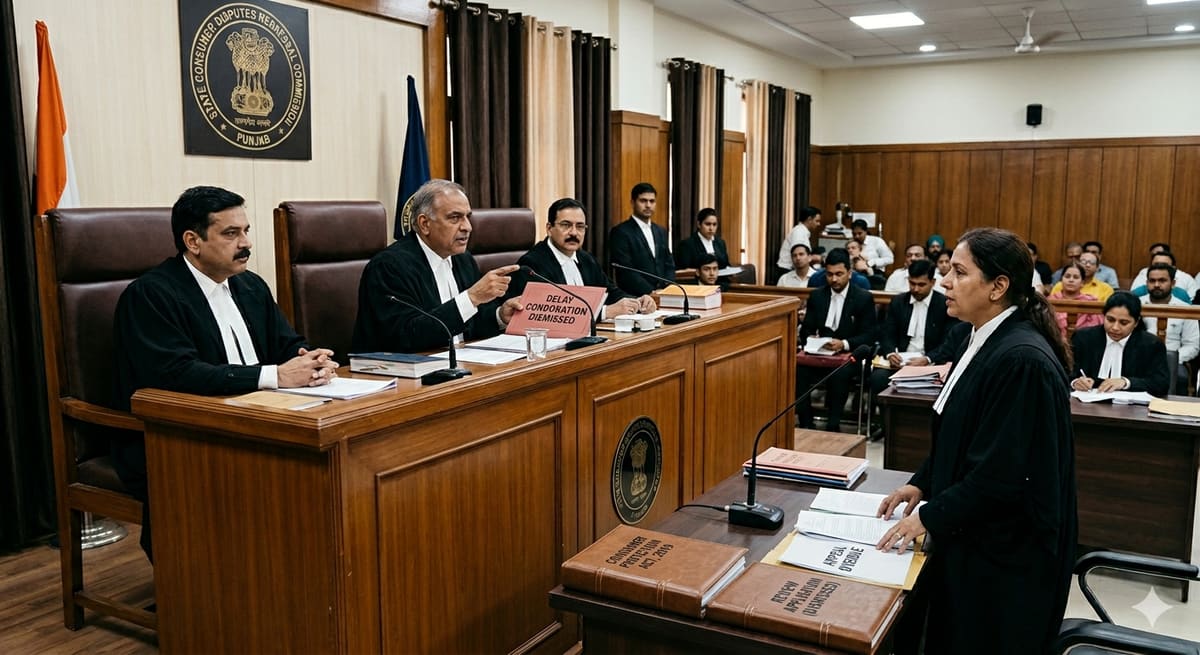
The Delhi State Consumer Disputes Redressal Commission has reaffirmed that statutory limitation periods under the Consumer Protection Act, 1986 are not to be relaxed without concrete, verifiable justification. In a decisive ruling, the Commission dismissed an appeal filed 109 days after the deadline, emphasizing that mere assertions of personal hardship, without documentary corroboration, cannot override the legislative intent of expeditious redressal.
Background & Facts
The Dispute
The appellant, Ms. Neha Gupta, filed a complaint before the District Consumer Disputes Redressal Commission-VI, New Delhi, in Complaint Case No. 231/2021 against Amazon Seller Services Pvt. Ltd., Apprario Retail Pvt. Ltd., and Samsung India Electronics Pvt. Ltd., alleging deficiency in service related to a defective electronic product. The District Commission passed its order on 20.09.2025, disposing of the complaint. The appellant did not file an appeal within the statutory 30-day period.
Key Facts
- The impugned order of the District Commission was pronounced on 20.09.2025
- The statutory limitation period for filing an appeal expired on 20.10.2025
- The appeal was filed online on 06.02.2026 and physically on 10.02.2026, resulting in delays of 109 days and 113 days respectively
- The appellant is a woman residing in Derra Bassi, Punjab, for employment purposes
- She was represented before the District Commission by legal aid counsel
- No documentary evidence was submitted to substantiate her employment, residence, or the timeline of her awareness of the order
- No communication records or correspondence with legal aid counsel were produced to explain the delay
Procedural History
- 20.09.2025: District Consumer Commission passes order in Complaint Case No. 231/2021
- 06.02.2026: First filing of appeal online with application for condonation of delay (IA No. 346/2026)
- 10.02.2026: Physical filing of appeal
- 19.03.2026: Delhi State Commission hears the condonation application and dismisses both the condonation plea and the appeal
Relief Sought
The appellant sought condonation of delay under Section 15 of the Consumer Protection Act, 1986, and restoration of her complaint for adjudication on merits. She claimed that her employment in Punjab, dependence on legal aid, and communication difficulties with counsel constituted sufficient cause for the delay.
The Legal Issue
The central question was whether the appellant’s explanation for a delay of over 100 days - based on employment relocation and reliance on legal aid without documentary proof - constitutes sufficient cause under Section 15 of the Consumer Protection Act, 1986 to condone the delay in filing an appeal.
Arguments Presented
For the Appellant
The appellant, through legal aid counsel, contended that her employment in Derra Bassi, Punjab, made it difficult to pursue legal remedies in Delhi. She claimed she was not promptly informed of the District Commission’s order due to her dependence on legal aid counsel, and that subsequent delays arose from difficulties in re-establishing contact with counsel and securing assistance to file the appeal. She relied on the humanitarian intent behind legal aid and the need for equitable relief.
For the Respondent
The respondents did not appear or file written submissions. However, the Commission noted that the statutory framework under the Consumer Protection Act, 1986, mandates strict adherence to limitation periods to ensure expeditious resolution of consumer disputes. The absence of any rebuttal did not absolve the appellant of her burden to establish sufficient cause.
The Court's Analysis
The Commission undertook a rigorous analysis of the statutory framework under Section 15 of the Consumer Protection Act, 1986, which permits condonation of delay only if the appellant demonstrates sufficient cause. The Court examined multiple precedents, including Basawaraj v. Spl. Land Acquisition Officer (AIR 2014 SC 746), Anil Kumar Sharma v. United Indian Insurance Co. (IV(2015)CPJ453(NC)), and H. Guruswamy & Ors. v. A. Krishnaiah (Civil Appeal No. 317 of 2025, decided 08.01.2025).
"The court has no power to extend the period of limitation on equitable grounds. The statutory provision may cause hardship or inconvenience to a particular party but the Court has no choice but to enforce it giving full effect to the same."
The Commission held that the term sufficient cause requires more than vague assertions. It must reflect a bona fide, non-negligent failure to act within the limitation period. The appellant’s explanation - that she was employed in Punjab and unaware of the order due to legal aid representation - was deemed speculative and unsubstantiated.
The Court emphasized that the appellant bore the burden of proving her claim with documentary evidence: appointment letters, communication logs with counsel, or proof of when she became aware of the order. The absence of any such material rendered her explanation legally inadequate.
"The question of limitation is not merely a technical consideration. The rules of limitation are based on the principles of sound public policy and principles of equity. No court should keep the 'Sword of Damocles' hanging over the head of a litigant for an indefinite period of time."
The Commission further noted that the appellant’s failure to disclose the date on which she became aware of the order, or the steps taken to file the appeal promptly thereafter, indicated a lack of diligence. The delay was neither explained nor excused.
The Verdict
The appeal was dismissed. The application for condonation of delay was rejected on the grounds that the appellant failed to establish sufficient cause under Section 15 of the Consumer Protection Act, 1986. The Commission held that the 109-day delay was unexplained and unsupported by documentary evidence. No costs were imposed. The order was uploaded to the Commission’s website and emailed to the parties on 19.03.2026.
What This Means For Similar Cases
Documentary Evidence Is Non-Negotiable
- Practitioners must advise clients to retain proof of residence, employment, and communication with legal counsel when claiming delay due to relocation or dependency on legal aid
- Vague affidavits without supporting documents will be rejected, even if the litigant is indigent or a legal aid beneficiary
Legal Aid Does Not Excuse Procedural Negligence
- Representation by legal aid counsel does not absolve the client of the duty to monitor case progress
- Clients must proactively confirm receipt of orders and initiate appeals within the limitation period, even if represented by counsel
Limitation Periods Are Strict in Consumer Law
- The Consumer Protection Act prioritizes speed and finality; courts will not entertain belated appeals absent compelling, documented justification
- Delay beyond 60 days is presumed to be inordinate unless exceptional circumstances are substantiated