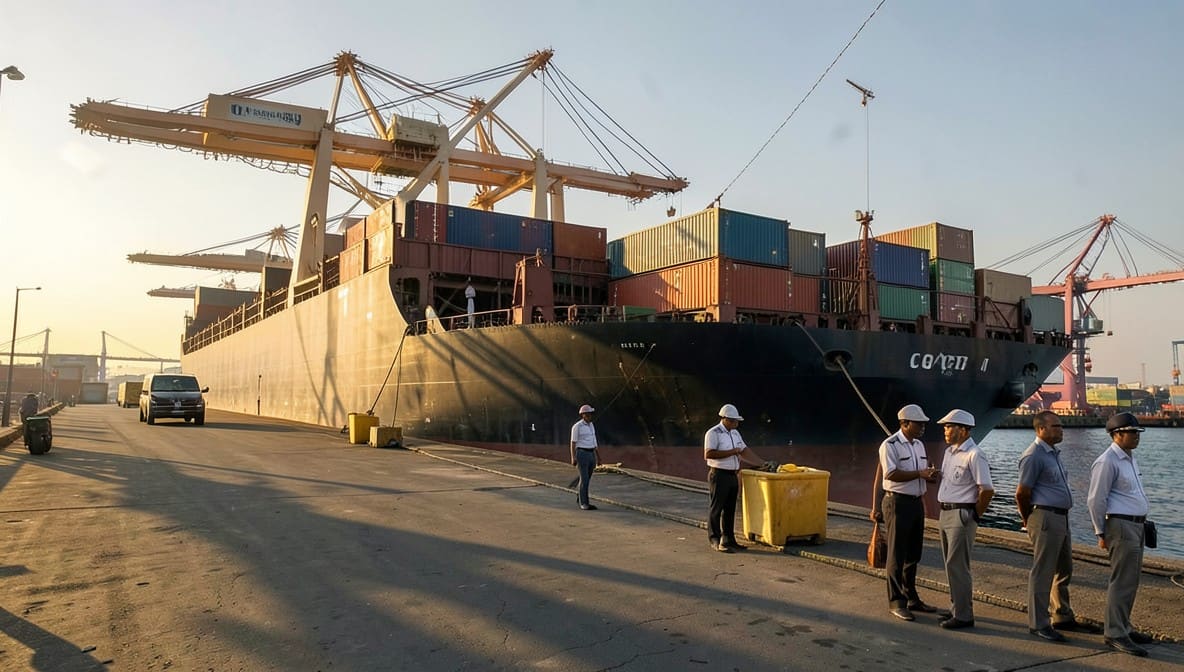
The Central Excise and Service Tax Appellate Tribunal (CESTAT) has clarified that the supply of fresh water to vessels within a port area, prior to July 1, 2010, constitutes a taxable port service under the Finance Act, 1994, and cannot be treated as a mere sale of goods. This ruling resolves a long-standing ambiguity in the taxation of ancillary maritime services and reinforces the principle that the nature of the transaction, not the label on the invoice, determines taxability.
Background & Facts
The Dispute
The appellant, M/s. Sea Shipping Services, supplied fresh water to vessels calling at ports in Gujarat through barges and tankers. It issued debit notes to ship owners for reimbursement of water costs, including transportation, pumping, and a nominal profit margin. The department alleged that these charges constituted taxable port services under Section 65(82) of the Finance Act, 1994, and sought service tax of Rs. 6,82,400 for the period 2009-10 to June 2010.
Procedural History
- 2012: Department conducted audit of appellant’s records and identified non-payment of service tax on water supply.
- 2014: Show cause notice issued proposing recovery of service tax, interest, and penalties under Section 73(1), Section 75, Section 77, and Section 78.
- 2016: Additional Commissioner confirmed demand and imposed penalties under Section 77 and Section 78.
- 2017: Commissioner (Appeals) upheld the order.
- 2026: Appeal filed before CESTAT, Ahmedabad.
Relief Sought
The appellant sought cancellation of the entire demand, arguing that water supply was a sale of goods exempt under the Gujarat VAT Act, 2005, and that it acted as a pure agent under Rule 5(2) of the Service Tax (Determination of Value) Rules, 2006. It also challenged the invocation of the extended limitation period.
The Legal Issue
The central question was whether the supply of fresh water to vessels by a private entity, authorized by the port, constitutes a taxable port service under Section 65(82) of the Finance Act, 1994, prior to July 1, 2010, or whether it amounts to a sale of goods exempt from service tax.
Arguments Presented
For the Appellant
The appellant contended that:
- The transaction was a sale of water, not a service, as evidenced by debit notes showing quantity and price per metric ton.
- Water was exempt from VAT under the Gujarat VAT Act, 2005, and therefore should not be taxed under service tax.
- It acted as a pure agent under Rule 5(2), merely reimbursing costs incurred on behalf of ship owners.
- Relied on United Port Services Pvt. Ltd. v. Commissioner of Central Excise and ICC Reality (India) Pvt. Ltd. v. CCE to argue that supply of essential commodities like water or electricity, when sold as goods, cannot be taxed as services.
For the Respondent
The department argued that:
- Water supply to vessels is explicitly listed as a component of port services in CBEC Circular No. B.11/1/2001-TRU dated 09.07.2001.
- The charges included not just the cost of water but also transportation, pumping, and operational expenses - indicative of a service.
- The appellant was authorized by the port to provide such services, satisfying the pre-2010 definition of port service under Section 65(82).
- Relied on Jaisu Dredging & Shipping v. Commissioner of Central Excise, Rajkot to assert that the dominant intention of the transaction was service provision, not sale.
The Court's Analysis
The Tribunal examined the nature of the transaction through the lens of statutory definition, administrative clarification, and documentary evidence. It emphasized that the substance of the transaction, not its form, governs taxability.
"From the invoice it is quite clear that it is not the cost of water alone that is charged, but it includes cost of charges of other elements."
The Court noted that while United Port Services held water supply to be a sale, that decision was based on conclusive evidence - invoices clearly labeled as sales, VAT returns filed, and no indication of service elements. In contrast, the appellant’s invoices described "supply of fresh water by barge as per nomination," consistent with port service terminology.
The Tribunal rejected the pure agent argument due to lack of documentary proof that the appellant acted on behalf of a third party. It also distinguished ICC Reality, which dealt with electricity supplied to tenants in a rented premises, as factually inapplicable.
Crucially, the Court affirmed that prior to July 1, 2010, port service included any service rendered by a person authorized by the port in relation to a vessel. The appellant’s authorization by the port was undisputed. The CBEC circular, though not statutory, was treated as authoritative interpretation of the law at the time.
The extended period of limitation was upheld because suppression was inferred from the appellant’s failure to disclose the nature of the transaction despite having all records in public domain.
The Verdict
The appellant lost on the service tax demand but won on penalty. The CESTAT upheld the service tax liability for the period prior to July 1, 2010, but set aside the penalty under Section 78 due to absence of mens rea. The penalty under Section 77 was affirmed.
What This Means For Similar Cases
Port Services Include Ancillary Supply Activities
- Practitioners must assess whether any supply to vessels (water, bunkers, provisions) is bundled with operational services.
- Even if goods are involved, if the supply is integrated with port infrastructure, logistics, or authorization, it may constitute a taxable service.
- Invoices must clearly reflect whether the transaction is sale or service; ambiguous descriptions favor the department.
Pure Agent Claims Require Documentary Proof
- Claiming pure agent status under Rule 5(2) requires: (a) contract showing agency, (b) payment on behalf of principal, (c) separate invoicing, (d) no profit retention.
- Absence of any one element invalidates the claim.
- Merely labeling a debit note as "reimbursement" is insufficient without supporting documentation.
Pre-July 2010 Taxability Is Strictly Interpreted
-
Post-2010 exemption under Notification No. 31/2010-ST does not apply retroactively.
-
Taxpayers must audit pre-2010 transactions involving port-related supplies.
-
CBEC circulars issued before statutory amendments remain binding for interpretation of pre-amendment law.
-
Service tax demand for water supply to vessels pre-01.07.2010 is valid if authorized by port.
-
Penalty under Section 78 may be waived if no intent to evade is proven.
-
VAT exemption on goods does not override service tax liability if the transaction is classified as a service.