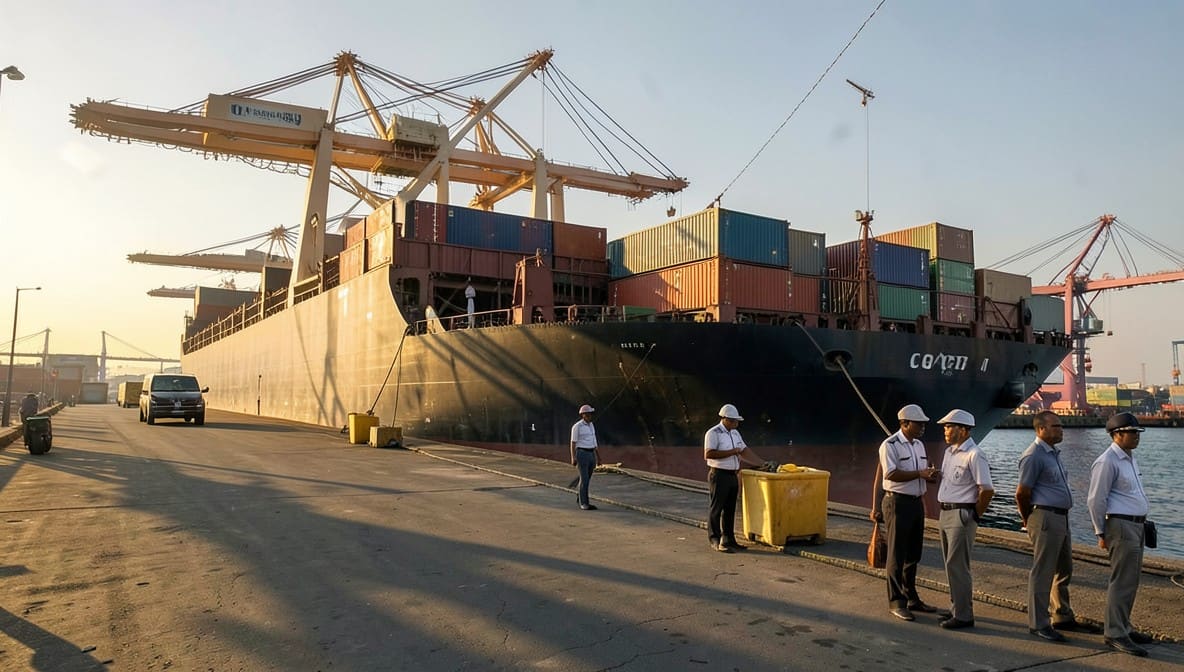
The Central Excise and Service Tax Appellate Tribunal (CESTAT), Hyderabad, has delivered a pivotal ruling clarifying that despatch money received by importers for expedited cargo unloading does not constitute a taxable 'port service' under the Finance Act, 1994. This decision resolves a long-standing ambiguity in service tax jurisprudence and provides critical relief to industrial importers who operate under charter party agreements.
Background & Facts
The Dispute
M/s Rashtriya Ispat Nigam Ltd (RINL), a Government of India undertaking operating the Visakhapatnam Steel Plant, imported raw materials under charter party agreements with vessel owners. These agreements included clauses for demurrage (penalty for delayed unloading) and despatch money (incentive for early unloading). The Department of Central Excise & Service Tax contended that the despatch money received by RINL from vessel owners constituted consideration for providing 'port services' under Section 65(105)(zn) read with Section 65(82) of the Finance Act, 1994, and therefore attracted service tax.
Key Facts
- The period under scrutiny: April 2007 to March 2012
- RINL received despatch money only when cargo was unloaded faster than the agreed time
- When unloading was delayed, RINL paid demurrage to vessel owners
- The net amount (despatch minus demurrage) was settled at the end of each charter period
- RINL engaged stevedores for unloading, but did not own or operate port infrastructure
- The Department treated the receipt of despatch money as a separate service distinct from the charter party agreement
- Adjudicating authority confirmed a service tax demand of Rs. 2,58,30,254/- along with an equal penalty under Section 78 of the Finance Act, 1994
Procedural History
- 24.06.2013: Order-in-Original issued by Commissioner of Customs, Central Excise & Service Tax, Visakhapatnam-I, confirming demand of Rs. 2,58,30,254/- and penalty
- 02.12.2025: Hearing before CESTAT Hyderabad, Division Bench
- 13.03.2026: Final Order passed by CESTAT Hyderabad
Relief Sought
The appellant sought quashing of the impugned order, deletion of the service tax demand and penalty, and a declaration that despatch money is not taxable as 'port service'.
The Legal Issue
Is despatch money received by an importer from a vessel owner for expedited cargo unloading consideration for a taxable 'port service' under Section 65(105)(zn) read with Section 65(82) of the Finance Act, 1994?
Arguments Presented
For the Appellant
The appellant relied on two key precedents: Vedanta Ltd v. CGST & CE [2015 (11) TMI 682] and Kafila Hospitality & Travels P Ltd v. CST [2021 (47) GSTL 140 (Tri-LB)]. It argued that despatch money is not consideration for a distinct service but an incentive embedded in the charter party agreement, akin to a discount or bonus. It further contended that splitting the contract to isolate despatch money as a separate service violates the principle established in Super Poly Fabricks Ltd v. CCE [2008 (10) STR 545], which prohibits artificial severance of inseparable contractual elements. The appellant emphasized that it did not perform any activity falling within the statutory definition of 'port service' - it merely facilitated timely unloading through its stevedore contractors.
For the Respondent
The Department maintained that the appellant’s arrangement with stevedores to expedite unloading constituted a service rendered to the vessel owner, for which despatch money was the consideration. It argued that the activity of ensuring quick turnaround of vessels benefited the vessel owner and thus qualified as a 'port service' under the expansive definition of service tax at the time. The Department relied on the functional outcome - faster vessel turnover - rather than the contractual structure.
The Court's Analysis
The Tribunal conducted a rigorous analysis of the statutory framework and contractual reality. It emphasized that service tax is leviable only on actual services rendered, not on contractual incentives or penalties. The Bench observed that the appellant did not own, manage, or operate any port facility, nor did it provide any infrastructure or manpower directly to the vessel owner. The stevedores were engaged by RINL for its own benefit, not as agents of the vessel owner.
"It is not the case of the department that they have always been getting despatch money, rather, they have been getting both despatch money as well as paying out demurrage charges depending on early despatch of cargo or later despatch of cargo than the agreed upon time limit provided in the agreement itself."
The Court distinguished between conditions of contract and consideration for service. It held that demurrage and despatch money are reciprocal financial adjustments tied to performance under the charter party, not independent consideration for a separate service. The Tribunal relied on its own decision in Krishnapatnam Port v. CCE & ST [2023 (72) GSTL 259 (Tri-Hyd)] and South Eastern Coalfields Ltd v. CCE & ST, Raipur [2020 (12) TMI 912], which held that compensation for breach or non-compliance cannot be construed as taxable service under Section 66E(e). The Bench concluded that the Department’s attempt to classify despatch money as 'port service' was an impermissible expansion of the statutory definition.
The Verdict
The appeal was allowed. The CESTAT Hyderabad set aside the impugned Order-in-Original dated 24.06.2013, quashed the service tax demand of Rs. 2,58,30,254/-, and cancelled the equal penalty. The Tribunal held that despatch money is not taxable as 'port service' under the Finance Act, 1994, as it constitutes a contractual incentive, not consideration for a distinct service.
What This Means For Similar Cases
Despatch Money Is Not a Taxable Service
- Practitioners must now argue that any incentive paid for early performance under a charter party or freight contract is a condition of the agreement, not a separate service
- Tax authorities cannot impose service tax on demurrage or despatch money unless a distinct service is demonstrably rendered
Contractual Integrity Must Be Preserved
- The judgment reinforces the principle from Super Poly Fabricks Ltd that contracts cannot be artificially split to create taxable events
- Any attempt to isolate a financial adjustment clause (e.g., bonus, penalty, discount) as a standalone service will fail unless the service itself is independently identifiable and rendered
Port Service Definition Remains Narrow
-
Only entities directly involved in port operations (berthing, cargo handling, terminal management) qualify as providers of 'port service'
-
Importers or charterers who merely facilitate unloading through third-party stevedores do not become service providers to vessel owners
-
Practitioners representing importers should cite this judgment to challenge similar service tax demands in other ports
-
Tax auditors must now distinguish between contractual adjustments and actual service provision before raising demands
-
This ruling aligns with the broader trend of narrowing service tax liability to actual economic activity, not financial outcomes