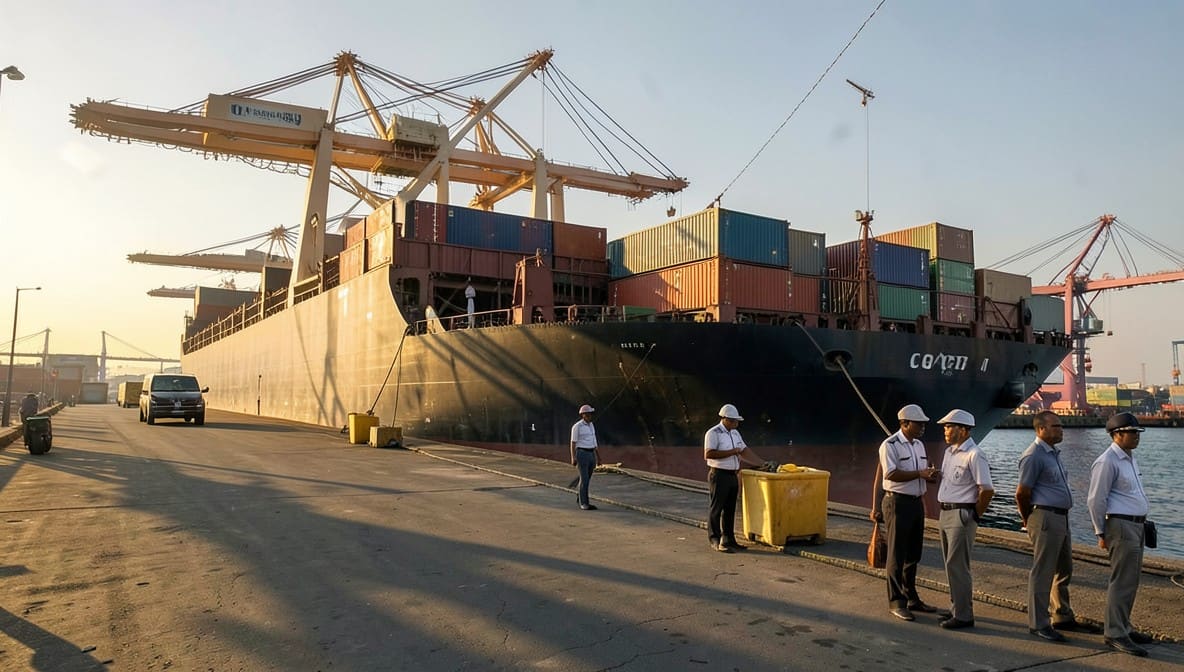
The Chennai Regional Bench of the Customs, Excise and Service Tax Appellate Tribunal has delivered a pivotal ruling clarifying that ocean freight collected by multimodal transporters on a principal-to-principal basis during the period 2013-2015 cannot be included in the taxable value for service tax purposes under the pre-amendment provisions of the Finance Act, 1994. This decision reaffirms the binding precedent set by the Supreme Court in Union of India v. Intercontinental Consultants and Technocrats Pvt Ltd and reinforces the principle that reimbursable expenses are not part of the value of taxable service unless expressly included by legislative amendment.
Background & Facts
The Dispute
M/s. Seaport Lines India (P) Limited, a registered multimodal transport operator (MTO) under the Multimodal Transport Operators Rules, 1992, was assessed for service tax on ocean freight collected from exporters during two financial years: April 2013 to March 2014 and April 2014 to March 2015. The Department alleged that the appellant, while acting as a freight forwarder, collected ocean freight charges from customers in excess of the amounts paid to shipping lines, and that this markup formed part of the taxable value under Section 67(1) and Rule 5(2) of the Service Tax (Determination of Value) Rules, 2006. The Department further contended that the appellant’s activity constituted "support services" under Section 65B(49) of the Finance Act, 1994, and not mere trading in cargo space.
Key Facts
- The appellant procured container space from shipping lines on its own account and sold it to exporters at negotiated rates.
- The transactions with shipping lines and exporters were conducted on a principal-to-principal basis, with no agency relationship established.
- The appellant did not act as an intermediary, agent, or commission agent for either party.
- The ocean freight charged to exporters was clearly identified as such in invoices, and the shipping lines did not levy service tax on the freight.
- The appellant pre-booked container space in anticipation of demand, bearing the risk of unsold capacity and potential losses.
- The appellant was registered under "Business Auxiliary Service" and "Goods Transport Agency Service" and had been paying service tax under these categories.
- The Department issued two Show Cause Notices (SCNs): SCN No. 46/2015 dated 10.04.2015 (for 2013-14) and SCN No. 12/2016-ST-I dated 22.02.2016 (for 2014-15).
- The proposed tax demand was Rs. 1,58,25,373 for 2013-14 and Rs. 2,56,30,208 for 2014-15, along with interest and penalties.
- The Department relied on a letter dated 19.07.2012 from the appellant seeking reclassification as "Business Support Service," but this letter was never acted upon, nor was it referenced in the SCNs.
Procedural History
- 10.04.2015: SCN No. 46/2015 issued for the period April 2013 to March 2014.
- 22.02.2016: SCN No. 12/2016-ST-I issued for the period April 2014 to March 2015.
- 29.07.2016: Order in Original passed by Principal Commissioner of Service Tax-I, Chennai, confirming the demand.
- 2017: Service Tax Appeals Nos. 40485-40486 of 2017 filed before CESTAT, Chennai Regional Bench.
- 19.11.2025: Hearing concluded before the Tribunal.
- 16.03.2026: Final Order passed by the Tribunal allowing the appeals.
The Parties' Positions
For the Appellant
- Argued that the activity was not a service but a purchase and sale of container space on principal-to-principal basis.
- Cited multiple CESTAT decisions, including its own prior case (Seaport Lines v. Commissioner GST & Central Excise, Final Order No. 42304-42305/2021), holding that such transactions are not taxable services.
- Relied on Geodis Overseas Pvt Ltd v. Commissioner of Service Tax, Chennai (2022) to establish that MTOs acting as principals are not liable for service tax on ocean freight.
- Emphasized that the Department failed to prove any agency relationship or change in service classification.
- Contended that the letter dated 19.07.2012 was not relied upon in the SCN and could not be used to alter the classification post-facto.
- Invoked the Supreme Court’s decision in Union of India v. Intercontinental Consultants and Technocrats Pvt Ltd (2018) to argue that reimbursable expenses like ocean freight are not includible in taxable value under pre-May 14, 2015 law.
For the Respondent
- Contended that the appellant was rendering "support services" under Section 65B(49) and was therefore liable to pay service tax on the gross amount charged.
- Argued that the markup on ocean freight indicated the appellant was acting as an intermediary, and the entire amount collected was consideration for a taxable service.
- Relied on Progeon Global Forwarding P Ltd (2023) to support the inclusion of freight charges in taxable value.
- Asserted that the appellant’s own letter dated 19.07.2012 indicated its intent to provide logistics services, thereby altering the nature of its activity.
- Maintained that Rule 5(2) of the Service Tax Valuation Rules, 2006 was applicable, and the appellant failed to meet the "pure agent" criteria due to the markup.
Relief Sought
The appellant sought: (1) quashing of the impugned order dated 29.07.2016; (2) setting aside of the service tax demand of Rs. 1,58,25,373 and Rs. 2,56,30,208 for the two periods; (3) cancellation of interest and penalties; and (4) recognition of its transactions as non-taxable purchase-sale of cargo space.
The Legal Issue
The central question was whether ocean freight collected by a multimodal transport operator on a principal-to-principal basis constitutes part of the taxable value under Section 67(1) of the Finance Act, 1994, prior to the amendment effective May 14, 2015, and whether such amounts can be taxed as "support services" under Section 65B(49) when the underlying activity is trading in cargo space.
Arguments Presented
For the Appellant
The appellant relied on the Supreme Court’s decision in Union of India v. Intercontinental Consultants and Technocrats Pvt Ltd (2018), which held that reimbursable expenses like ocean freight are not part of the value of taxable service under pre-amendment Section 67. The appellant argued that its transactions were not services but commercial sales of container space, with risk and profit inherent in the business model. It cited multiple coordinate bench decisions from CESTAT, including Geodis Overseas and its own prior case, which uniformly held that such transactions are not taxable. The appellant emphasized that the Department failed to discharge the burden of proving a change in service classification, and that reliance on an unacted-upon letter violated principles of natural justice.
For the Respondent
The Department contended that the appellant’s activity fell under "support services" as defined under Section 65B(49), and that the markup on freight indicated the appellant was acting as an intermediary. It relied on Progeon Global Forwarding to argue that the entire amount collected must be taxed as gross consideration. The Department also attempted to use the 19.07.2012 letter to reclassify the service, despite its absence from the SCN, and argued that Rule 5(2) disqualified the appellant from being a "pure agent" due to the differential between amounts collected and paid.
The Court's Analysis
The Tribunal conducted a rigorous analysis of the statutory framework, factual matrix, and binding precedents. It first examined the Supreme Court’s decision in Union of India v. Intercontinental Consultants and Technocrats Pvt Ltd, which unequivocally held that Section 67 of the Finance Act, 1994, permits taxation only on the gross amount charged for the service actually rendered, and not on reimbursable expenditures. The Court noted that the amendment to Section 67, effective May 14, 2015, was substantive and prospective, and therefore could not be applied retrospectively to the period 2013-2015.
"As noted above, prior to April 19, 2006, i.e., in the absence of any such Rule, the valuation was to be done as per the provisions of Section 67 of the Act... the valuation of taxable service shall be the gross amount charged by the service provider 'for such service' and the valuation of taxable service cannot be anything more or less than the consideration paid as quid pro quo for rendering such a service."
The Tribunal further held that the Department’s attempt to classify the appellant’s activity as "support services" under Section 65B(49) was legally untenable, as Section 65 of the Act had been repealed with effect from July 1, 2012, and replaced by the Negative List regime. The reliance on obsolete provisions rendered the adjudication invalid.
The Tribunal also found that the Department had failed to discharge its burden of proving a change in service classification. The letter dated 19.07.2012, upon which the Department relied, was never acted upon, was not referenced in the SCN, and could not be used to alter the classification post-facto without affording the appellant an opportunity to respond. This violated the principles of natural justice as established in CCE Nagpur v. Ballarpur Industries Ltd and Dhakeshwari Cotton Mills v. CIT.
The Tribunal then examined the Geodis Overseas decision, which directly paralleled the facts of the present case. In that case, the Tribunal held that a multimodal transport operator purchasing and selling container space on its own account, bearing the risk of unsold capacity, engages in a principal-to-principal transaction, not a service. The Tribunal found no material distinction between Geodis and the appellant’s operations.
Finally, the Tribunal noted that the appellant’s own prior case, decided on September 7, 2021, had already held in its favor on identical facts. The Department had not appealed or sought a stay of that order, thereby rendering the issue res judicata between the parties.
The Verdict
The appeals were allowed. The impugned order dated 29.07.2016 was set aside. The service tax demand of Rs. 1,58,25,373 for the period April 2013 to March 2014 and Rs. 2,56,30,208 for the period April 2014 to March 2015 was cancelled. All interest and penalties imposed were also set aside. The Tribunal directed that no further demand or recovery proceedings be initiated on the same facts for the said periods.
What This Means For Similar Cases
Principal-to-Principal Transactions Are Not Taxable Services
- Practitioners must now argue that any entity purchasing and selling cargo space, container slots, or transport capacity on its own account, bearing commercial risk, is engaged in a trade, not a service.
- The mere fact that a party collects a markup does not convert a sale into a service; the nature of the transaction, not the pricing, determines taxability.
Reimbursable Expenses Are Excluded Unless Statutorily Included
- For periods prior to May 14, 2015, ocean freight, customs duties, port charges, and other reimbursable costs cannot be included in the taxable value under Section 67.
- The burden lies on the Department to prove that the expense forms part of the service consideration, not on the taxpayer to prove it does not.
Classification Changes Require Procedural Fairness
- The Department cannot unilaterally reclassify a taxpayer’s service based on internal documents not cited in the SCN.
- Any change in classification must be proposed in the SCN, and the taxpayer must be given a full opportunity to respond.
- Reliance on unacted-upon correspondence violates natural justice and renders the order void.
Precedent Binding Even Without Formal Stay
- When a coordinate bench has decided an identical issue in favor of a taxpayer, and the Department has not appealed or stayed that order, the principle of res judicata applies between the same parties.
- Tribunals are bound by their own coordinate benches unless there is a compelling reason to depart, as per National Insurance Co. v. Pranay Sethi.