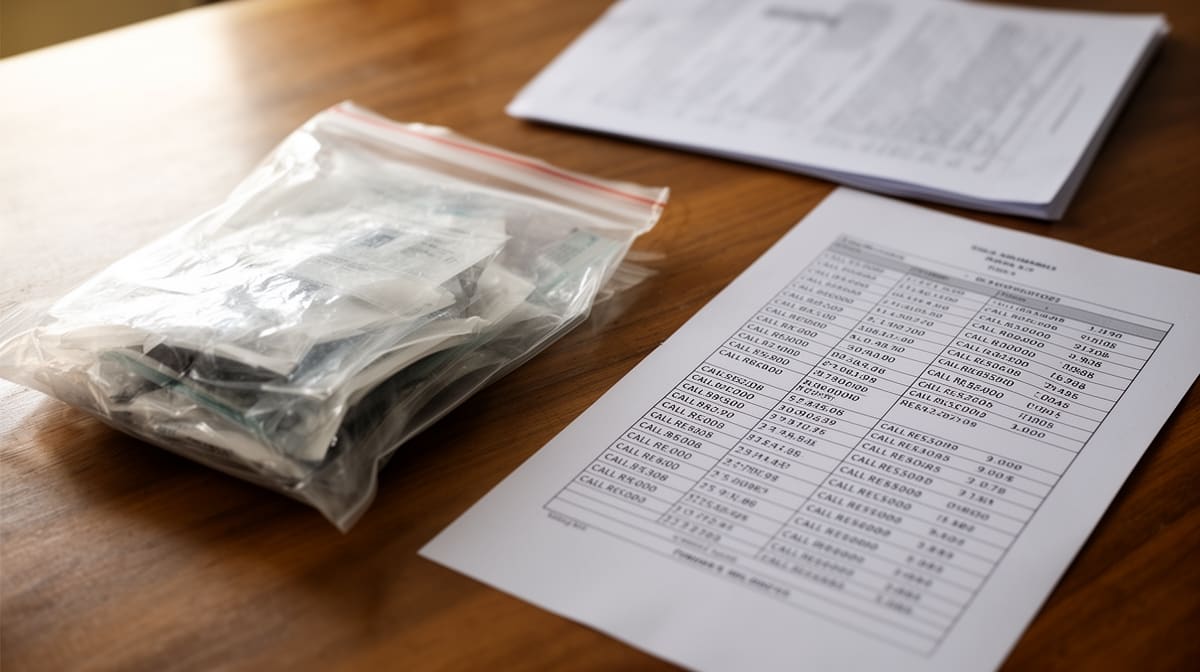
The Supreme Court has delivered a landmark ruling reinforcing the mandatory nature of Section 65-B of the Evidence Act for admissibility of electronic records, acquitting an accused whose conviction rested entirely on unverified call detail records and flawed recoveries. This judgment reasserts foundational principles of evidentiary rigor in criminal trials, particularly where the prosecution relies on circumstantial evidence.
Background & Facts
The Dispute
The appellant, Pooranmal, was convicted alongside his co-accused Ladu Lal for the murder of Aruna, Ladu Lal’s wife, and for destruction of evidence under Sections 302/34 and 201 of the IPC. The prosecution’s case against Pooranmal was built exclusively on circumstantial evidence, as no eyewitnesses or direct evidence linked him to the crime.
Procedural History
- March 2010: Murder of Aruna; FIR registered under Section 460 IPC (now Section 331(8) BNS)
- February 2012: Trial Court convicts both accused; sentences them to life imprisonment and seven years’ rigorous imprisonment, to run concurrently
- March 2018: High Court of Rajasthan affirms conviction
- February 2022: Special Leave Petition filed by co-accused Ladu Lal dismissed in limine by Supreme Court
- January 2026: Supreme Court grants leave to Pooranmal, condoning 2749-day delay due to poverty and lack of legal access
Relief Sought
The appellant seeks acquittal on the grounds that the prosecution failed to prove its case beyond reasonable doubt, particularly due to inadmissible electronic evidence and defective chain of custody for physical evidence.
The Legal Issue
The central question was whether call detail records can be admitted as evidence without a mandatory certificate under Section 65-B of the Evidence Act, and whether recovered currency and a blood-stained shirt, in the absence of an unbroken chain of custody, can sustain a conviction for murder under circumstantial evidence.
Arguments Presented
For the Appellant
Learned counsel contended that:
- The call detail records were inadmissible under Section 65-B of the Evidence Act as no certificate was produced, violating the mandatory requirements laid down in Anvar P.V. v. P.K. Basheer and Arjun Panditrao Khotkar v. Kailash Kushanrao Gorantyal
- The recovery of Rs.46,145 in currency was inconsistent - amount recorded in memo (Ex. P-52) was Rs.46,000, but actual count was Rs.46,145, rendering the recovery unreliable
- The blood-stained shirt’s chain of custody was broken: evidence showed the item was sent to FSL on 12th March 2010, returned, and resent on 18th March 2010, with no explanation for the delay or return
- The FSL report (Ex. P-49) was rendered worthless due to failure to prove sanctity of the sample from seizure to analysis
For the Respondent
The State argued that:
- The call detail records were proved through testimony of Vodafone and Bharati Hexacom officials (PW.23 and PW.24), making the Section 65-B certificate unnecessary
- The recovery of blood-stained clothing and currency, coupled with the appellant’s failure to explain possession of large sums, triggered Section 106 of the Evidence Act, shifting the burden to him
- The concurrent findings of the trial court and High Court should not be disturbed absent manifest error
- The dismissal of Ladu Lal’s SLP implied the correctness of the conviction
The Court's Analysis
The Court undertook a meticulous review of the prosecution’s evidence, applying the five-pronged test from Sharad Birdhichand Sarda v. State of Maharashtra to assess circumstantial evidence. It found each pillar of the case crumbling under scrutiny.
"The very admissibility of such a document i.e. electronic record which is called as computer output, depends on the satisfaction of the four conditions under Section 65-B(2)."
The Court reaffirmed that Section 65-B(4) is not a mere procedural formality but a mandatory precondition for admissibility of electronic evidence. Oral testimony by service providers cannot substitute the statutory certificate. The Court explicitly overruled any notion that Shafhi Mohammad had diluted this requirement, reiterating that Anvar P.V. and Arjun Panditrao remain binding.
Regarding the blood-stained shirt, the Court noted the chain of custody was irreparably broken. The malkhana register (Ex. D-3) recorded an initial transfer on 12th March 2010, yet witnesses denied this. The FSL report (Ex. P-49) was rendered inadmissible because the prosecution failed to prove the article remained sealed and untampered from seizure to analysis. The Court cited Karandeep Sharma v. State of Uttarakhand and Allarakha Habib Memon v. State of Gujarat, holding that matching blood groups alone cannot establish guilt without corroborative evidence linking the accused to the act.
The recovery of currency was deemed unreliable due to the discrepancy between the memo (Rs.46,000) and actual count (Rs.46,145). The Court emphasized that mere possession of cash, without proof of its origin or connection to the crime, cannot constitute an incriminating circumstance.
The Court concluded that none of the three alleged incriminating circumstances - call records, shirt, or cash - were independently reliable, nor did they form an unbroken chain excluding all reasonable hypotheses of innocence.
The Verdict
The appellant won. The Supreme Court held that call detail records are inadmissible without a Section 65-B certificate, and recovered evidence without an unbroken chain of custody cannot sustain a conviction. The conviction of Pooranmal was set aside and he was acquitted. He was ordered to be released forthwith, unless detained in any other case.
What This Means For Similar Cases
Electronic Evidence Cannot Be Proved Orally
- Practitioners must now insist on a Section 65-B certificate for all electronic records - call logs, WhatsApp messages, CCTV footage, bank statements
- Oral testimony from telecom employees is insufficient; failure to produce the certificate renders evidence inadmissible
- Defence counsel should file objections at the earliest stage to exclude such evidence
Chain of Custody Is Non-Negotiable
- Every item recovered must be documented with timestamps, seals, and witness signatures at every transfer point
- Any gap, delay, or inconsistency in the malkhana register or transfer logs will invalidate forensic reports
- Prosecutors must examine malkhana in-charges and carriers as primary witnesses, not as afterthoughts
Blood Group Matches Are Not Conclusive
-
FSL reports showing matching blood groups are not sufficient to prove guilt
-
The prosecution must establish a direct link between the recovered item and the act of violence
-
Courts will no longer accept such evidence in isolation, especially in absence of DNA or other corroborative proof
-
Defence lawyers should challenge FSL reports on chain-of-custody grounds even if blood group matches
-
Prosecutors must now prepare detailed custody logs and call all custodians as witnesses
-
Forensic labs should be required to issue receipts with unique identifiers for each sample received