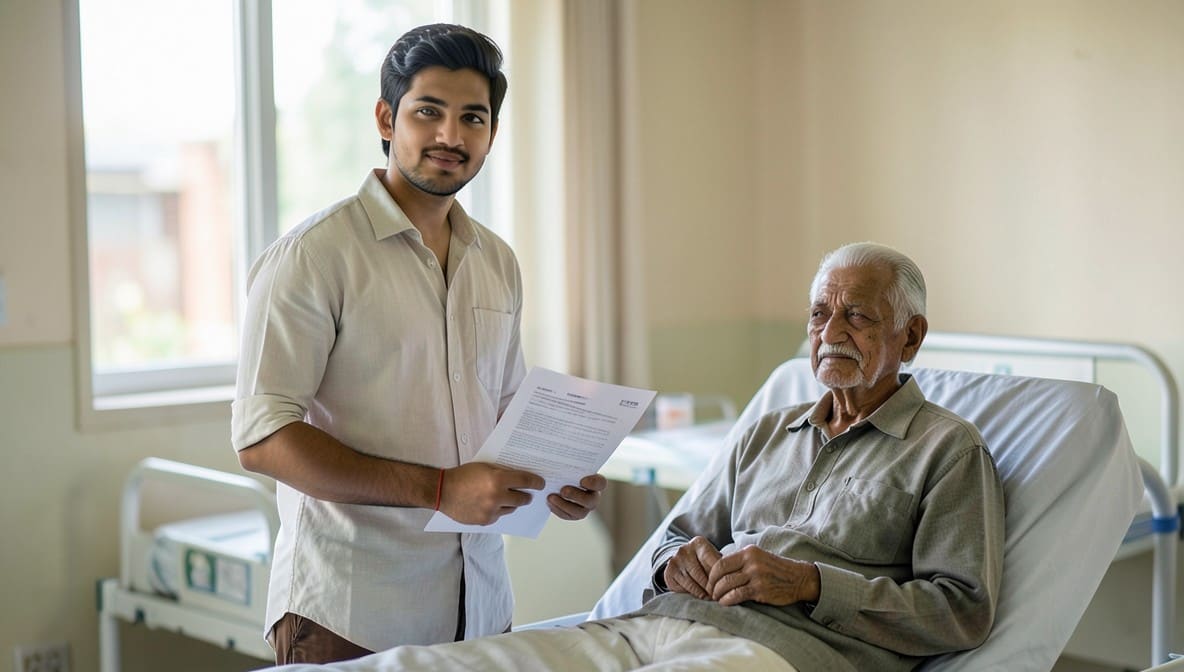
The Rajasthan High Court has granted interim bail to an accused facing serious charges under the NDPS Act and IPC, recognizing the exceptional humanitarian ground of a petitioner’s sole responsibility to care for his critically ill mother requiring urgent cardiac surgery. The order underscores that procedural rigidity must yield to compelling personal circumstances, even in grave criminal cases, provided strict conditions are met.
Background & Facts
The Dispute
The petitioner, Hanuman Ram @ Hadman Ram, aged approximately 30 years, resident of Khari, P.S. Sayla, District Jalore, was arrested in connection with FIR No. 45/2024 registered at P.S. Shri Balaji, District Nagaur. He is currently lodged in District Jail, Nagaur. The case involves allegations under Sections 8, 15, and 29 of the Narcotic Drugs and Psychotropic Substances (NDPS) Act, and Sections 420, 467, 468, 471, and 120-B of the Indian Penal Code (IPC). The charges relate to drug trafficking, forgery, criminal conspiracy, and cheating.
Key Facts
- The petitioner is the only male member in his family responsible for the care of his mother, who suffers from a severe cardiac ailment
- Medical advice from Dr. Rohit Mathur, Professor & Dean, Dr. S.N. Medical College, Jodhpur, indicates that cardiac surgery is medically necessary
- The petitioner’s mother has not yet undergone surgery due to logistical or financial constraints
- A certificate issued by the Administrative Officer, Gram Panchayat Dabli, Panchayat Samiti Sayla, confirms the petitioner’s status as the sole male caregiver
- No dispute was raised by the prosecution regarding the authenticity of the medical condition or the petitioner’s caregiving role
Procedural History
- 15.03.2024: FIR No. 45/2024 registered at P.S. Shri Balaji, District Nagaur
- 05.04.2024: Petitioner arrested in connection with the FIR
- 07.04.2026: High Court directed the Public Prosecutor to submit a medical report on the petitioner’s mother’s condition
- 09.04.2026: SHO, P.S. Shri Balaji, submitted a report along with the medical opinion of Dr. Rohit Mathur
- 10.04.2026: Interim bail application filed under Section 483 of BNSS (equivalent to Section 439 Cr.P.C.) heard and decided
Relief Sought
The petitioner sought interim bail for a period of 45 days to enable him to assist his mother in undergoing cardiac surgery, asserting that no other family member is available to provide care.
The Legal Issue
Can interim bail be granted to an accused facing serious non-bailable offences under the NDPS Act and IPC on the sole ground of being the primary caregiver to a family member requiring urgent medical intervention, without prejudging the merits of the case?
Arguments Presented
For the Petitioner
Learned counsel, Mr. Prakash Raika, submitted that the petitioner’s mother suffers from a life-threatening cardiac condition requiring immediate surgical intervention. He emphasized that the petitioner is the only male member in the family capable of providing physical and emotional support during pre- and post-operative care. The certificate from the Gram Panchayat and the medical opinion from Dr. S.N. Medical College were presented as conclusive evidence. Counsel argued that denial of bail under these circumstances would violate the principles of human dignity and familial obligation recognized under Article 21 of the Constitution.
For the Respondent
The Public Prosecutor, Mr. Pawan Bhati, opposed the application on the grounds of the gravity of the offences under the NDPS Act and IPC. However, he did not dispute the factual assertions regarding the petitioner’s mother’s medical condition or his role as the sole caregiver. The opposition was procedural rather than factual, focusing on the seriousness of the charges without challenging the humanitarian basis of the request.
The Court's Analysis
The Court explicitly declined to evaluate the merits of the criminal allegations, stating that the decision was based solely on humanitarian grounds. It acknowledged the seriousness of the charges but emphasized that bail jurisprudence must accommodate exceptional personal circumstances that invoke fundamental rights under Article 21.
"Without expressing any opinion on merits/demerits of the case, this Court deems it just and proper to grant interim bail to the petitioner for a period of 30 days."
The Court relied on the unchallenged medical evidence and the official certification from the Gram Panchayat to establish the factual necessity of the petitioner’s presence. It noted that the prosecution did not contest the veracity of the mother’s condition or the petitioner’s unique caregiving role. The Court further observed that the law does not require the accused to prove innocence to seek interim relief on compassionate grounds, particularly where the family structure leaves no alternative caregiver.
The Court balanced the public interest in prosecuting serious drug-related offences against the individual’s right to familial care, concluding that temporary release under strict conditions would not prejudice the investigation or trial.
The Verdict
The petitioner succeeded. The Court granted interim bail for a period of 30 days, subject to the following conditions: (1) deposit of Rs. 5,00,000 before the trial court; (2) execution of a personal bond of Rs. 2,00,000 with two solvent sureties, each providing a surety of Rs. 1,00,000 (one of whom must be a close relative); (3) surrender to the jail authorities on completion of 30 days; and (4) compliance with all other conditions imposed by the trial court. The Rs. 5,00,000 deposit shall be refunded upon timely surrender; failure to surrender will result in immediate forfeiture. The matter is listed for compliance report on 12.05.2026.
What This Means For Similar Cases
Compassionate Grounds Can Override Gravity of Offence
- Interim bail may be granted even in serious NDPS or IPC cases if the accused is the sole caregiver to a family member facing life-threatening medical emergencies
- Prosecution’s silence on factual humanitarian claims constitutes tacit acceptance for bail purposes
- Courts are empowered to prioritize Article 21 rights without prejudging the criminal case
Conditions Must Be Strict and Enforceable
- Monetary deposits and surety requirements must be clearly specified and tied to surrender obligations
- Forfeiture clauses must be explicit and immediate upon non-compliance
- Compliance reporting by the prosecution is mandatory and should be scheduled in the order
Documentation Is Critical
- Official medical certificates from recognized institutions carry decisive weight
- Gram Panchayat or local authority certification of family structure is admissible and persuasive
- Petitioners must submit contemporaneous, verifiable documentation - not mere assertions