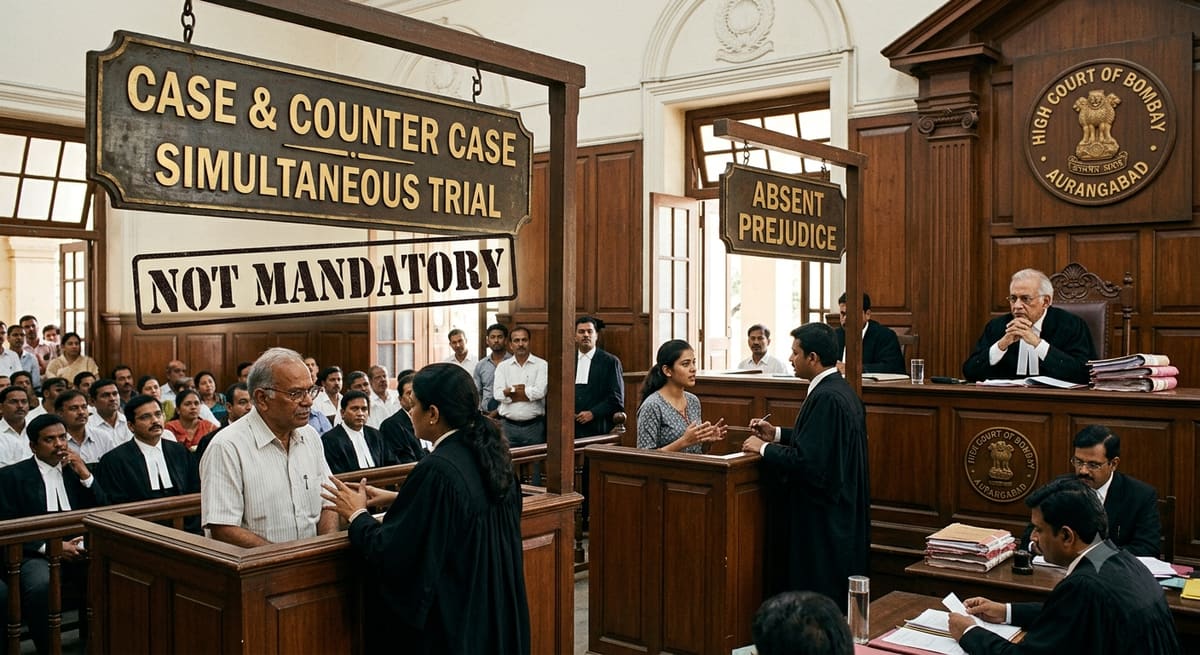
The Bombay High Court has clarified that the failure to try a case and its counter case simultaneously does not automatically invalidate proceedings, even where judgments are delivered on different dates. The Court emphasized that procedural irregularities under Section 465 of the CrPC are curable unless they occasion a failure of justice, reinforcing the primacy of substantive fairness over technical compliance.
Background & Facts
The Dispute
The dispute arose from a violent altercation on 17.06.2010 between two families in Vanjarwadi, Taluka Jamkhed, District Ahmednagar, over a boundary dispute concerning agricultural land. The incident resulted in injuries to members of both families, prompting the registration of two rival FIRs by the Jamkhed Police Station.
Key Facts
On 17.06.2010, a physical confrontation occurred in an agricultural field involving the applicant (Nilesh s/o Bhimrao Nagawade) and respondents (Baban, Ganesh, Dhananjay, and Alka Murkute), all relatives.
Crime No. 143/2010 was registered against Respondents 1 to 4 under Sections 326, 324, 504, 506(II) read with Section 34 IPC.
Crime No. 146/2010 was registered against the applicant and three others under Sections 323, 324, 504, 506(II) read with Section 34 IPC.
Both cases were committed to the Court of Sessions and registered as Regular Criminal Cases (RCC) No. 204/2010 and RCC No. 203/2010 respectively.
The trial in both cases was conducted separately by the same Judicial Magistrate, First Class, Jamkhed.
Judgment in RCC No. 203/2010 (against the applicant) was delivered on 03.08.2017, acquitting all accused.
Judgment in RCC No. 204/2010 (against Respondents 1 to 4) was delivered on 04.08.2017, also acquitting the accused.
No appeal was filed against the acquittal in RCC No. 203/2010.
The applicant filed a Criminal Appeal (No. 07/2019) against the acquittal in RCC No. 204/2010.
Procedural History
17.06.2010: Incident occurred in agricultural field, Vanjarwadi.
17.06.2010: Crime No. 143/2010 registered against Respondents 1 to 4.
17.06.2010: Crime No. 146/2010 registered against Applicant and others.
04.08.2017: Judgment delivered in RCC No. 204/2010 acquitting Respondents 1 to 4.
03.08.2017: Judgment delivered in RCC No. 203/2010 acquitting Applicant and co-accused.
2019: Criminal Appeal No. 07/2019 filed by Applicant before Additional Sessions Judge, Shrigonda, challenging acquittal in RCC No. 204/2010.
28.11.2023: Additional Sessions Judge set aside both judgments (RCC No. 203/2010 and RCC No. 204/2010) on the ground that judgments were not pronounced on the same day and no reference was made to the counter case.
02.07.2026: Criminal Revision Application No. 30 of 2024 decided by Bombay High Court, Aurangabad Bench.
The Parties' Positions
For the Applicant (Petitioner)
Argued that the Sessions Court erred in treating non-simultaneous pronouncement as a fatal irregularity.
Contended that Section 465 CrPC applies, and no prejudice was shown to the accused.
Highlighted that no appeal was filed against RCC No. 203/2010, so the Sessions Court had no jurisdiction to set aside that judgment.
Relied on State of Karnataka v. Hosakeri Ningappa and Nathilal v. State of U.P. to argue that procedural deviation does not vitiate trial absent prejudice.
For the Respondents 1 to 4
Supported the Sessions Court’s view that simultaneous trial is mandatory under Nathilal and Sudhir.
Argued that failure to refer to the counter case in the judgment rendered the trial defective.
Relied on T. Balaji v. State and Valmiki Faleiro to justify the Sessions Court’s revisional powers.
Relief Sought
The applicant sought quashing of the Sessions Court’s order dated 28.11.2023, restoration of the acquittal in RCC No. 204/2010, and direction to decide the appeal on merits without remanding both cases.
The Legal Issue
The central question was whether the failure to pronounce judgments in a case and its counter case on the same day, without reference to the other case, vitiates the trial under Section 465 of the CrPC, or whether such an irregularity is curable unless it causes a failure of justice.
Arguments Presented
For the Appellant/Petitioner
The applicant argued that the Sessions Court misapplied the principles in Nathilal v. State of U.P. and Sudhir v. State of M.P., which describe a salutary practice, not a mandatory statutory requirement. He emphasized that Section 465 CrPC explicitly bars reversal of findings on account of procedural irregularities unless a failure of justice is demonstrated. The applicant pointed out that the Sessions Court had no jurisdiction to set aside the judgment in RCC No. 203/2010, as no appeal was filed against it. He cited State of Karnataka v. Hosakeri Ningappa to show that appellate courts must examine prejudice, not mere deviation from procedure. The applicant further contended that the Sessions Court’s reliance on Valmiki Faleiro was misplaced, as that case involved suo motu revision, whereas the Sessions Court acted in appeal.
For the Respondent/State
The respondents contended that the simultaneous trial and pronouncement of judgments in case and counter case is a mandatory procedural norm established by the Supreme Court to ensure fairness and prevent bias. They argued that the Sessions Court rightly exercised its powers under Section 386(e) CrPC to remand the matter for proper adjudication. They relied on T. Balaji v. State to assert that non-compliance with procedural guidelines for counter cases can justify interference, even in the absence of an appeal against one of the judgments. The respondents maintained that the failure to refer to the counter case in the judgment indicated a failure to appreciate the full context of the incident, thereby undermining the integrity of the trial.
The Court's Analysis
The Court undertook a detailed examination of the jurisprudence surrounding case and counter case trials, beginning with the Supreme Court’s observations in Nathilal v. State of U.P. and Sudhir v. State of M.P., which described simultaneous trial as a "salutary practice" and "proper procedure" but did not declare it mandatory. The Court then turned to Section 465 CrPC, which provides that no finding shall be reversed on account of any error, omission, or irregularity unless a failure of justice has been occasioned.
"The procedure to be adopted in case and counter case is that the investigation should be conducted by the same Investigating Officer... The judgments should be pronounced by the same Judge simultaneously i.e., one after the other. [...] However, if the procedure prescribed is not followed by the concerned Trial Judge, the aggrieved party would have to show as to how the same has caused prejudice to him."
The Court held that the Karnataka High Court’s Full Bench decision in State of Karnataka v. Hosakeri Ningappa correctly interpreted these precedents: non-compliance with the simultaneous trial norm is an irregularity, not a jurisdictional defect. The Court emphasized that the Sessions Court had no authority to set aside the judgment in RCC No. 203/2010, as no appeal lay before it. Under Chapter XXIX CrPC, appellate powers are confined to the judgment challenged. The Sessions Court’s action in setting aside both judgments amounted to an illegal expansion of its appellate jurisdiction.
The Court further noted that the applicant had not been denied a fair trial. He was given full opportunity to cross-examine witnesses, present evidence, and argue his case. The fact that the trial court acquitted both parties on separate days, without referencing the other judgment, did not deprive the accused of any substantive right. The Court concluded that the Sessions Court’s order was legally unsustainable, as it was based on a technicality that did not meet the threshold of prejudice under Section 465 CrPC.
The Verdict
The applicant succeeded. The Bombay High Court quashed and set aside the order dated 28.11.2023 of the Additional Sessions Judge, Shrigonda. The Criminal Appeal No. 07/2019 is restored to the file of the Additional Sessions Judge for fresh adjudication in accordance with law. The acquittal in RCC No. 204/2010 stands reinstated pending the fresh decision. No costs were awarded.
What This Means For Similar Cases
Procedural Irregularities Are Curable Under Section 465 CrPC
Practitioners must now argue that any deviation from the "simultaneous trial" norm in case and counter case matters is not fatal unless prejudice is affirmatively demonstrated.
Courts cannot set aside acquittals merely because judgments were delivered on different dates or lacked cross-references.
The burden shifts to the party alleging prejudice to show how the irregularity affected the fairness of the trial.
Appellate Courts Cannot Set Aside Unchallenged Acquittals
An appellate court’s jurisdiction is strictly limited to the judgment appealed against.
Setting aside a separate acquittal (e.g., in a counter case) without an appeal against it constitutes a jurisdictional overreach.
Any such action is void ab initio and subject to immediate quashing under Section 465 CrPC and Article 227 of the Constitution.
Evidence in Counter Cases Cannot Be Used Unless Legally Introduced
Trial courts must decide each case solely on the evidence recorded in that case.
Evidence from the counter case may be admitted only if formally brought on record through proper procedure (e.g., cross-examination, admission, or application under Section 311 CrPC).
Merely referring to the existence of a counter case in the judgment does not permit reliance on its evidence.