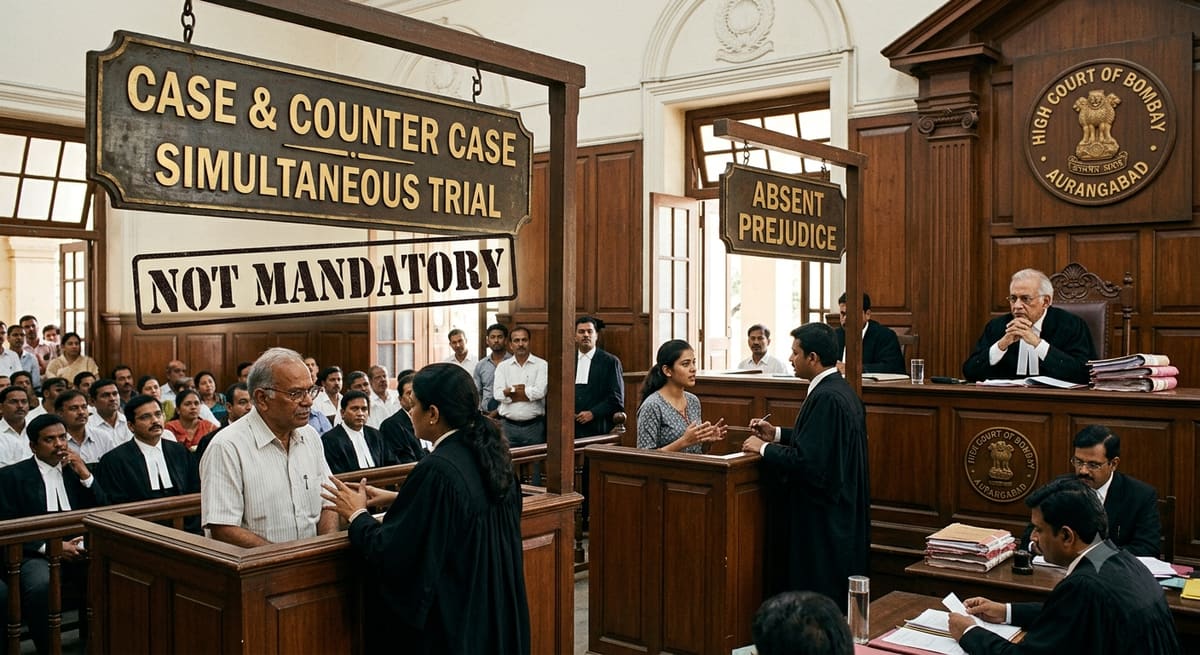
The Allahabad High Court has clarified a critical procedural principle in criminal trials: when two separate sessions trials arise from a single incident, the judgments must be pronounced together by the same judge, even if the trials themselves cannot be clubbed. This ruling reinforces the doctrine of procedural fairness and prevents conflicting outcomes in factually intertwined cases.
Background & Facts
The Dispute
The applicant, Rahul Singh @ Hari Mangal Singh, was named as an accused in Crime No. 178/2012 under Section 306 IPC at Police Station Chanda, District Sultanpur, relating to the alleged abetment of suicide of one Smt. Sushma Devi. A co-accused, Smt. Gulshan Singh, was also named in the same FIR. The applicant was arrested, produced before court, and granted bail. The trial against him commenced and progressed to the stage where defence witnesses had been examined.
Key Facts
- Crime No. 178/2012 was registered on 12.05.2012
- The applicant was granted bail on 28.07.2012
- Session Trial No. 336/2012 (State vs. Rahul Singh @ Hari Mangal Singh) commenced and progressed to defence stage
- Smt. Gulshan Singh, the co-accused, remained absconding for over 13 years
- Smt. Gulshan Singh surrendered before the court on 15.03.2025
- A separate Session Trial No. 1152/2025 (State vs. Smt. Gulshan Singh) was initiated on 20.03.2025
- The prosecution witnesses in Trial No. 1152/2025 are currently being examined
- Both trials relate to the same incident, same FIR, same evidence record, and same investigating officer
Procedural History
- 12.05.2012: FIR No. 178/2012 registered under Section 306 IPC
- 28.07.2012: Applicant granted bail
- 2012: Session Trial No. 336/2012 commenced
- 15.03.2025: Smt. Gulshan Singh surrendered
- 20.03.2025: Session Trial No. 1152/2025 initiated against Smt. Gulshan Singh
- 11.12.2025: Applicant filed application seeking clubbing of both trials
- 21.04.2026: Additional District and Sessions Judge rejected the application
- 25.04.2026: Present application under Section 482 CrPC filed before Allahabad High Court, Lucknow Bench
The Parties' Positions
The applicant contended that both trials arise from the same incident, involve the same witnesses, and are being tried by the same court. He argued that separate judgments may lead to contradictory findings, violating the principles of natural justice and the settled law laid down by the Supreme Court. He sought clubbing of trials or, at minimum, simultaneous pronouncement of judgments.
The State opposed the application on technical grounds, arguing that clubbing of trials is not permissible under law once separate trial numbers are assigned. However, the State did not object to the applicant being granted liberty to file a fresh application for simultaneous pronouncement of judgments.
Relief Sought
The applicant sought quashing of the order dated 21.04.2026 rejecting his application for clubbing. Alternatively, he sought liberty to file a fresh application before the trial court for pronouncing judgments of both trials on the same day, with a direction to the trial court to decide the same within a stipulated time.
The Legal Issue
The central question was whether, in two separate sessions trials arising from the same incident and FIR, the law permits or mandates that judgments be pronounced simultaneously by the same judge, even if the trials cannot be clubbed.
Arguments Presented
For the Appellant/Petitioner
Learned counsel relied on Nathi Lal and Others v. State of U.P. (1990 Supp SCC 145), State of M.P. v. Mishrilal (2003 SCC 426), and Sudhir and Others v. State of M.P. (2001 SCC 688) to argue that when two criminal cases arise from the same incident, the judgments must be pronounced together by the same judge to avoid conflicting outcomes. He emphasized that the trial court’s rejection of the application was based on a misreading of the prayer, which was not for clubbing trials but for synchronized judgment delivery. He submitted that the applicant, an army personnel posted in Leh, faces hardship and that justice demands a practical resolution.
For the Respondent/State
The Additional Government Advocate contended that once separate trial numbers are assigned, clubbing is legally impermissible. He argued that the trial court correctly applied the law in rejecting the application as framed. However, he conceded that the applicant should be permitted to file a fresh application seeking simultaneous pronouncement of judgments, in line with Supreme Court precedents.
The Court's Analysis
The Court examined the Supreme Court’s jurisprudence on cross-cases arising from a single incident. In Nathi Lal, the Apex Court held that when two cases arise from the same incident, the same judge must try them consecutively, reserve judgment in each, and pronounce both judgments one after the other, without cross-referencing evidence. The Court reiterated that the purpose is to prevent conflicting judgments and ensure consistency in factual appreciation.
"Each case must be decided on the basis of the evidence which has been placed on record in that particular case without being influenced in any manner by the evidence or arguments urged in the cross case. But both the judgments must be pronounced by the same learned Judge one after the other."
The Court noted that in Mishrilal, the Supreme Court emphasized that the investigating officer’s failure to properly investigate and consolidate the two versions of the same incident led to a grave miscarriage of justice. Similarly, in Sudhir, the Court described cross-cases as "different or conflicting versions of one incident," and stressed that trying them separately risks convicting one party before the full picture is before the court.
The Court observed that while clubbing of trials is not permissible under the CrPC once separate trial numbers are assigned, the requirement for simultaneous pronouncement of judgments is not a matter of procedural convenience but of substantive justice. The trial court’s rejection of the application was based on a narrow reading of the prayer, which the Court found to be a misinterpretation. The applicant’s intent was clearly to secure synchronized judgment delivery, not to merge trials.
The Court further held that the trial court must not be bound by its earlier order rejecting the application, as it was based on a flawed understanding of the relief sought. The applicant, being a serving army personnel, is entitled to procedural accommodation.
The Verdict
The application was disposed of with the following directions: (1) The two session trials shall continue separately; (2) The applicant is granted liberty to file a fresh application before the trial court within 15 days seeking simultaneous pronouncement of judgments in Session Trial No. 336/2012 and Session Trial No. 1152/2025; (3) The trial court shall consider the fresh application within eight weeks of its filing, ignoring the order dated 21.04.2026; (4) The applicant may file the fresh application through his counsel, given his posting in Leh.
What This Means For Similar Cases
Simultaneous Pronouncement Is Mandatory, Not Discretionary
- Practitioners must now argue that when two trials arise from the same incident, the trial court is legally obligated to pronounce judgments together, even if trials proceed separately
- A rejection of such a prayer on grounds of "no statutory provision" is legally unsustainable in light of Nathi Lal and subsequent rulings
- The burden shifts to the trial court to ensure synchronized judgment delivery, not to the accused to prove necessity
Clubbing ≠ Pronouncement - A Critical Distinction
- Applications seeking "clubbing" of trials may be rejected on technical grounds
- But applications seeking "simultaneous pronouncement of judgments" are legally valid and must be granted
- Drafting precision matters: the prayer must focus on judgment timing, not trial consolidation
- This distinction allows practitioners to circumvent procedural barriers while securing substantive justice
Procedural Accommodation for Special Circumstances
- Courts must consider hardship faced by accused in service or remote postings
- Liberty to file fresh applications through counsel is a recognized remedy when the original application is poorly worded
- Judges are directed to look beyond the form of the prayer to the substance of the request
- This opens the door for similar applications in cases involving absent co-accused, delayed trials, or cross-complaints