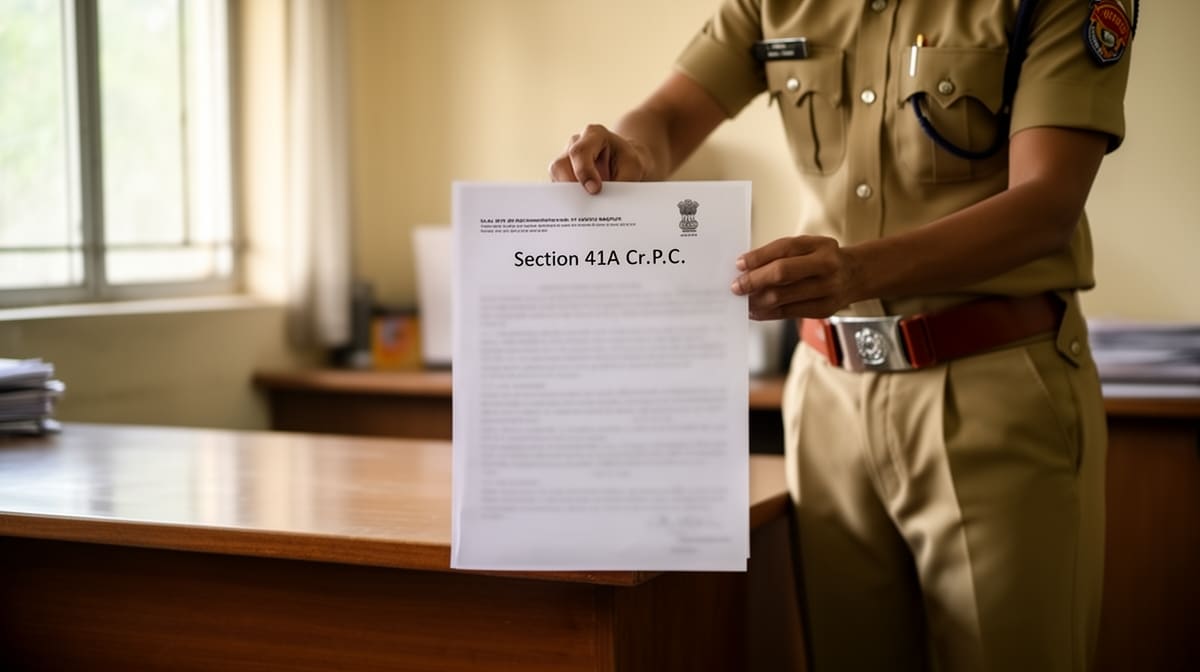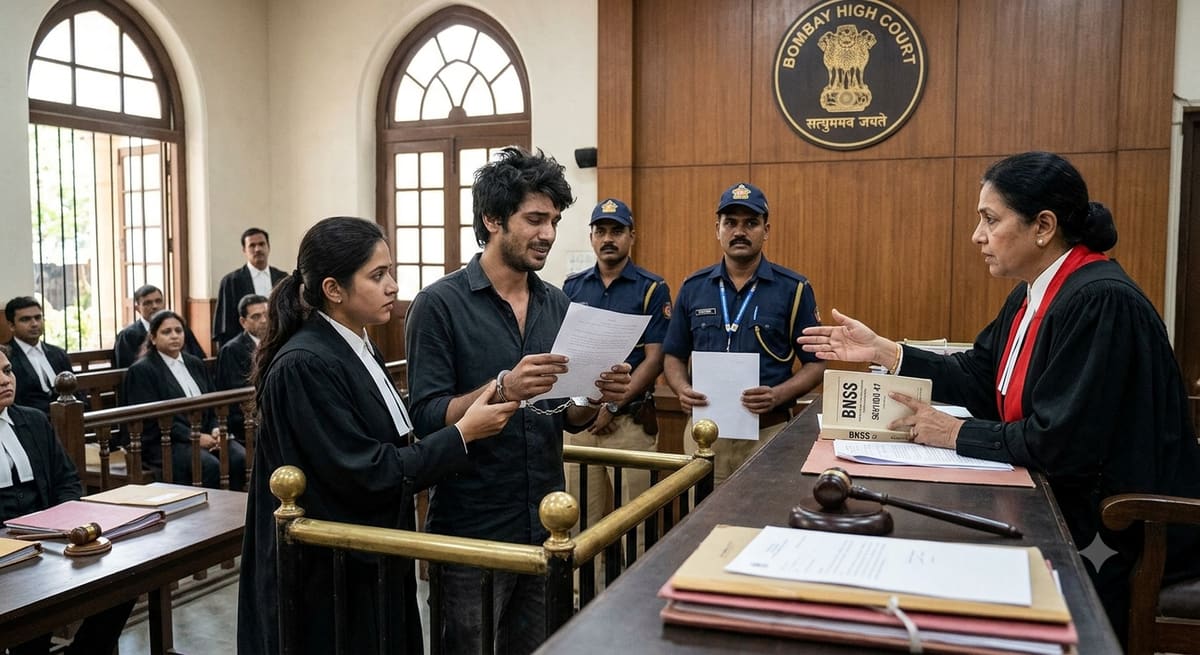
The Bombay High Court has declared the arrest of a businessman unlawful where the police served a Section 41A CrPC notice only after effecting arrest, manipulated official records to justify the detention, and colluded with a developer to implicate the petitioner in a false extortion case. The Court awarded Rs 5,00,000 compensation, directed immediate suspension of the Sub-Inspector, and referred the conduct of the remand Magistrate to the Administrative Committee for action.
Background & Facts
The Dispute
The petitioner, Bipin Satish Chandra Agrwal, a 49-year-old businessman engaged in import and export of garments, was arrested on 4th August 2017 from the office of M/s. Seth and Sonal Developers at Marine Lines, Mumbai. The arrest followed a meeting where the petitioner, acting as Constituted Attorney for his 70-year-old mother-in-law Smt. Asawari K. Kulkarni, had negotiated the sale of her flat in the New Aarti Co-operative Housing Society, Andheri East, for approximately Rs 1.64 crore. The developers handed him an advance of Rs 2,00,000, following which police personnel arrived, handcuffed him, and took him to Azad Maidan Police Station.
Key Facts
- The Society was undergoing redevelopment by M/s. Seth and Sonal Developers (partners: Bhavesh Seth and Kamlesh Vora); the building was demolished without execution of individual agreements with flat owners.
- Following her husband's demise, Smt. Kulkarni appointed the petitioner as her Constituted Attorney to negotiate with the builder.
- Pursuant to a telephonic conversation on 2nd August 2017, the petitioner agreed to meet the developers at their office on 4th August 2017 at 11:00 am; the meeting was rescheduled to 6:00 pm.
- At the meeting, the petitioner negotiated sale of the flat for ~Rs 1.64 crore; developers handed advance of Rs 2,00,000 in cash.
- Immediately thereafter, police arrived, handcuffed the petitioner, and transported him to Azad Maidan Police Station.
- FIR No. 243 of 2017 was registered under Section 384 IPC (extortion, maximum punishment three years) against the petitioner.
- A Notice under Section 41A CrPC was served at 8:20 pm on 4th August 2017 - after the arrest.
- The petitioner was produced before the 64th Court, Mumbai on 5th August 2017 at 1:45 pm and remanded to police custody till 8th August 2017; remand extended to 10th August 2017 without reasons.
- On 10th August 2017, he was remanded to judicial custody; bail application filed same day, listed 14th August 2017, adjourned to 16th August 2017; judicial custody continued till 24th August 2017.
- Bail granted by Sessions Court on 28th August 2017 on bond of Rs 25,000; petitioner released.
- The petitioner alleged a prior complaint dated 23rd June 2017 was filed but no notice/summons issued; RTI response later contradicted receipt of any such complaint.
Procedural History
- 4th August 2017: Arrest of petitioner; FIR No. 243/2017 registered; Section 41A notice served post-arrest.
- 5th August 2017: Production before Magistrate; remand to police custody till 8th August 2017.
- 8th August 2017: Police custody extended to 10th August 2017.
- 10th August 2017: Remand to judicial custody; bail application filed.
- 14th August 2017: Bail hearing adjourned to 16th August 2017.
- 16th August 2017: Judicial custody continued till 24th August 2017.
- 22nd August 2017: Further bail hearing before Magistrate.
- 28th August 2017: Sessions Court grants bail (Rs 25,000 bond).
- 2017: Writ Petition No. 4458 of 2017 filed under Article 226 seeking declaration of illegal arrest, departmental inquiry, and compensation.
- 2018: Criminal Application No. 32 of 2018 filed by Bhavesh Seth (developer) for intervention.
- 6th February 2018, 3rd April 2018, 1st February 2020, 10th September 2020: Sessions Court orders directing compliance with voice sample recording guidelines per Sudhir Choudhary v. State (NCT) of Delhi.
- 18th October 2017: Voice sample dispatched, analyzed, returned, and forensic report prepared - all same day.
- 20th August 2026: Arguments concluded; judgment reserved.
- 22nd October 2026: Judgment pronounced.
The Parties' Positions
Petitioner (in person): Arrest was illegal, malafide, and product of collusion between Respondent No. 2 (Sub-Inspector Mahesh Lamkhade) and the developers. Section 41A notice served after arrest; no investigation conducted; arrest form tampered (dates overwritten); medical examination not recorded; grounds of arrest not communicated; characterized as recidivist without evidence. Relied on Arnesh Kumar v. State of Bihar (2014) 8 SCC 273.
State (Mr. J.P. Yagnik, APP): Relied on Nagpur Bench decision distinguishing "grounds of arrest" from "reasons of arrest"; submitted grounds need only be furnished two hours prior to remand - not done here.
Respondent No. 2 (Mr. Anvay Pawar): Claimed compliance with Bombay Police Manual 1956 Volume III Rule 35; Magistrate's remand order ratified legality; relied on Satender Kumar Antil v. CBI (2026 SCC OnLine SC 162), Arnesh Kumar, and Superintendent of Police, CBI v. Tapan Kumar Singh (2003) 6 SCC 175.
Relief Sought
Declaration that arrest on 4th August 2017 was illegal and unlawful; departmental inquiry against Respondent No. 2 and concerned officers; compensation from State for illegal detention and deprivation of lawful rights.
The Legal Issue
Whether the arrest of the petitioner on 4th August 2017 was lawful where: (i) a Section 41A CrPC notice was served only after arrest; (ii) the offence under Section 384 IPC carries a maximum sentence of three years; (iii) official records were manipulated to justify the arrest; and (iv) no preliminary investigation was conducted before arrest.
Arguments Presented
For the Petitioner
The petitioner contended that Section 41A CrPC mandates notice before arrest for offences punishable up to seven years; the notice served at 8:20 pm on 4th August 2017 was post-arrest and therefore the arrest was ab initio illegal. He highlighted multiple document manipulations: Station Diary Entry No. 50 (17:10 hours) recorded complainant's statement without preliminary verification; Station Diary Entry No. 55 (20:20 hours) showed FIR registration, arrest, medical examination, and notice service all within 2 hours 10 minutes - proving FIR registered after arrest. The Arrest Form showed overwriting of dates (5th August changed to 4th August at three places), blank entries for medical examination (Serial 7), grounds of arrest and legal rights (Serial 8), and intimation to wife. The petitioner was falsely characterized as a recidivist (Serial 12) without any criminal antecedents. The voice sample forensic report dated 18th October 2017 was suppressed. The Magistrate failed to record reasons for repeated remands.
For the Respondent
The State argued that "grounds of arrest" and "reasons of arrest" are distinct; CrPC does not prescribe specific mode or timeframe for communication of grounds; grounds need only be furnished two hours prior to remand. Respondent No. 2 claimed scrupulous compliance with Bombay Police Manual Rule 35; submitted that Magistrate's remand order ratified the arrest; relied on Satender Kumar Antil, Arnesh Kumar, and Tapan Kumar Singh to argue that the arrest was justified and procedures followed.
The Court's Analysis
The Court, per Kamal Khata J., conducted a meticulous examination of the police records and found "a classic case where a Police Sub Inspector has exploited his official position and weaponized Police machinery at his command, to advance the Developer's interest against the Petitioner."
"It is evident from the documents placed on record. It is a classic case where a Police Sub Inspector has exploited his official position and weaponized Police machinery at his command, to advance the Developer's interest against the Petitioner, to wreak havoc in the Petitioner's life apparently because he did not succumb to their pressure to accept the deal offered and threatened them to expose their wrongdoings along with certain Society members."
Manipulation of Station Diary Entries: Diary Entry No. 50 (17:10 hours) recorded the complainant's statement without any preliminary investigation. Diary Entry No. 55 (20:20 hours) claimed completion of FIR registration, arrest, medical examination, and Section 41A notice service within 2 hours 10 minutes - demonstrating the FIR was registered after arrest, contrary to criminal jurisprudence. The complainant's name was absent from Diary Entry No. 50 despite alleged prior complaint of 23rd June 2017.
FIR Contradictions: The FIR concocted a dispute between petitioner and mother-in-law, belied by the Power of Attorney, Individual Agreement (unregistered) dated 8th May 2017 (petitioner as witness, share certificate no. 50 in mother-in-law's name, para 29 directing notices to petitioner's Walkeshwar address), and emails from April 2017 regarding indemnity bond. RTI response contradicted the written complaint of 23rd June 2017. Chargesheet stated police had not annexed the written complaint copy.
Arrest Form Tampering: The form showed date 5th August 2017 at four places overwritten as 4th August 2017 at three places. Serial No. 1 recorded Arrest Registration No. 262 dated 5th August 2017 - exposing the actual arrest date. Serial No. 7 (medical examination) left blank despite Diary Entry 55 recording it. Serial No. 8 (grounds of arrest, legal rights, intimation to wife) entirely blank. Signatures obtained between 1:20 am and 2:00 am on 5th August 2017. Serial No. 12 falsely characterized petitioner as recidivist likely to abscond - no evidence of criminal antecedents.
Section 41A Violation: No evidence that petitioner was granted genuine opportunity to comply with the notice under Section 41A(2) and (3). No reasons recorded under Section 41A for alleged non-compliance. Arrest preceded notice - "undoubtedly illegal under the well-settled law."
Voice Sample and Forensic Report: The same-day turnaround (18th October 2017) for dispatch, analysis, return, and report preparation was "remarkable and inconsistent with usual and normal forensic procedure." Respondents violated successive Sessions Court orders (6th February 2018, 3rd April 2018, 1st February 2020, 10th September 2020) directing compliance with Sudhir Choudhary guidelines. Forensic report suppressed from chargesheet.
Precedents Distinguished: Satender Kumar Antil (para 32) holds police officer cannot arrest simply to ask questions; must satisfy why investigation cannot proceed without custody - no such satisfaction here. Arnesh Kumar requires answers to: Why arrest necessary? Is it really required? What purpose will it serve? What object will it achieve? - no legally justifiable answers found. Tapan Kumar Singh imposes duty to collect information - deliberately not done.
Magistrate's Failure: The learned Magistrate of 64th Court failed to independently apply mind, adopted casual approach, recorded no reasons for continued remands on 5th, 8th, 10th August 2017 and bail hearings on 16th, 22nd August 2017 - causing grave prejudice.
The Verdict
The petitioner succeeded. The Court: (a) declared the arrest of 4th August 2017 unlawful and illegal; (b) directed the State to pay Rs 5,00,000 compensation for unlawful arrest and detention (6 days police custody, 20 days judicial custody) within two weeks from date of uploading the order on the official website; (c) directed the State to initiate strict action including immediate suspension against Respondent No. 2 (Sub-Inspector Mahesh Lamkhade) and all concerned officers, with recovery of proportionate compensation from their salaries; (d) directed the Registry to place the judgment before the Administrative Committee of the Bombay High Court for appropriate action against the learned Magistrate(s) of the 64th Court, Mumbai who adjudicated the remand applications (5th, 8th, 10th August 2017) and bail applications (16th, 22nd August 2017) for wrongfully permitting police and judicial custody without verifying, examining, or recording reasons. Criminal Application No. 32 of 2018 disposed of.
What This Means For Similar Cases
Section 41A Compliance Is Non-Negotiable
The judgment reinforces that for offences punishable up to seven years (including Section 384 IPC with three-year maximum), arrest cannot precede Section 41A notice. The notice must be served before arrest, and the accused must be given a genuine opportunity to comply. Post-arrest service of notice renders the arrest ab initio illegal. Practitioners must:
- Verify timing of Section 41A notice service against arrest memo
- Check whether reasons for non-compliance were recorded by police under Section 41A
- Challenge remand orders where notice was served post-arrest
Document Tampering Will Be Exposed Through Cross-Referencing
The Court's method - cross-referencing Station Diary entries, FIR, Arrest Form, medical records, and RTI responses - provides a template for exposing fabricated records. Key checks:
- Arrest Form vs. Arrest Register: Discrepancy in dates (overwriting vs. unaltered registration number)
- Station Diary vs. Arrest Form: Medical examination recorded in diary but blank in arrest form
- FIR vs. RTI: Contradiction on prior complaint receipt
- Chargesheet vs. FIR: Non-annexure of written complaint mentioned in FIR
- Voice Sample Timeline: Same-day forensic turnaround as indicator of manipulation
Magistrates Must Record Reasons for Remand - Casual Approach Will Be Called Out
The referral of the Magistrate's conduct to the Administrative Committee signals judicial intolerance for mechanical remand orders. Practitioners should:
- Insist on reasoned remand orders at every stage
- File revision applications where reasons are absent
- Cite this judgment to demand Magistrate accountability under Section 167 CrPC
Compensation for Illegal Arrest Is Now Quantified and Enforceable
The Rs 5,00,000 award (for 6 days police + 20 days judicial custody) with a two-week compliance deadline and recovery from errant officers' salaries sets a concrete precedent. Lawyers should:
- Plead specific compensation amounts with breakdown (police custody days, judicial custody days)
- Seek recovery from individual officers' salaries where malafide is established
- Use the two-week deadline as benchmark for compliance applications
Developer-Police Collusion Can Be Proven Through Documentary Evidence
The judgment demonstrates how commercial disputes are criminalized through police collusion. The petitioner's lawful attorney relationship (Power of Attorney, agreement as witness, email correspondence) was twisted into extortion. Practitioners handling redevelopment disputes should:
- Preserve all communication (emails, agreements, POA) as anticipatory evidence
- File pre-emptive complaints against coercive tactics
- Use RTI to verify existence of prior police complaints
- Challenge FIRs that contradict documentary evidence of lawful representation