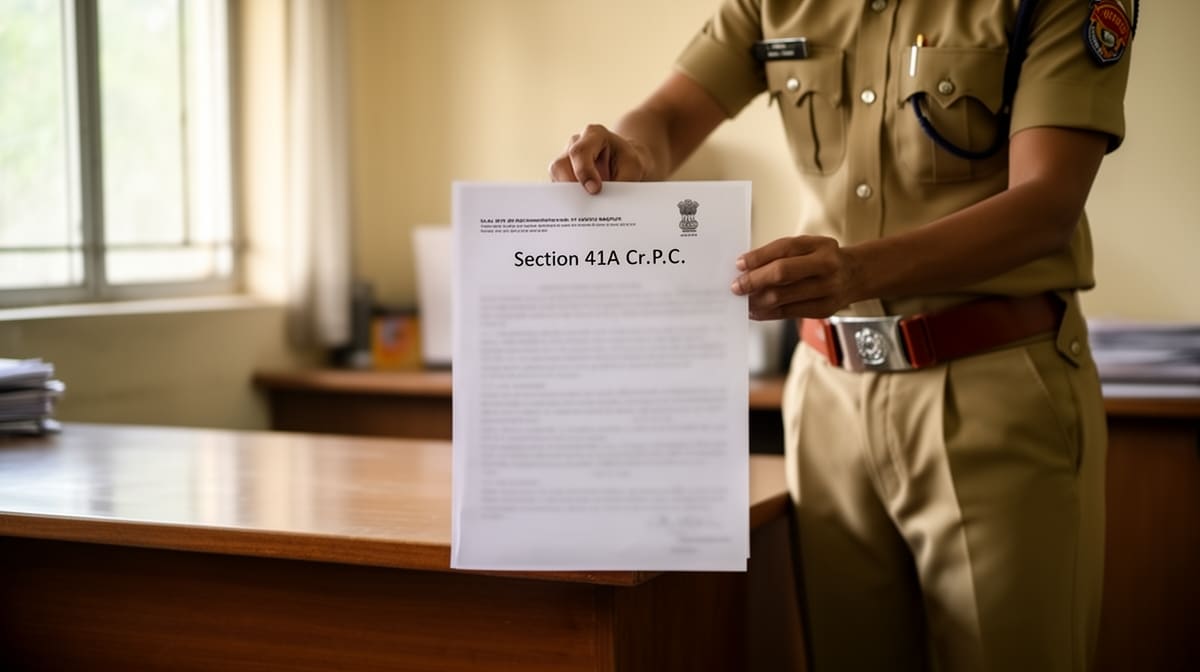
The Bombay High Court has reinforced a foundational safeguard against arbitrary arrest by holding that police must strictly comply with the mandatory notice requirement under Section 41A of the Criminal Procedure Code before detaining individuals accused of offences punishable with up to seven years’ imprisonment. This ruling, grounded in the Supreme Court’s landmark jurisprudence in Arnesh Kumar v. State of Bihar and Satender Kumar Antil v. Central Bureau of Investigation, restores procedural integrity in pre-arrest investigations.
Background & Facts
The Dispute
The petitioner, Kalpesh s/o Kalidas Kharade, was arrested without prior notice for alleged offences under Section 354-D (stalking), Section 67 (publishing obscene material in electronic form), and Section 12 (sexual assault on a child) of the Protection of Children from Sexual Offences Act, 2012. All these offences carry a maximum punishment of seven years, making them eligible for the procedural protections under Section 41A Cr.P.C. The petitioner contended that his arrest was unlawful because no notice was issued under Section 41A, which mandates that police must first issue a notice requiring the accused to appear before them, unless exceptional circumstances exist.
Procedural History
- 10 November 2025: The High Court issued an interim order directing the State to inquire whether the arresting officer had violated the directives in Arnesh Kumar and Satender Kumar Antil.
- December 2025: The Assistant Commissioner of Police, Mr. Ankush Khedkar, submitted a report on the inquiry.
- 7 March 2026: The Court reviewed the report and found no mention of Section 41A Cr.P.C. compliance.
Relief Sought
The petitioner sought a declaration that his arrest was illegal and a direction to the State to initiate disciplinary action against the arresting officer for failure to follow mandatory procedural safeguards.
The Legal Issue
The central question was whether Section 41A of the Criminal Procedure Code imposes a mandatory obligation on police to issue a notice before arrest in cases where the maximum punishment does not exceed seven years, and whether failure to do so renders the arrest unlawful even if the offence is non-bailable.
Arguments Presented
For the Petitioner
The petitioner’s counsel relied on Arnesh Kumar v. State of Bihar and Satender Kumar Antil v. CBI to argue that Section 41A Cr.P.C. is not discretionary but mandatory for offences punishable with up to seven years. He emphasized that the Supreme Court has repeatedly held that arrest must be the last resort and that non-compliance with Section 41A violates Article 21 of the Constitution. The report filed by the Assistant Commissioner of Police, he submitted, was a complete omission of the statutory requirement and amounted to a failure of duty.
For the Respondent
The Additional Public Prosecutor conceded that the report did not explicitly reference Section 41A but argued that the investigation was ongoing and that the arrest was justified due to the nature of the allegations involving a minor. He requested time to obtain instructions on whether the officer had considered the provisions but failed to document them.
The Court's Analysis
The Court examined the Supreme Court’s consistent jurisprudence that Section 41A Cr.P.C. is a statutory shield against arbitrary arrest. In Arnesh Kumar, the Court held that police officers must record reasons for arrest only after considering whether the conditions under Section 41A have been satisfied. In Satender Kumar Antil, the Court reiterated that failure to issue notice under Section 41A is a serious procedural lapse that cannot be excused by the gravity of the offence.
"The law does not permit the police to bypass the statutory notice requirement merely because the offence is non-bailable or involves moral turpitude. The procedural safeguard is not a technicality - it is a constitutional imperative."
The Court noted that the inquiry report filed by the Assistant Commissioner of Police contained no reference to Section 41A, no analysis of whether the accused could be summoned, and no justification for immediate arrest. This silence, the Court held, was not inadvertent but indicative of systemic disregard for binding precedent. The Court emphasized that Section 41A applies irrespective of whether the offence is bailable or non-bailable, as long as the punishment does not exceed seven years.
The Verdict
The petitioner succeeded. The Court held that Section 41A Cr.P.C. mandates issuance of notice before arrest in offences punishable with up to seven years, and failure to comply renders the arrest procedurally invalid. The Court directed the State to initiate disciplinary proceedings against the officer for non-compliance and ordered the filing of a fresh affidavit explaining the absence of Section 41A compliance.
What This Means For Similar Cases
Notice Under Section 41A Is Non-Negotiable
- Practitioners must now challenge every arrest in offences punishable up to seven years where no Section 41A notice was issued, regardless of the offence’s seriousness.
- Police reports must explicitly state compliance with Section 41A; silence will be construed as violation.
Judicial Scrutiny of Arrest Reports Has Intensified
- Courts will no longer accept generic or incomplete inquiry reports. Any omission of Section 41A analysis will trigger disciplinary action.
- Defence counsel should routinely file applications under Section 439 Cr.P.C. seeking quashing of FIRs where Section 41A was ignored.
Disciplinary Consequences for Non-Compliance Are Real
- Officers who ignore Section 41A may face departmental action under service rules, as confirmed by this judgment.
- Prosecutors must now verify compliance with Section 41A before filing chargesheets; failure may lead to dismissal of prosecution.