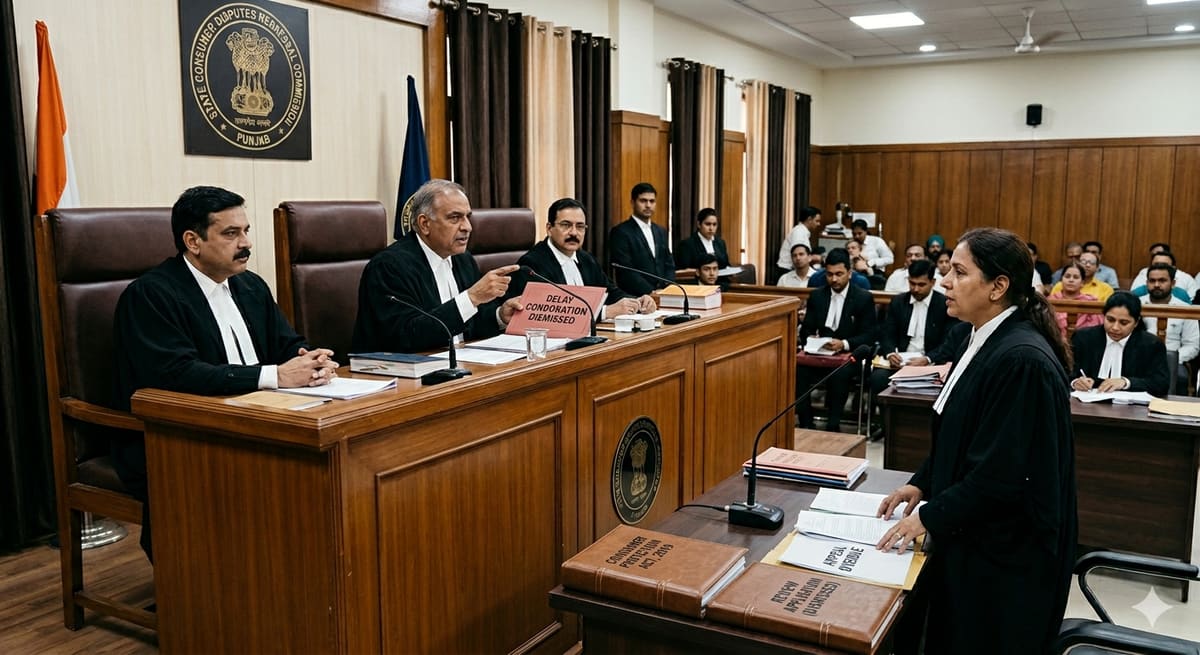
The Allahabad High Court has reaffirmed that refusal to condone delay in consumer litigation must be grounded in reasoned analysis of the specific grounds advanced, not merely on the status of the party as a government authority. This judgment reinforces procedural fairness under the Consumer Protection Act, 2019, and sets a critical precedent for appellate and revisional forums handling time-barred claims.
Background & Facts
The Dispute
The dispute arose from a consumer complaint filed by Mahesh Chandra Pandey, respondent no.4, against the Executive Officer of the Nagar Panchayat, Dibiyapur Pargana, Auraiya. The complainant alleged illegal recovery of water tax amounting to Rs.580/- and sought refund, compensation for mental torture, and litigation expenses.
Key Facts
- The complaint was filed as Complaint No.134 of 2018 before the District Consumer Disputes Redressal Commission, Auraiya.
- On 03.03.2023, the District Forum passed an ex parte order partly allowing the complaint, directing:
- Refund of Rs.580/- with 7% interest from 02.05.2018
- Additional 6% interest from 03.03.2023
- Rs.500/- as litigation expenses
- Rs.500/- for physical and mental torture
- The Nagar Panchayat, petitioner herein, filed an appeal before the State Consumer Disputes Redressal Commission, Lucknow, under Section 41 of the Consumer Protection Act, 2019, along with a delay condonation application on 26.08.2024.
- The State Commission dismissed the appeal on 29.01.2025 on grounds of delay and imposed a cost of Rs.2,00,000/- on the Nagar Panchayat.
- The Nagar Panchayat filed a revision petition under Section 58(1)(b) of the Consumer Protection Act, 2019, before the National Consumer Disputes Redressal Commission (NCDRC), New Delhi, on 12.01.2026, along with a delay condonation application.
- The delay in filing the revision petition was 256 days.
- The NCDRC dismissed the revision petition on 06.03.2026, refusing to condone the delay.
Procedural History
- 02.05.2018: Complaint filed by Mahesh Chandra Pandey before District Consumer Forum, Auraiya
- 03.03.2023: District Forum passed ex parte order in favor of complainant
- 26.08.2024: Appeal filed before State Consumer Commission, Lucknow, with delay condonation application
- 29.01.2025: State Commission dismissed appeal on delay and imposed cost of Rs.2,00,000/-
- 12.01.2026: Revision petition filed before NCDRC, New Delhi, with delay condonation application (IA/435/2026)
- 06.03.2026: NCDRC dismissed revision petition, refusing to condone 256-day delay
- 04.05.2026: Writ petition filed before Allahabad High Court under Article 227
The Parties' Positions
For the Petitioner (Nagar Panchayat)
- Argued that the delay in filing the revision petition was due to:
- Non-availability of Board members to pass a resolution
- Delay in convening the Board meeting, which was held only on 20.11.2025
- Need to obtain legal opinion after the limitation period expired
- Documents were in Devnagri script and required translation
- Winter vacations caused administrative delays
- Ex parte nature of District Forum order delayed access to records
- Emphasized that the delay was neither intentional nor deliberate
- Cited Supreme Court precedents that refusal to condone delay may defeat substantial justice
For the Respondents (Union of India and NCDRC)
- Contended that being a government authority does not justify delay
- Relied on Shivamma v. Karnataka Housing Board and Office of the Chief Post Master General v. Living Media India Ltd. to argue that administrative lethargy cannot be a ground for condonation
- Asserted that the Consumer Protection Act mandates time-bound disposal and condoning such delay undermines its spirit
- Claimed the NCDRC’s refusal was justified as the sole ground advanced was the petitioner’s governmental status
Relief Sought
The petitioner sought:
- Setting aside of the NCDRC’s order dated 06.03.2026
- Remand of the delay condonation application for fresh consideration
- No adjudication on the merits of the revision petition
The Legal Issue
The central question was whether the refusal to condone delay under the Consumer Protection Act, 2019, is legally sustainable when the revisional authority fails to address the specific grounds advanced in the delay condonation application, and instead relies solely on the petitioner’s status as a government authority.
Arguments Presented
For the Petitioner
The petitioner’s counsel argued that the NCDRC’s order was procedurally defective because it did not engage with any of the six specific grounds raised in the delay condonation application. The petitioner emphasized that the Supreme Court in Shivamma and Office of the Chief Post Master General did not lay down a blanket rule against condonation for government bodies, but rather required a meaningful evaluation of the cause. The petitioner contended that the NCDRC’s cursory dismissal - reducing complex administrative challenges to a single phrase - violated the principles of natural justice and rendered the delay condonation application redundant.
For the Respondent
The respondent’s counsel argued that the NCDRC correctly applied settled law: government agencies cannot claim exemption from limitation periods due to bureaucratic processes. They cited the Supreme Court’s emphasis that modern administrative systems must function efficiently, and that excuses like translation delays or winter vacations are not exceptional. They maintained that the Consumer Protection Act’s objective of expeditious redressal demands strict adherence to timelines, and that condoning delay without substantial cause would encourage procedural laxity.
The Court's Analysis
The Allahabad High Court conducted a rigorous review of the NCDRC’s order dated 06.03.2026 and found it legally unsustainable. The Court observed that while the NCDRC correctly cited Shivamma and Office of the Chief Post Master General, it failed to apply them meaningfully. The judgment noted that the Supreme Court has never held that government agencies are categorically barred from seeking condonation - rather, they must demonstrate bona fides and diligence.
"The only reason shown for said delay is that the petitioner is a Government authority. This ground for condonation of delay of 256 days is not sufficient enough."
The Court held that this single-line reasoning was inadequate. The NCDRC did not address any of the five specific factual grounds raised in the delay condonation application - including the need for Board resolution, translation of Devnagri documents, winter vacations, ex parte proceedings, and the time taken to obtain legal advice. The Court emphasized that procedural fairness requires that every ground raised must be individually considered and responded to, even if ultimately rejected.
The Court further noted that the order spanned four pages, yet only one paragraph dealt with the delay condonation application, and even that paragraph merely parroted the petitioner’s status without engaging with the substance. The Court held that such a mechanical approach violates the principle of reasoned decision-making, which is fundamental to administrative and quasi-judicial bodies under the Consumer Protection Act.
The Court clarified that it was not directing the NCDRC to condone the delay, but only to reconsider it with proper application of mind to the facts and law. The Court underscored that the law of limitation is not a technicality to be weaponized against litigants, but a tool to ensure justice is not delayed indefinitely.
The Verdict
The writ petition was allowed. The Allahabad High Court set aside the NCDRC’s order dated 06.03.2026 dismissing the revision petition on grounds of delay. The matter was remanded to the NCDRC to reconsider the delay condonation application in accordance with law, by addressing each of the specific grounds raised in the application. The NCDRC was directed to pass a fresh order within two months from the date of production of the certified copy of this judgment. All other questions on the merits of the revision petition were left open.
What This Means For Similar Cases
Procedural Fairness Is Non-Negotiable
- Practitioners must now insist that delay condonation applications be addressed point-by-point, not summarily dismissed with generic phrases like "government authority" or "administrative delay"
- Any order refusing condonation without engaging with the factual grounds is liable to be set aside for lack of reasoning
Government Bodies Are Not Automatically Disqualified
- While administrative lethargy cannot excuse delay, legitimate procedural hurdles - such as mandatory resolutions, document translation, or ex parte proceedings - may constitute sufficient cause
- The burden is on the authority to demonstrate diligence, not on the court to assume negligence
Consumer Forums Must Adhere to Timeliness Without Sacrificing Due Process
-
The Consumer Protection Act’s mandate for speed does not override the right to a reasoned hearing
-
Delay condonation is not a discretionary privilege but a procedural safeguard - its denial must be justified with precision
-
Always file delay condonation applications with detailed, fact-specific grounds
-
Never rely on vague assertions like "government delays" - cite specific events, dates, and impediments
-
If an appellate or revisional authority ignores your grounds, challenge the order on grounds of non-application of mind