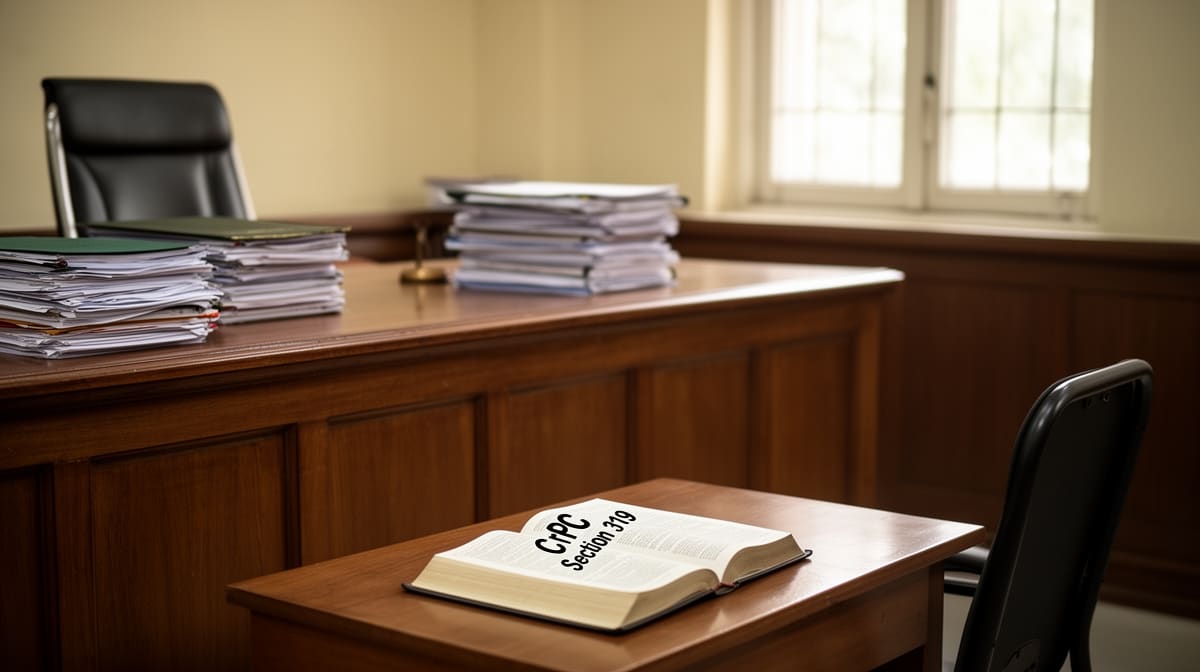
The Supreme Court has reaffirmed that the power under Section 319 of the Code of Criminal Procedure to summon additional accused is not a tool for pre-trial adjudication of credibility, but a mechanism to ensure no potentially guilty party escapes trial when the evidence, viewed cumulatively, reasonably supports their involvement. This judgment corrects a misapplication of the evidentiary threshold by lower courts, restoring the balance between judicial caution and procedural fairness.
Background & Facts
The Dispute
The appellant, Mohammad Kaleem, was the complainant and primary witness (PW-1) in a First Information Report (FIR) dated 22.08.2017 registered at Police Station Kotwali Nagar, Muzaffarnagar, under Sections 307, 302, and 120-B of the Indian Penal Code. The FIR alleged the murder of Mohammad Ammar, who was shot dead while traveling on a scooter with the complainant. The complainant claimed that the murder was the result of a conspiracy hatched by individuals detained in jail - Gulshanawwar, Jamshed, and Naushad - who allegedly instructed Rajendra and Mausam to eliminate Ammar because he was actively pleading in a prior case involving the accused.
Key Facts
- The deceased, Mohammad Ammar, was not a witness of fact in the prior murder case involving the jailed accused; he had only testified regarding the seizure of blood-stained soil.
- The complainant, Mohammad Kaleem, had previously been the victim of two attempted murders (against his brother Bhura and nephew Taslim) and was the sole eyewitness and complainant in all three incidents.
- The complainant did not sustain any injuries during the fatal shooting, despite being seated directly behind the deceased on the scooter and the deceased sustaining five gunshot wounds.
- Two witnesses, Khalil (PW-6) and Tazeem (PW-7), testified that they overheard Rajendra and Mausam discussing the plan to kill Ammar after meeting Gulshanawwar, Naushad, and Jamshed in jail.
- The Trial Court rejected the application to summon Rajendra and Mausam under Section 319 CrPC, citing inconsistencies between the complainant’s FIR and testimony, contradictions among PW-1, PW-6, and PW-7, absence of jail visit records, and implausible witness routes.
- The High Court upheld the Trial Court’s order.
Procedural History
- 22.08.2017: FIR registered at PS Kotwali Nagar, Muzaffarnagar.
- 18.09.2017: Investigation record (CD No. 17) confirms Jamshed was transferred from Muzaffarnagar Jail to Saharanpur Jail, then to Mirzapur Jail, prior to the incident.
- 17.03.2021: Trial Court rejects application under Section 319 CrPC to summon Rajendra and Mausam as additional accused.
- 2021: High Court of Judicature at Allahabad, in Criminal Revision No. 9654/2021, affirms the Trial Court’s order.
- 2023: Special Leave Petition (Crl.) No. 11085/2025 filed in the Supreme Court.
- 17.03.2026: Supreme Court delivers judgment.
The Parties' Positions
Appellant (Mohammad Kaleem): Argued that the cumulative testimony of three witnesses - himself, PW-6, and PW-7 - provided sufficient grounds under Section 319 CrPC to summon Rajendra and Mausam. He emphasized that minor contradictions are inherent in eyewitness accounts and should not defeat the invocation of Section 319.
Respondent (State of Uttar Pradesh): Contended that the inconsistencies in the testimonies, absence of corroborative jail records, implausible witness routes, and contradictions with the General Diary and post-mortem report rendered the evidence unreliable and insufficient to meet the threshold for summoning additional accused.
Relief Sought
The appellant sought: (1) setting aside the orders of the Trial Court and High Court rejecting the Section 319 application; (2) direction to summon Rajendra and Mausam as additional accused; and (3) continuation of trial against them in accordance with law.
The Legal Issue
The central question was whether the Trial Court erred in applying a standard of proof approaching that required for conviction, rather than the lower threshold of "strong and cogent evidence" under Section 319 of the Code of Criminal Procedure, when evaluating an application to summon additional accused.
Arguments Presented
For the Appellant
The appellant relied on Hardeep Singh v. State of Punjab and Neeraj Kumar v. State of U.P. to argue that Section 319 CrPC does not require the court to conduct a mini-trial or resolve credibility disputes. He emphasized that the evidence of three witnesses, including the complainant, provided a prima facie basis for inferring involvement in the conspiracy. Minor inconsistencies in timing, route, or detail are matters for trial, not for rejection at the summoning stage. The court must assess the cumulative weight of evidence, not dissect each inconsistency in isolation.
For the Respondent
The State contended that the testimonies of PW-1, PW-6, and PW-7 were mutually contradictory on material points: the number of accused persons in jail involved, the date and time of the alleged meeting, the route taken by the witnesses, and the nature of Ammar’s involvement in the prior case. The absence of jail visit records, the implausibility of the witnesses’ route, and the complainant’s unexplained lack of injury further undermined reliability. The State argued that summoning additional accused without clear corroboration would violate the principle of fair trial and expose innocent persons to undue stigma.
The Court's Analysis
The Supreme Court undertook a structured review of the evidentiary standard under Section 319 CrPC, distinguishing it from the standards applicable at charge-framing and conviction stages. The Court observed that while the power to summon additional accused is extraordinary, it is not to be exercised with undue caution that defeats its purpose.
"The Court need not establish guilt or conduct a detailed credibility assessment at this stage... pre-trial scrutiny should not resemble a mini-trial."
The Court found that the Trial Court had misapplied the law by treating minor inconsistencies - such as the absence of jail visit logs, the route taken by witnesses, and slight variations in the description of the meeting - as dispositive. These were not grounds for rejection under Section 319, which permits reliance on oral evidence alone, even without documentary corroboration.
The Court emphasized that the cumulative testimony of three witnesses, including the complainant, provided a reasonable basis to infer that Rajendra and Mausam were involved in the conspiracy. The fact that the complainant had prior enmity with the accused did not, by itself, invalidate his testimony; it was a matter for cross-examination and evaluation at trial.
The Court further noted that the Trial Court’s fragmented analysis - treating each inconsistency as fatal rather than assessing the overall reliability of the evidence - was legally flawed. The law requires a holistic view: if the evidence, taken together, reasonably suggests involvement, the accused must be summoned.
"The testimony, on oath, by 3 witnesses, including the complainant no less, in our view, is sufficient in the facts of this case to meet the strong and cogent evidence standard."
The Court also clarified that the absence of jail records does not negate the possibility of an unauthorized meeting; such records are not mandatory for proving conspiracy. Similarly, the complainant’s lack of injury, while suspicious, does not disprove the occurrence of the crime or the existence of a conspiracy.
The Court held that the lower courts had effectively imposed a higher standard than permitted under Section 319 CrPC, thereby undermining the statutory objective of ensuring that no person who may be implicated in a crime escapes trial.
The Verdict
The appeals were allowed. The orders of the Trial Court and the High Court rejecting the application under Section 319 CrPC were set aside. Rajendra and Mausam were ordered to be summoned as additional accused and proceeded against in accordance with law. A copy of this order was directed to be sent to the Trial Court through the Registrar General, High Court of Judicature at Allahabad, for necessary action. Pending applications were closed.
What This Means For Similar Cases
Summoning Under Section 319 CrPC Is Not a Mini-Trial
- Practitioners must argue that minor contradictions in witness statements, timing discrepancies, or absence of documentary corroboration cannot be grounds to reject a Section 319 application.
- The court’s role is to determine whether the evidence, viewed cumulatively, reasonably suggests involvement - not to resolve credibility conflicts.
- Oral testimony alone, if consistent on material points, suffices to meet the "strong and cogent" threshold.
Cumulative Evidence Trumps Isolated Inconsistencies
- Lawyers must present evidence as a whole, highlighting the convergence of multiple witnesses on core allegations (e.g., conspiracy, motive, location).
- Focus on the substance of the testimony, not peripheral details like exact time of meeting or route taken.
- Argue that the burden at this stage is not to prove guilt, but to establish a reasonable inference of involvement.
Judicial Caution Must Not Become Judicial Overreach
- Courts must avoid applying conviction-level scrutiny at the summoning stage.
- The absence of jail visit logs, hospital records, or physical corroboration cannot be used to dismiss applications unless they directly contradict the core allegations.
- The complainant’s prior enmity or lack of injury are factors for trial, not for pre-trial rejection.