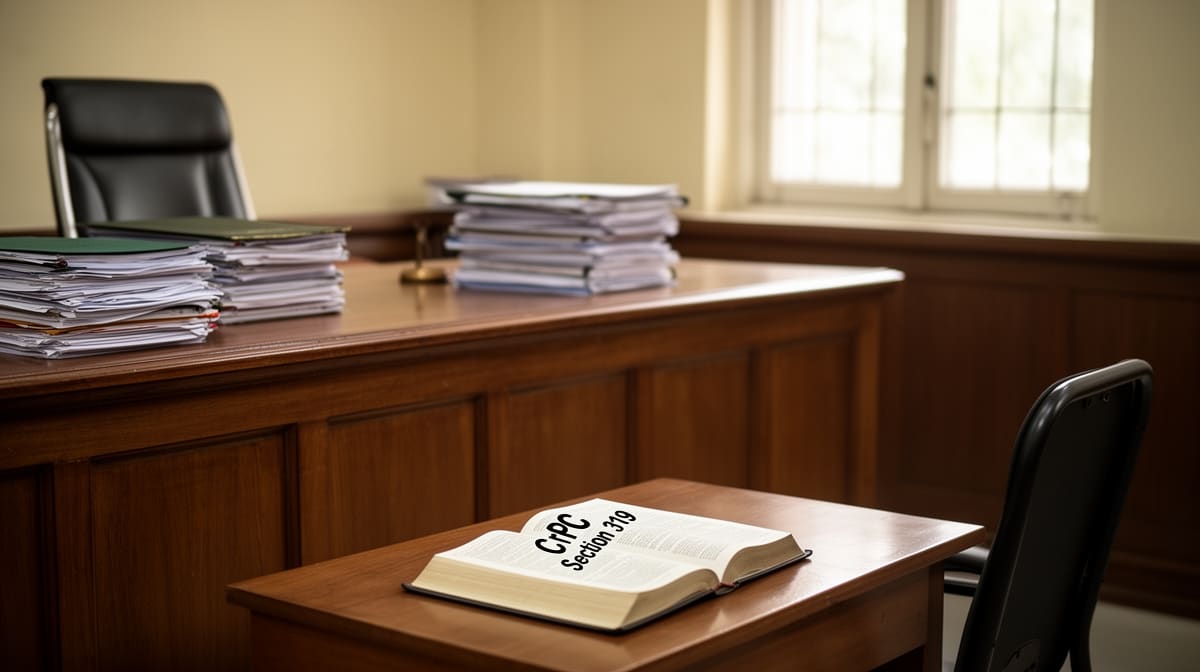
The High Court of Punjab and Haryana clarified the threshold for exercising the extraordinary power under Section 319 CrPC to summon persons as additional accused, holding that only strong and cogent evidence recorded before the trial court can justify such summons. The court modified the lower court's order to summon one accused while rejecting the summons of another, thereby sharpening the evidentiary standard for future applications.
Background & Facts
The Dispute
The petitioner, Anirudh, filed a revision petition challenging the order dated 04.12.2019 of the Additional Sessions Judge, Jhajjar, which had summoned Pardeep as an additional accused but dismissed the application to summon Jagjeet and Sudesh in a case arising out of FIR No. 282 dated 24.10.2017. The FIR was registered under Sections 323, 341, 506 and 34 of the IPC, Section 3 of the SC/ST Act, 1989 and Section 25 of the Arms Act at Police Station Sahlawas, District Jhajjar.
Key Facts
- 24.10.2017: FIR lodged alleging assault, intimidation and use of a weapon.
- 22.10.2017, 8:30 p.m.: Incident occurred near a Government School where Rajbir, his son Jagjeet and JCB owner Pardeep were filling a well used by the Scheduled Caste community.
- Rajbir kicked the complainant and threatened demolition of his house; Pardeep beat the complainant with a danda.
- Jagjeet allegedly stood in front of the complainant’s companions, used derogatory language and aimed a pistol at them.
- Sudesh, the Sarpanch, was present but allegedly did not intervene.
- Investigation report placed Rajbir in column 1 (accused) and Jagjeet, Pardeep and Sudesh in column 2.
- 06.08.2018: Petitioner appeared as PW-1, reiterating specific roles of Jagjeet, Pardeep and Sudesh.
- Application under Section 319 CrPC filed by petitioner and Public Prosecutor to summon the three persons as additional accused.
- 04.12.2019: Trial Court allowed summons of Pardeep only; dismissed summons of Jagjeet and Sudesh.
- Petition for revision filed seeking modification of the order to summon Jagjeet and Sudesh.
Procedural History
- 24.10.2017: FIR registered.
- 06.08.2018: PW-1 testimony recorded.
- 04.12.2019: Trial Court order allowing Pardeep as additional accused, dismissing Jagjeet and Sudesh.
- Revision petition filed (date not specified).
- 11.08.2026: Judgment reserved.
- 17.08.2026: Judgment pronounced.
Parties' Positions
- Petitioner: Argues that the FIR and PW-1 testimony contain specific allegations against Jagjeet and Sudesh, constituting strong and cogent evidence warranting their summons as additional accused.
- Respondents (State and others): Contend that the evidence against Jagjeet and especially Sudesh is weak, not corroborated, and that the investigating agency did not charge them; therefore, the trial court correctly declined to summon them.
Relief Sought
The petitioner seeks modification of the 04.12.2019 order to summon both Jagjeet (respondent No.2) and Sudesh (respondent No.3) as additional accused under Section 319 CrPC.
The Legal Issue
What is the evidentiary threshold for a court to exercise its discretionary power under Section 319 CrPC to summon a person as an additional accused, and did the trial court err in refusing to summon respondent No.2 Jagjeet and respondent No.3 Sudesh?
Arguments Presented
For the Petitioner
- Relied on the petitioner’s PW-1 testimony that specifically named Jagjeet and Sudesh, alleging direct participation in the assault.
- Cited Hardeep Singh v. State of Punjab (2014) and Manjeet Singh v. State of Haryana (2021) emphasizing that the power under Section 319 is extraordinary and must be exercised only when strong, cogent evidence is on record, more than a mere prima facie case.
- Asserted that the FIR itself contains explicit allegations against Jagjeet, satisfying the requirement of strong evidence.
For the Respondents
- Submitted that the investigating agency’s final report placed Jagjeet and Sudesh in column 2, indicating lack of involvement; the court should not override this investigative finding.
- Emphasised that Sudesh’s alleged misconduct appears only in a later statement by the petitioner, not in the FIR, and lacks corroboration from other witnesses, thus failing the “strong and cogent” test.
- Argued that the trial court correctly exercised discretion by limiting the summons to Pardeep, whose involvement was clearly established.
The Court's Analysis
The Court began by restating the language of Section 319 CrPC, which empowers a court to proceed against any person who, on the basis of evidence presented before it, appears to have committed an offence that can be tried together with the accused. The Court highlighted that this power is extraordinary and discretionary, requiring a threshold higher than a mere prima facie case. It referred to the Supreme Court’s observations in Hardeep Singh v. State of Punjab that the test is “more than prima facie but short of satisfaction that, if unrebutted, would lead to conviction.”
The Court then examined the evidentiary record concerning respondent No.2 Jagjeet. The FIR explicitly alleged that Jagjeet stood in front of the complainant’s companions, used derogatory language and aimed a pistol at them. Moreover, PW-1 reiterated these allegations in his examination-in-chief. The Court held that such specific, contemporaneous allegations satisfy the “strong and cogent” requirement, even though the investigating agency had placed Jagjeet in column 2. The Court emphasized that the trial court must consider evidence that surfaces during trial, not be bound by the investigative report.
"The material on record satisfies the requisite threshold for exercise of power under Section 319 Cr.P.C."
Regarding respondent No.3 Sudesh, the Court noted that the FIR contains no overt allegation against her; the only reference is that she was present at the spot. The allegation of slapping and abusive language emerged only in the petitioner’s later statement before the trial court, which the Court characterized as a “material improvement” over the original complaint. The Court found no corroborative testimony from other witnesses and therefore concluded that the evidence against Sudesh does not rise to the level of strong and cogent. Consequently, summoning Sudesh would exceed the permissible scope of Section 319.
The Court also reiterated that the power under Section 319 may be exercised at any stage after the charge-sheet is filed but before judgment, provided the evidence before the court justifies it. It stressed that the court should not be swayed by the investigative agency’s placement of a person in column 2 when substantive evidence later emerges.
In sum, the Court applied the established jurisprudence to differentiate between the two respondents: Jagjeet’s alleged conduct, as recorded in the FIR and reiterated by PW-1, met the evidentiary threshold, whereas Sudesh’s alleged conduct, lacking FIR mention and corroboration, did not.
The Verdict
The petition is partly allowed. The order dated 04.12.2019 is modified to the extent that respondent No.2 Jagjeet is ordered to be summoned as an additional accused under Section 319 CrPC. The prayer to summon respondent No.3 Sudesh is dismissed. The trial court shall proceed against Jagjeet in accordance with law.
What This Means For Similar Cases
Evidentiary Threshold for Section 319
- Courts will require specific, contemporaneous allegations recorded in the FIR or in the testimony of a prosecution witness to deem evidence “strong and cogent.”
- Post-FIR additions or uncorroborated statements are insufficient to meet the threshold.
Role of Investigation Reports
- An investigating agency’s placement of a person in column 2 is not conclusive; the trial court may still summon the person if trial-court evidence satisfies the statutory test.
Practical Guidance for Practitioners
- When filing an application under Section 319 CrPC, attach the FIR excerpts and any witness statements that directly allege the person’s participation.
- Anticipate challenges on the basis of lack of corroboration; be prepared to produce independent evidence beyond the FIR.
- Counsel should argue that the power is extraordinary and must be exercised sparingly, citing Hardeep Singh and Manjeet Singh.