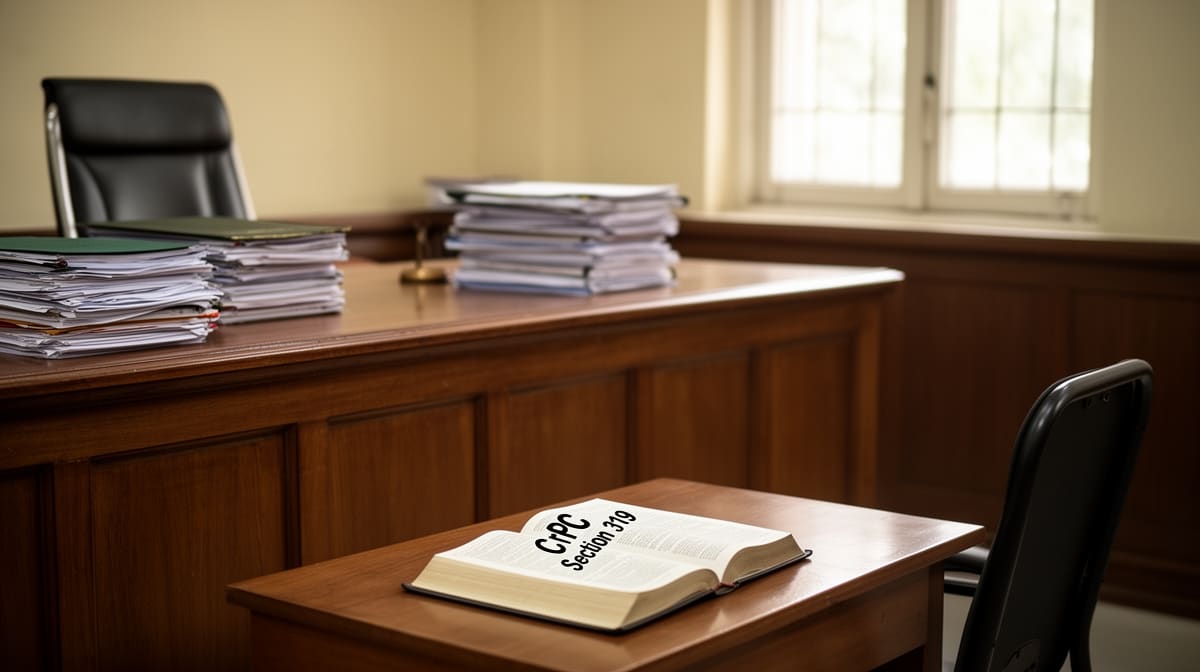
The Supreme Court has reaffirmed that the threshold for summoning additional accused under Section 319 of the Code of Criminal Procedure is not one of conclusive proof, but of strong and cogent evidence - wherein minor inconsistencies, plausibility concerns, or absence of documentary corroboration cannot justify outright rejection. This judgment restores the balance between judicial caution and the imperative to ensure no potentially culpable party escapes trial.
Background & Facts
The Dispute
The appellant, Mohammad Kaleem, was the complainant in an FIR dated 22.08.2017 registered at Police Station Kotwali Nagar, Muzaffarnagar, under Sections 307, 302, and 120-B IPC. The FIR alleged that Ammar, who was pleading in a pending murder case involving the accused, was murdered in a targeted attack while traveling on a scooter. The complainant claimed to have witnessed the incident and named four assailants on two motorcycles. He later sought to summon two additional persons - Rajendra and Mausam - as accused under Section 319 CrPC, alleging they were part of a conspiracy hatched in jail.
Key Facts
- The deceased, Mohammad Ammar, was shot dead on 22.08.2017 at approximately 10:30 a.m. near Aryapuri Galli, Muzaffarnagar.
- The complainant (PW-1) and Iqbal (PW-2) allegedly took Ammar to the District Hospital by rickshaw, where he was declared dead at 11:25 a.m.
- The post-mortem report recorded five gunshot injuries: three on the back and two on the front.
- The complainant claimed he was seated behind Ammar on the scooter and suffered no injury despite close proximity to the firing.
- The complainant admitted he had prior enmity with the accused and was an eyewitness/informant in three prior incidents involving the same accused, including an attempted murder of his brother.
- The prosecution’s theory of motive was that Ammar was targeted because he was pleading in a case involving Gulshanawwar, Jamshed, and Naushad, who were in jail.
- The complainant admitted Ammar was not a witness of fact in that case but only a witness for seizure of blood-stained soil and had never testified against the accused.
- The complainant’s FIR stated four assailants on two motorcycles. During trial, he introduced a new version: three additional persons on a third motorcycle.
- PW-6 (Khalil) and PW-7 (Tazim) testified that they overheard Rajendra and Mausam discussing with Dilshad, Mumtaz, and Aabid about killing Ammar, after meeting Gulshanawwar, Naushad, and Jamshed in jail.
- The jail records showed Jamshed had been transferred from Muzaffarnagar Jail to Saharanpur Jail and then to Mirzapur Jail nearly a year before the incident.
- The General Diary of PS Kotwali Nagar recorded that Ammar was brought to the hospital in an injured condition at 10:20 a.m. by Farid Ahmad, a rickshaw puller, and died at 11:25 a.m.
- The complainant’s statement before the Court contradicted his FIR on multiple points: number of assailants, mode of transport, hospital admission details, and the existence of a prior conspiracy.
Procedural History
- 22.08.2017: FIR registered at PS Kotwali Nagar, Muzaffarnagar.
- 18.09.2017: Investigation completed; charge sheet filed against Dilshad, Mumtaz, Aabid, Gulshanawwar, Naushad, and Jamshed.
- 17.03.2021: Trial Court rejected application under Section 319 CrPC to summon Rajendra and Mausam as additional accused.
- 2021: High Court dismissed revision petition upholding the Trial Court’s order.
- 2023: Special Leave Petition (Crl.) No. 11085 of 2023 filed before the Supreme Court.
- 17.03.2026: Judgment delivered by the Supreme Court.
The Parties' Positions
The complainant (appellant) contended that the testimonies of PW-1, PW-6, and PW-7 collectively established a strong and cogent basis to infer involvement of Rajendra and Mausam in the conspiracy. He argued that the Trial Court erred by applying a conviction-level standard and by dissecting evidence in isolation.
The State (respondent) defended the Trial Court’s reasoning, emphasizing contradictions in witness accounts, absence of jail visit records, implausible witness routes, and the complainant’s questionable credibility.
Relief Sought
The appellant sought: (1) setting aside the orders of the Trial Court and High Court rejecting the Section 319 application; (2) direction to summon Rajendra and Mausam as additional accused; and (3) continuation of trial against them in accordance with law.
The Legal Issue
The central question was whether the evidence presented by the complainant, PW-6, and PW-7 met the threshold of "strong and cogent" evidence required under Section 319 CrPC to summon additional accused, or whether the Trial Court was justified in rejecting the application based on minor inconsistencies and absence of documentary corroboration.
Arguments Presented
For the Appellant/Petitioner
The appellant relied on Hardeep Singh v. State of Punjab and Neeraj Kumar v. State of U.P. to argue that Section 319 CrPC does not require proof beyond reasonable doubt or a mini-trial. He contended that the cumulative testimony of three witnesses - including the complainant - establishing a conspiracy to kill Ammar, even with minor discrepancies, was sufficient to meet the "strong and cogent" standard. He emphasized that the Court must assess the totality of evidence, not isolate contradictions, and that oral testimony alone can suffice without corroboration from jail registers or hospital logs.
For the Respondent/State
The State argued that the testimonies of PW-6 and PW-7 were mutually contradictory on key points: the number of jail inmates involved, the timing of the meeting, and the route taken by the witnesses. It highlighted the absence of any official record of visits to the jail, the implausible route taken by the witnesses, and the complainant’s inconsistent statements regarding the number of assailants and the hospital admission of the deceased. It further contended that the complainant’s credibility was fatally compromised by his prior enmity and unexplained survival in multiple violent incidents.
The Court's Analysis
The Supreme Court began by delineating the three-tiered standard of evidence in criminal proceedings: prima facie for framing charges, strong and cogent for Section 319 CrPC, and proof beyond reasonable doubt for conviction. It emphasized that the purpose of Section 319 is not to determine guilt but to ensure that no person who may reasonably be implicated escapes trial.
"The Court must not conduct a mini-trial or engage in detailed credibility assessment at the stage of summoning additional accused. Minor contradictions, absence of documentary corroboration, or plausibility concerns cannot be decisive at this threshold."
The Court found that the Trial Court had misapplied the standard by treating each inconsistency in isolation - such as the discrepancy in the number of jail inmates mentioned, the absence of jail visit records, and the route taken by the witnesses - as fatal to the application. It noted that the jail transfer records, while relevant, were not mandatory for establishing the meeting’s occurrence; oral testimony, if credible, can stand alone.
The Court further observed that the Trial Court’s focus on the complainant’s survival without injury, while factually curious, was not a legal ground to dismiss the application. The Court held that the cumulative weight of the three witnesses’ sworn statements - despite their differences - provided a reasonable inference of involvement by Rajendra and Mausam in the conspiracy.
"The law requires a holistic appreciation of evidence. Fragmented scrutiny, especially when it elevates minor discrepancies to dispositive status, defeats the very object of Section 319 CrPC."
The Court also rejected the notion that the complainant’s prior enmity or inconsistencies in his FIR automatically invalidated the entire chain of evidence. It held that such issues are for trial and cross-examination, not for pre-trial rejection.
The Verdict
The Supreme Court allowed the appeals and set aside the orders of the Trial Court and High Court. It directed the Trial Court to summon Rajendra and Mausam as additional accused under Section 319 CrPC and proceed with the trial against them in accordance with law. The Court ordered that a copy of this judgment be sent to the Trial Court through the Registrar General of the Allahabad High Court for necessary action. Pending applications were closed.
What This Means For Similar Cases
Strong and Cogent Evidence Is Cumulative, Not Perfect
- Practitioners must argue that Section 319 CrPC requires a holistic view of evidence, not a forensic dissection of every inconsistency.
- Minor contradictions in witness accounts - such as differing numbers of jail inmates or imprecise timing - do not automatically negate the existence of a conspiracy.
- The absence of jail visit logs, CCTV, or hospital records cannot be used to reject applications unless the evidence is entirely devoid of credibility.
Oral Testimony Can Sustain Section 319 Applications
- Documentary corroboration is not mandatory; credible oral testimony from multiple witnesses suffices.
- Courts must not demand perfection in witness statements at the pre-trial stage.
- The burden is on the accused to rebut the evidence during trial, not on the prosecution to prove the case at the summoning stage.
Beware of Over-Scrutiny by Trial Courts
- Trial Courts must avoid conducting mini-trials when considering Section 319 applications.
- Judges should not substitute their own assessment of credibility for the trial process.
- Rejection of Section 319 applications based on plausibility arguments (e.g., "why didn’t they inform the victim?" or "why didn’t they take a different route?") is legally unsound.