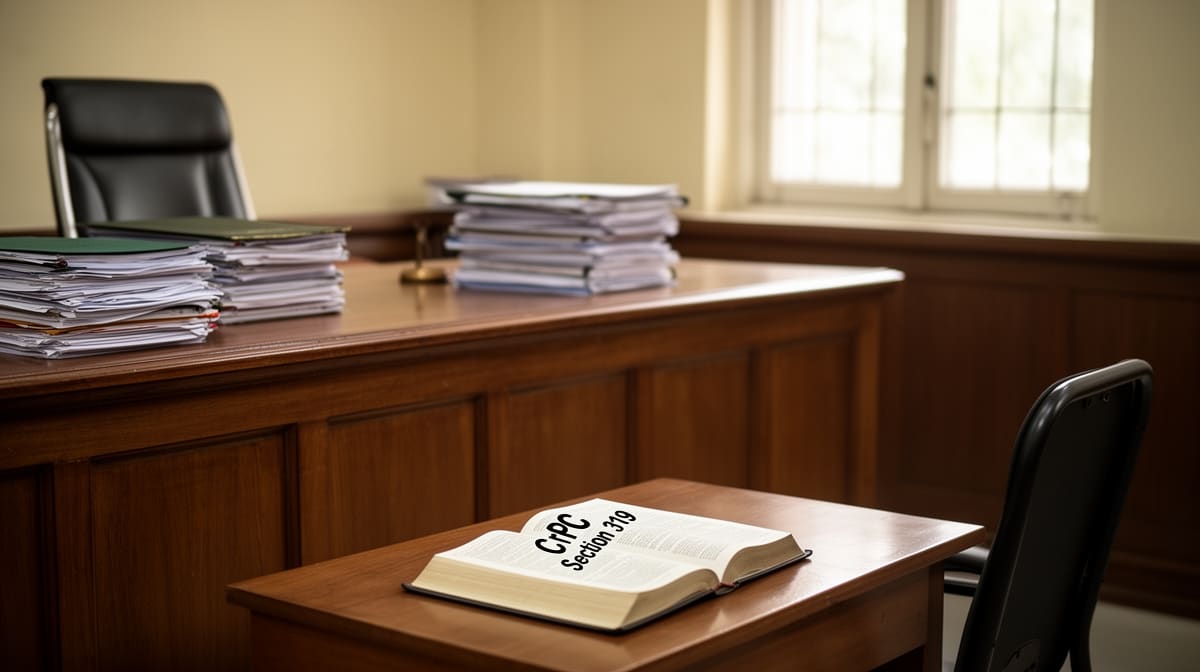
The Punjab and Haryana High Court has reaffirmed that summoning additional accused under Section 319 CrPC demands evidence significantly stronger than a prima facie case, rejecting casual judicial invocation of this extraordinary power. The judgment underscores the necessity of credible, substantial material linking non-accused persons to the offence before they are subjected to trial.
Background & Facts
The Dispute
The dispute arose from a violent altercation on 02.02.2012 at Committee Bazar, Raikot, District Ludhiana, between two families embroiled in a prior matrimonial dispute. The complainant, Bharat Bhushan, alleged that he was assaulted by Sushil Kumar, Rohit Kumar, Sanjiv Verma, and Charanjiv Verma @ Sonu, who were initially named in FIR No.11 dated 03.02.2012 registered under Sections 323, 341, 294, 506, and 149 IPC. During investigation, Bharat Bhushan filed a cross-version alleging that these four individuals, along with five others, had assaulted him and stolen his purse containing Rs.4,500 and gold ornaments weighing 28.500 milligrams.
Key Facts
- The incident occurred on 02.02.2012 at approximately 7:20 PM near Hind General Store, Committee Bazar, Raikot
- Bharat Bhushan was riding his motorcycle (PB-56A-4972) when he was surrounded by Sushil Kumar
- He alleged that Rohit Kumar, Sanjiv Verma, Charanjiv Verma, and Shakti Kumar, along with four unidentified persons, attacked him
- He claimed Shakti Kumar kicked him on the head while he was lying on the ground
- His purse and gold ornaments were stolen by Rohit Kumar
- Bharat Bhushan was admitted to Civil Hospital, Raikot, for treatment
- The motive was alleged to be a family dispute between Bharat Bhushan’s brother Varinder Kumar and Sunanda Verma, sister of Rohit Kumar
- No weapon was alleged to have been used by any accused
- No serious injuries were medically documented in the FIR or hospital records
- The initial FIR and cross-version did not mention the names of Surinder Kumar, Raman Kumar, Manohar Lal @ Laddi, Gagan Singh, or Shakti Kumar as direct participants
Procedural History
- 02.02.2012: Alleged incident at Committee Bazar, Raikot
- 03.02.2012: FIR No.11 registered at Police Station Raikot against Sushil Kumar, Rohit Kumar, Sanjiv Verma, Charanjiv Verma
- 17.03.2014: Bharat Bhushan deposed as witness in trial; for the first time named Shakti Kumar and referred to four other unidentified persons
- 23.09.2014: Trial Court (JMIC, Jagraon) issued summoning order under Section 319 CrPC against Surinder Kumar, Raman Kumar, Manohar Lal @ Laddi, Gagan Singh, and Shakti Kumar as additional accused
- 04.11.2015: Additional Sessions Judge, Ludhiana, upheld the summoning order on revision
- 12.12.2016: Writ petition filed under Section 482 CrPC before Punjab and Haryana High Court
- 01.04.2026: Judgment reserved
- 10.04.2026: Judgment pronounced and uploaded
The Parties' Positions
The petitioners (Surinder Kumar, Raman Kumar, Manohar Lal @ Laddi, Gagan Singh, Shakti Kumar) contended that their names were not mentioned in the initial FIR or cross-version, and no independent evidence linked them to the assault. They argued that the summoning orders were based solely on uncorroborated oral testimony, with no material to satisfy the heightened threshold under Section 319 CrPC.
The State contended that summoning was a procedural step and that the trial court could assess the veracity of allegations at the stage of framing charges. It argued that no prejudice was caused by summoning and that acquittal remained available if evidence failed.
Relief Sought
The petitioners sought quashing of the summoning orders dated 23.09.2014 and 04.11.2015, and dismissal of the application under Section 319 CrPC, arguing that the orders were legally unsustainable and violated their right to fair trial.
The Legal Issue
The central question was whether the evidence recorded during trial, consisting solely of uncorroborated oral testimony from the complainant, satisfies the legal threshold under Section 319 CrPC to summon additional accused, particularly when no prior investigation or material supports their involvement.
Arguments Presented
For the Petitioner
Learned counsel relied on multiple judgments of the Supreme Court, including Hardeep Singh v. State of Punjab, Kailash v. State of Rajasthan, and Juhru & Ors v. Karim & Anr., to argue that Section 319 CrPC requires evidence that is more than prima facie but short of what would lead to conviction. He emphasized that the complainant’s deposition did not attribute specific roles to the petitioners during the incident, and their names were disclosed only during trial without any prior investigation or corroboration. He contended that the trial and revision courts failed to examine the investigation records, which showed no link between the petitioners and the offence, and that summoning was arbitrary and violative of the principles laid down in Hardeep Singh.
For the Respondent
The State argued that summoning under Section 319 CrPC is a procedural safeguard and does not prejudge guilt. It maintained that the trial court is best placed to evaluate evidence at the stage of framing charges, and that acquittal remains an option if the prosecution fails to prove the allegations. It submitted that the petitioners’ inclusion in the trial would not cause irreparable harm and that the courts below had exercised discretion properly.
The Court's Analysis
The Court undertook a rigorous review of the legal standards governing Section 319 CrPC, emphasizing that this power is extraordinary and must be exercised with extreme caution. It noted that the complainant’s initial cross-version and FIR contained no mention of the petitioners. Their names emerged only during the examination-in-chief on 17.03.2014, without any prior investigation or independent corroboration.
"The key words in this Section are 'it appears from the evidence'... It is not, therefore, that merely because some witnesses have mentioned the name of such person or that there is some material against that person, the discretion under Section 319 Criminal Procedure Code would be used by the court."
The Court held that the trial court and revisional court failed to apply the test laid down in Hardeep Singh v. State of Punjab, which requires evidence that is "much stronger than mere probability of complicity" and falls short of what would lead to conviction if unrebutted. The Court observed that the complainant’s testimony was vague, inconsistent with the initial complaint, and unsupported by any material from the investigation file.
"In the absence of such satisfaction, the court should refrain from exercising power under Section 319 Cr.P.C."
The Court further noted that the revisional court merely reiterated the trial court’s order without independent analysis, and both courts ignored the investigation records which contradicted the complainant’s later assertions. The Court concluded that summoning the petitioners was a mechanical exercise, devoid of judicial reasoning and contrary to binding precedents.
The Verdict
The petition succeeded. The High Court set aside the summoning order dated 23.09.2014 passed by the JMIC, Jagraon, and the revisional order dated 04.11.2015 passed by the Additional Sessions Judge, Ludhiana. The application under Section 319 CrPC was dismissed. The petitioners are discharged from the proceedings as additional accused. No costs were awarded.
What This Means For Similar Cases
Summoning Under Section 319 CrPC Requires Substantive Evidence
- Practitioners must challenge summoning orders where names are introduced for the first time during trial without prior investigation or corroboration
- Mere deposition in court, without supporting material, is insufficient to meet the Hardeep Singh threshold
- Courts must examine investigation records before invoking Section 319 CrPC, not rely solely on oral testimony
Judicial Scrutiny of Summoning Orders Is Mandatory
- Revisional courts cannot merely endorse trial court orders without independent analysis
- Failure to discuss evidence or explain why the threshold is met renders the order liable to quashing
- Courts must record reasons showing how the evidence satisfies the "more than prima facie" standard
Pre-Trial Summoning Must Not Become a Tool for Harassment
- Section 319 CrPC is not a mechanism to expand the list of accused based on suspicion or family vendettas
- Courts must guard against misuse of this power, especially in cases involving minor injuries and no weapons
- The burden lies on the prosecution to demonstrate credible linkage, not on the accused to disprove allegations