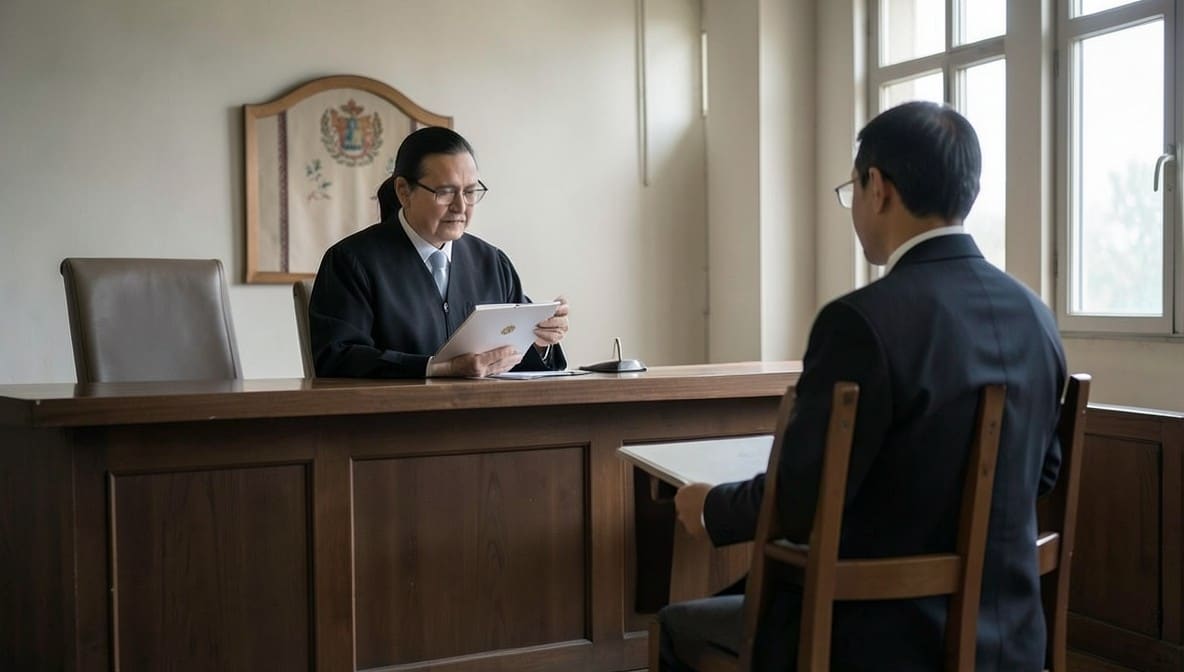
The Madhya Pradesh High Court has affirmed a foundational principle of criminal justice: when new documentary evidence is admitted during trial, the accused must be given a meaningful opportunity to cross-examine the witness on that document. This ruling reinforces the procedural safeguards under the Bhartiya Nyaya Suraksh Sanhita, 2023, and ensures that the right to a fair trial is not diluted by technical objections to interlocutory orders.
Background & Facts
The Dispute
The dispute arose from a commercial transaction involving a sale agreement between the petitioner, Ajay Dholpure, and the complainant, Rajesh Fuleriya. The total transaction value was Rs. 3,00,000, of which Rs. 2,50,000 was allegedly paid by the complainant. However, during the initial examination of the complainant, the original sale agreement was not produced. The petitioner, as the accused, sought to challenge the credibility of the complainant’s testimony in light of this missing document.
Procedural History
- 2022: Criminal complaint filed under relevant provisions of the BNSS.
- During trial: Complainant failed to produce the original sale agreement during examination-in-chief.
- Application under Section 94 BNSS: Petitioner filed an application seeking production of the original document, which was granted by the trial court.
- Application under Section 348 BNSS: Petitioner sought permission to cross-examine the complainant on the newly produced document.
- 24 February 2025: Trial Magistrate rejected the Section 348 application, holding it unnecessary.
- 2025: Petitioner filed this petition under Section 528 BNSS challenging the rejection.
Relief Sought
The petitioner sought quashing of the trial court’s order rejecting the cross-examination application and requested that the right to cross-examine the complainant on the newly produced document be restored.
The Legal Issue
The central question was whether Section 348 of the Bhartiya Nyaya Suraksh Sanhita, 2023 entitles an accused to cross-examine a witness on a document that was not produced during examination-in-chief but is later admitted into evidence under Section 94 BNSS.
Arguments Presented
For the Petitioner
The petitioner’s counsel argued that the original sale agreement was a material document affecting the credibility of the complainant’s version of events. Since the document was admitted under Section 94 BNSS, which permits production of documents not initially available, the accused must be allowed to test its authenticity and relevance through cross-examination. Reliance was placed on the principle of natural justice and the right to a fair trial under Article 21 of the Constitution. The counsel emphasized that denying cross-examination on newly admitted evidence renders the trial fundamentally unfair.
For the Respondent
The respondent’s counsel contended that the order rejecting the cross-examination application was interlocutory and therefore not appealable under Section 528 BNSS. They argued that the petitioner’s remedy lay in filing a revision under Section 529 BNSS, and that the petition was an abuse of process. Further, they submitted that the trial court had discretion to deny cross-examination if it deemed the document immaterial or cumulative.
The Court's Analysis
The Court rejected the argument that the order was merely interlocutory and beyond the scope of Section 528 BNSS. It held that while interlocutory orders are generally not subject to quashing, the denial of cross-examination on a document that materially affects the case constitutes a violation of procedural fairness and amounts to an illegal exercise of judicial power.
"The right to cross-examine is not a mere formality; it is the very soul of adversarial justice. When a document that alters the factual matrix is brought on record, the accused must be given the opportunity to challenge it. To deny that opportunity is to deny justice itself."
The Court emphasized that Section 348 BNSS explicitly provides for cross-examination on documents produced during trial, regardless of whether they were available at the outset. The admission of the document under Section 94 BNSS triggered the automatic right to cross-examine. The trial court’s refusal to permit such cross-examination was arbitrary and contrary to the spirit of the BNSS, which seeks to replace outdated procedural rigidity with substantive fairness.
The Court further noted that the complainant had also availed the benefit of Section 94 BNSS to produce documents, making it inequitable to deny the accused the same procedural right. The principle of equality before law and the right to be heard (audi alteram partem) demanded parity in procedural rights.
The Verdict
The petitioner won. The Court held that Section 348 BNSS mandates the right to cross-examine a witness on any document admitted into evidence during trial, including those produced under Section 94 BNSS. The impugned order was set aside, and the application for cross-examination was allowed.
What This Means For Similar Cases
Cross-Examination Is Mandatory on Newly Produced Evidence
- Practitioners must immediately file applications under Section 348 BNSS whenever new documents are admitted during trial.
- Trial courts cannot deny cross-examination on grounds of delay or alleged irrelevance without recording reasoned findings.
- Denial of cross-examination on material documents may now be challenged directly under Section 528 BNSS, even if the order is technically interlocutory.
Procedural Fairness Trumps Technical Objections
- Arguments based solely on the interlocutory nature of an order will not bar judicial review if fundamental rights to fair trial are infringed.
- Courts must treat Section 528 BNSS as a safeguard against procedural injustice, not a procedural trap.
- The burden shifts to the prosecution to justify why cross-examination should be denied - mere discretion is insufficient.
Document Production and Cross-Examination Are Inseparable
- The admission of documents under Section 94 BNSS is not a one-sided benefit; it triggers reciprocal rights for the accused.
- Lawyers must treat every document produced during trial as a potential pivot point for cross-examination and prepare accordingly.
- Failure to request cross-examination at the earliest opportunity may be viewed as waiver, but courts must actively ensure this right is not lost due to procedural ignorance.