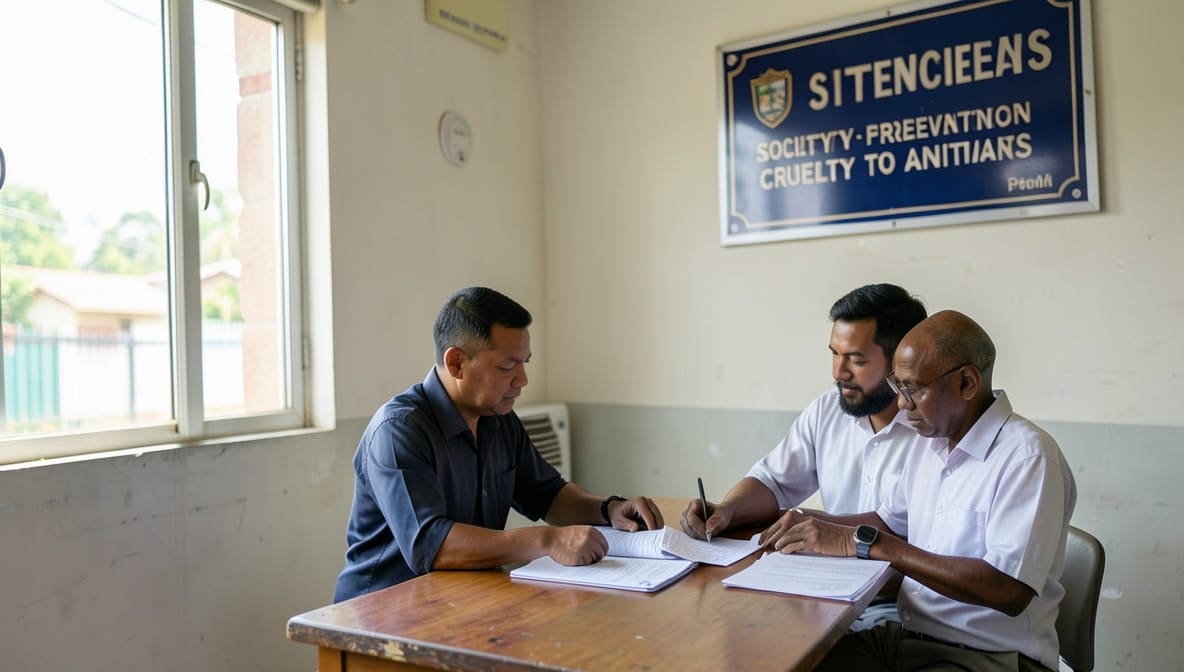
The Punjab & Haryana High Court has dismissed a Public Interest Litigation seeking state intervention against private dog fights, holding that existing statutory mechanisms under the Prevention of Cruelty to Animals Act, 1960, and the Code of Criminal Procedure provide adequate remedies. The judgment affirms that citizens may directly initiate criminal proceedings without requiring court-mandated investigative bodies.
Background & Facts
The Dispute
The petitioner filed a Public Interest Litigation alleging that private dog fights involving ferocious breeds were being conducted with impunity across Punjab and Haryana, and that state functionaries had failed to take preventive or curative action despite the activity being a cognizable offence under the Prevention of Cruelty to Animals Act, 1960.
Key Facts
- The petitioner alleged organized dog fighting events involving breeds such as Pit Bulls and Rottweilers were occurring in rural and urban areas
- No specific incidents, locations, or dates of dog fights were cited in the petition
- No prior complaints or notices to police or SPCA authorities were mentioned
- The petitioner did not allege any failure of the Societies for Prevention of Cruelty to Animals (SPCAs) to function, but rather sought their enhanced oversight
Procedural History
- 19.03.2026: Petition filed as CWP-PIL-111-2024 (O&M) before the Punjab & Haryana High Court
- 19.03.2026: Oral hearing conducted; affidavits from Punjab and Haryana governments submitted
- 19.03.2026: Court delivered oral judgment disposing of the petition
The Parties' Positions
For the Petitioner
- Argued that state inaction on dog fighting violated Section 11(1)(m)(ii) and Section 11(1)(n) of the Prevention of Cruelty to Animals Act, 1960
- Contended that the absence of a dedicated investigative body rendered enforcement ineffective
- Sought judicial intervention to compel systemic action
For the Respondents (State of Punjab, State of Haryana, Union of India)
- Affirmed that SPCAs had been constituted in every district under the chairmanship of Deputy Commissioners
- Cited Rule 12 of the Prevention of Cruelty to Animals Rules, 1964, which empowers SPCAs to investigate complaints and initiate action
- Stated that Section 31 of the Act renders offences under Section 11(1) cognizable, enabling any person to file an FIR
- Emphasized that no systemic failure of SPCAs was demonstrated
Relief Sought
The petitioner sought:
- A writ of mandamus directing the state to take legal action against private dog fights
- Appointment of an independent investigative body to monitor illegal animal fights
- Direction to the State of Punjab for effective implementation of Section 11(1)(m)(ii) and Section 11(1)(n) of the Act of 1960
- Any other direction in the interest of justice
The Legal Issue
The central question was whether the failure of state authorities to proactively investigate private dog fights constitutes a justiciable public wrong warranting a writ of mandamus, or whether existing statutory remedies under the Prevention of Cruelty to Animals Act, 1960, and the Code of Criminal Procedure, 1973, render such intervention unnecessary.
Arguments Presented
For the Petitioner
The petitioner relied on the principle that public interest litigation is a tool to enforce statutory duties where systemic failure is evident. It argued that the absence of documented enforcement actions indicated institutional apathy, and that the mere existence of SPCAs did not equate to effective implementation. The petitioner cited Bandhua Mukti Morcha v. Union of India to support the court’s duty to intervene in matters of widespread animal cruelty.
For the Respondent
The respondents countered that Section 31 of the Act renders offences under Section 11(1) cognizable, meaning any citizen may file an FIR without requiring prior court sanction. They emphasized that Rule 12 of the 1964 Rules mandates SPCAs to receive complaints and initiate action, and that no evidence was presented of SPCA inaction. They further noted that the petitioner had not attempted any remedy under the CrPC, making the PIL premature.
The Court's Analysis
The Court examined the statutory framework under the Prevention of Cruelty to Animals Act, 1960, and found that the petitioner’s grievances were addressable through existing mechanisms. The Court observed:
"If a cognizable offence occurs, even a stranger can lodge an FIR, provided the information so furnished to the Police or the concerned competent authority alleges commission of a cognizable offence."
The Court noted that the petitioner had not attempted to file an FIR or approach the local SPCA, and that the mere existence of a legal remedy precludes the need for judicial intervention through PIL. The Court further held that the constitution of district-level SPCAs under the chairmanship of Deputy Commissioners fulfilled the state’s obligation under the Act and its Rules.
The Court distinguished this case from PILs involving complete institutional collapse, noting that here, the machinery was in place and functional. The Court emphasized that PILs are not meant to substitute personal litigation or to serve as a substitute for due diligence by citizens.
The Verdict
The petition was dismissed. The Court held that the second prayer for appointment of an independent investigative body was satisfied by the existing district-level SPCAs. The Court directed that the petitioner and any other citizen may file an FIR under Section 31 of the Prevention of Cruelty to Animals Act, 1960, whenever instances of illegal dog fighting are observed, and may invoke the provisions of the Bharatiya Nagarik Suraksha Sanhita, 2023, if authorities refuse to register a cognizable offence. All pending applications were disposed of.
What This Means For Similar Cases
Citizen Action Is Required Before PIL
- Practitioners must advise clients to exhaust statutory remedies (e.g., filing FIRs with police or complaints to SPCAs) before approaching courts with PILs on animal cruelty
- Courts will not entertain PILs where the complainant has not attempted to use existing enforcement mechanisms
- The burden shifts to the petitioner to demonstrate systemic failure, not mere inaction in a single instance
SPCAs Are Legally Sufficient Enforcement Bodies
- District-level SPCAs chaired by Deputy Commissioners are recognized as statutorily empowered entities under the Act and Rules
- No additional investigative bodies need to be created unless a pattern of SPCA non-functioning is proven
- Legal action against dog fighting can be initiated directly by any citizen under Section 31 without waiting for state action
PILs Cannot Be Used as Substitute for Criminal Complaints
- The Court reaffirmed that PILs are not a substitute for personal litigation or criminal complaints
- Courts will dismiss PILs seeking enforcement of cognizable offences if the complainant has not first utilized the CrPC or relevant statutory complaint mechanisms
- Future petitions must include evidence of prior attempts to trigger enforcement, such as copies of FIRs, SPCA complaints, or written representations to authorities