The Rajasthan High Court, in a consolidated order dated 19 August 2026, held that authorities cannot demolish residential premises for road widening without granting notice, hearing and compensation, thereby reinforcing procedural due process under Articles 14, 21 and 300-A of the Constitution.
Background & Facts
The Dispute
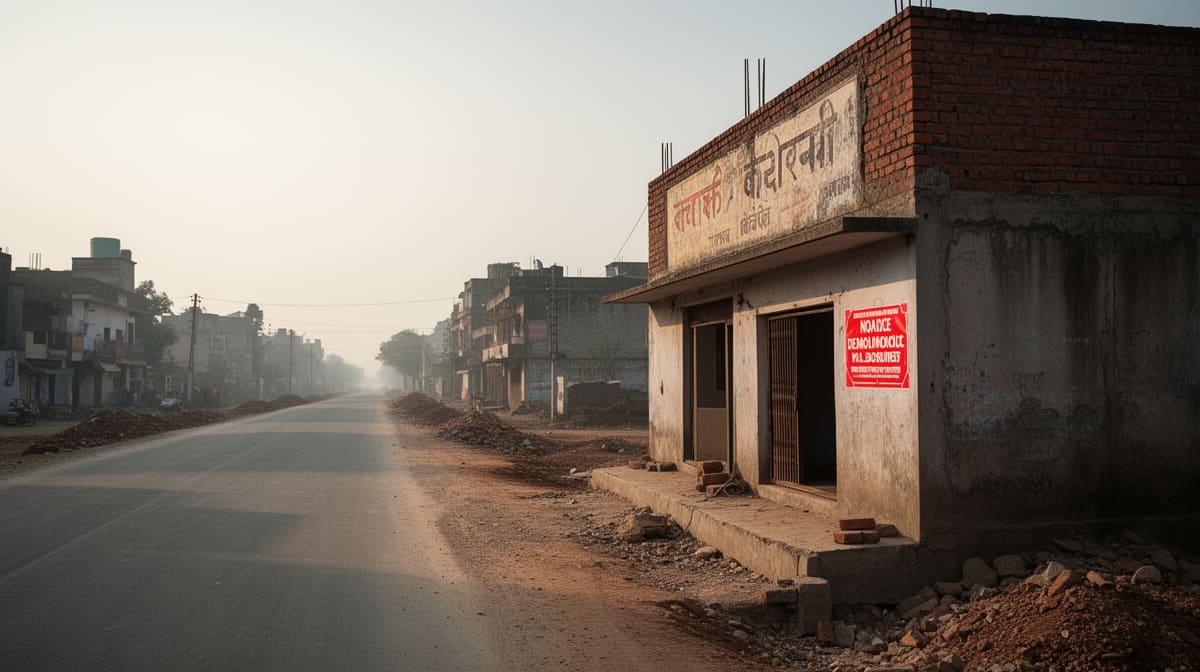
The petitioners, a group of individual landowners from Sri Ganganagar district, filed a series of civil writ petitions (S.B. Civil Writ Petition Nos. 9960/2016, 9961/2016, 10657/2016, 10666/2016, 10667/2016, 11121/2016, 14424/2016, 14579/2016, 15750/2021, 15836/2021, 16873/2021 and 15739/2021) seeking a writ of mandamus against the State of Rajasthan, the Urban Improvement Trust (UIT) of Sri Ganganagar, the Land Acquisition Officer and the Municipal Council. The core grievance was the issuance of a notice dated 22.08.2016 (Annex-6) by the UIT ordering demolition of their residential premises situated at Chak 1-A Chhoti, Jassa Singh Marg, Sri Ganganagar, for the purpose of widening an 80-foot public road as shown in the Master Plan 1981-2001.
Key Facts
- The land in question was originally recorded in revenue records in the names of erstwhile owners and later transferred through agreements to sell executed by those owners.
- Petitioners claim lawful possession based on those agreements and on continuous residential use.
- Respondents contend that the land belongs to the UIT under Section 90-B(1) of the Rajasthan Land Revenue Act, 1956 and that an agreement to sell does not confer title.
- The Master Plan prepared under Sections 5 and 6 of the Rajasthan Urban Improvement Act, 1959 designates the land as a proposed public road.
- Notices for removal of alleged encroachments were issued after the road construction began, but petitioners allege they were not given an opportunity to be heard.
- The petitioners rely on constitutional guarantees (Articles 14, 21, 300-A) and precedents such as Vidya Devi v. State of Himachal Pradesh (2020) and Maneka Gandhi v. Union of India (1978).
- Respondents rely on Vinod Infra Developers Ltd. v. Mahaveer Lunia & Ors. (2025) and the statutory authority of the UIT.
Procedural History
- 22.08.2016: Notice dated 22.08.2016 issued by UIT demanding demolition of the petitioners’ premises.
- 2016-2021: Multiple writ petitions filed (Nos. 9960/2016 through 16873/2021) raising the same grievance.
- 13.08.2026: Date of conclusion of arguments before the Division Bench of the Rajasthan High Court.
- 13.08.2026: Order reserved.
- 19.08.2026: Full judgment pronounced, disposing of all the writ petitions in a common order.
Relief Sought
The petitioners prayed for:
- Quashing of the 22.08.2016 notice and any demolition action.
- A declaration that they have rightful possession of the land and that no encroachment exists.
- An injunction restraining the respondents from proceeding with demolition without due process.
- Compensation if the land is required for public road construction.
- Costs of the writ petitions.
The Legal Issue
Whether the State of Rajasthan, the Urban Improvement Trust, the Land Acquisition Officer and the Municipal Council can lawfully demolish or evict petitioners from residential premises earmarked for road widening without first providing statutory notice, an opportunity of hearing and compensation, in compliance with Articles 14, 21 and 300-A of the Constitution and the procedural requirements of the Rajasthan Urban Improvement Act, 1959 and the Rajasthan Municipalities Act, 2009.
Arguments Presented
For the Petitioners
- Assert that the notice dated 22.08.2016 was issued without prior notice or hearing, violating the constitutional guarantee of procedural due process.
- Cite Maneka Gandhi v. Union of India to argue that “procedure established by law” must be fair, just and reasonable.
- Rely on Vidya Devi v. State of Himachal Pradesh for the principle that eviction without compensation is unlawful.
- Contend that the agreements to sell, coupled with revenue records, confer a valid title and that the respondents have no statutory authority to dispossess them.
- Emphasise that the Master Plan, while a policy document, cannot be used to override individual property rights without due process.
For the Respondents
- Argue that the land falls within the jurisdiction of the UIT under Section 90-B(1) of the Rajasthan Land Revenue Act, 1956, and therefore the UIT has the power to acquire it for public road construction.
- Maintain that an agreement to sell does not create a vested title against the State, citing the respondent’s counsel.
- Rely on Vinod Infra Developers Ltd. v. Mahaveer Lunia & Ors. to support the view that the authority may proceed with demolition when the land is required for a public purpose.
- Assert that the Master Plan’s designation of the land as a public road justifies the demolition, irrespective of individual claims.
The Court's Analysis
The Court began by reiterating the constitutional mandate that any deprivation of property must be effected in accordance with procedure established by law and that such procedure must be “fair, just and reasonable” (Maneka Gandhi). It observed that the Rajasthan Municipalities Act, 2009, expressly requires notice and an opportunity of hearing before any adverse action can be taken against an occupier of public land. The Court quoted the settled proposition that “due process of law means that proper notice and due opportunity of being heard must be provided to the affected parties, before any adverse action is taken against them.”
"Due process of law means that proper notice and due opportunity of being heard must be provided to the affected parties, before any adverse action is taken against them."
The judgment examined the statutory framework:
- Rajasthan Urban Improvement Act, 1959 empowers UITs to prepare and implement Master Plans, but the Act does not dispense with the procedural safeguards embedded in the Constitution and the Municipalities Act.
- Section 90-B(1) of the Rajasthan Land Revenue Act, 1956 confers acquisition power on the UIT, yet the Court held that acquisition power is subject to the procedural requirements of notice, hearing and compensation.
- The Master Plan, while indicating the land as a proposed 80-foot road, is a policy document and not a static instrument that can be invoked to bypass due process. The Court relied on Gulab Kothari v. State of Rajasthan to stress that the Master Plan must be implemented “rigorously” but not at the expense of constitutional safeguards.
The Court distinguished the respondents’ reliance on Vinod Infra Developers by noting that the latter dealt with a different factual matrix where the acquisition process had complied with statutory notice and compensation provisions. Here, the petitioners had not been afforded any hearing, nor had any compensation been offered.
The Court further observed that the agreements to sell, though not conferring title against the State, established a prima facie right of possession for the petitioners, which could not be summarily extinguished. Consequently, the Court could not adjudicate the individual title disputes on the writ jurisdiction but could enforce procedural compliance.
In order to balance the public interest of completing the road with the petitioners’ right to due process, the Court fashioned a committee mechanism. It directed the respondents to constitute a committee of senior officials within fifteen days, after which petitioners must file their representations within another fifteen days. The committee is mandated to provide a hearing, consider the title documents, and pass reasoned orders. Where a petitioner’s title is upheld and the land is still required for the road, the committee must award compensation at prevailing DLC rates or allot alternative land under government schemes.
The Court also imposed a tree-planting directive, requiring the respondents to replace each removed tree with ten shade-plants, underscoring the larger public-interest considerations.
The Verdict
The Rajasthan High Court dismissed all the writ petitions but issued comprehensive directions:
- Respondents shall constitute a committee of higher officials within 15 days from the date of the order.
- Petitioners shall submit their representations and objections to the committee within 15 days thereafter.
- The committee shall provide a hearing to each petitioner, examine title documents, and pass reasoned orders.
- If a petitioner’s title is valid and the land is needed for the road, the committee shall award compensation as per prevailing DLC rates or allot alternative land under applicable schemes.
- Where no objections are filed, respondents may proceed with demolition in accordance with law.
- For every tree or plant removed during road works, respondents must plant ten shade-plants in nearby public areas and submit a compliance report.
- Any aggrieved party may approach the appropriate forum for further redress.
What This Means For Similar Cases
Procedural Safeguards Cannot Be Bypassed
- Authorities must issue a statutory notice and afford a hearing before any demolition, even when the land is earmarked in a Master Plan.
- Failure to comply renders any demolition order illegal and subject to quashing.
Creation of a Fact-Finding Committee
- Courts may order the formation of a committee to sift through title documents and hear parties, thereby avoiding full factual adjudication in writ jurisdiction.
- The committee’s orders must be reasoned and binding, ensuring uniformity across multiple petitioners.
Compensation and Alternative Relief
- When public purpose necessitates acquisition, compensation must be calculated on prevailing DLC rates or alternative land must be allotted, aligning with State of Haryana v. Mukesh Kumar.
- Practitioners should advise clients to prepare title documents and be ready to present them before such committees.
Practical Takeaways
- File a detailed notice under the Rajasthan Municipalities Act, 2009, before any eviction.
- Preserve all agreements to sell, revenue records and possession evidence.
- Anticipate the need for a committee hearing and prepare concise representations.
- Calculate compensation based on DLC rates to expedite settlement.
- Advise clients on tree-planting obligations if demolition proceeds.